

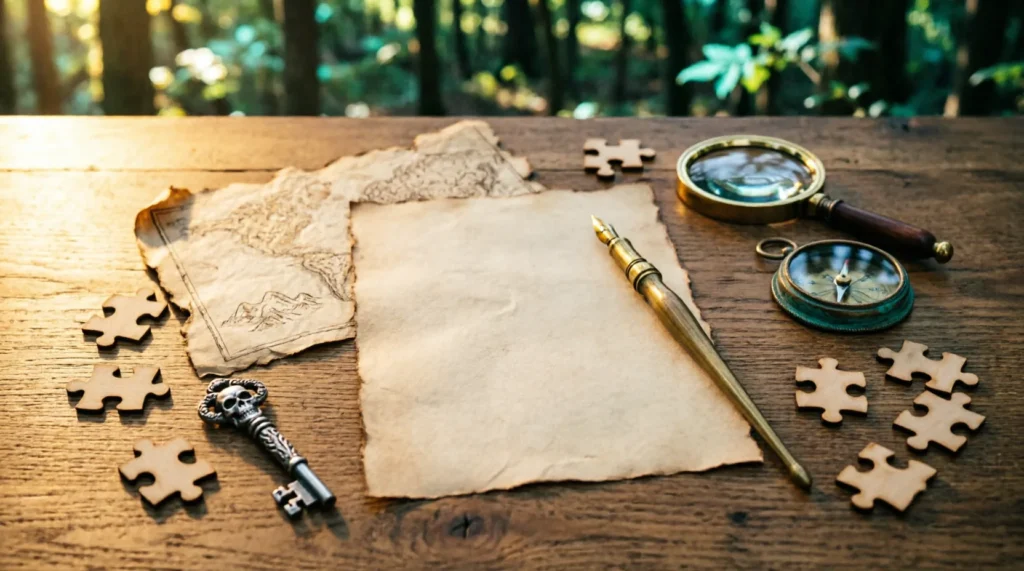
Planning a treasure hunt? The riddles make or break the experience. I’ve designed treasure hunts for everything from backyard birthday parties to corporate team-building events, and I’ve learned that a great riddle should be challenging enough to spark “aha!” moments but solvable enough to keep momentum going. Below, you’ll find my tested collection of treasure hunt riddles with answers, plus the framework I use to write custom clues that fit any location or theme.
Top 5 Treasure Hunt Riddles
These are the riddles I reach for most often—they’re crowd-pleasers that work across age groups and settings.
I have cities, but no houses. I have mountains, but no trees. I have water, but no fish. What am I? Answer: A map
The more you take, the more you leave behind. What am I? Answer: Footsteps
I speak without a mouth and hear without ears. I have no body, but I come alive with wind. What am I? Answer: An echo
You see me once in June, twice in November, but not at all in May. What am I? Answer: The letter “e”
I have keys but no locks. I have a space but no room. You can enter, but you can’t go inside. What am I? Answer: A keyboard
Easy Treasure Hunt Riddles
Perfect for younger hunters or when you want to keep the energy high and the frustration low. When I run these with kids ages 6-9, they solve them in under 30 seconds, which keeps the hunt moving.
What has hands but cannot clap? Answer: A clock
What gets wet while drying? Answer: A towel
What can you catch but not throw? Answer: A cold
What goes up but never comes down? Answer: Your age
What has a head and a tail but no body? Answer: A coin
What can travel around the world while staying in a corner? Answer: A stamp
Hard Treasure Hunt Riddles
These require lateral thinking and are my go-to for adult groups or competitive family hunts. According to research on riddles, the best puzzles force solvers to abandon literal interpretation—these five do exactly that. I mark these as “genuinely hard” because they’ve stumped even clever adults for 10+ minutes.
The person who makes it has no need of it; the person who buys it has no use for it. The person who uses it can neither see nor feel it. What is it? Answer: A coffin
Tested note: The wrong answer everyone blurts out is “a gift.” It takes most people 5+ minutes to pivot to the correct answer.
I am not alive, but I grow; I don’t have lungs, but I need air; I don’t have a mouth, but water kills me. What am I? Answer: Fire
What can bring back the dead; make us cry, make us laugh, make us young; is born in an instant yet lasts a lifetime? Answer: A memory
The more you remove, the bigger it gets. What is it? Answer: A hole
I am taken from a mine and shut up in a wooden case, from which I am never released, and yet I am used by almost every person. What am I? Answer: Pencil lead (graphite)
Funny Treasure Hunt Riddles
These get laughs while still making people think. I use these at party hunts where the goal is entertainment over intense competition.
Why don’t scientists trust atoms? Answer: Because they make up everything
What do you call a fake noodle? Answer: An impasta
Why did the scarecrow win an award? Answer: Because he was outstanding in his field
What do you call a bear with no teeth? Answer: A gummy bear
Why can’t you give Elsa a balloon? Answer: Because she’ll let it go
What do you call cheese that isn’t yours? Answer: Nacho cheese
Location-Based Treasure Hunt Riddles
These clues point to specific places in a house, yard, or venue. I always customize these based on the actual hunt location, but these templates work universally.
I have a face but no eyes, hands but no arms. I tell you something important every day. Where am I? Answer: On the wall (a clock)
I’m full of holes but still hold water. You use me when things get dirty. Where am I? Answer: The kitchen sink (or a sponge in the sink)
I have many stories but no words. You can open me but I’m not a door. Where am I? Answer: On a bookshelf
I’m cold and keep your food fresh. Open me when you’re hungry. Where am I? Answer: In the kitchen (the refrigerator)
I have a neck but no head. I keep your clothes safe. Where am I? Answer: In the closet (a hanger)
I have teeth but can’t bite. You use me to get ready in the morning. Where am I? Answer: In the bathroom (a comb)
Object-Based Treasure Hunt Riddles
These riddles describe the treasure or clue container itself. They work brilliantly when the “treasure” is hidden inside or under something specific.
I have a spine but no bones. I have pages but I’m not a calendar. What am I? Answer: A book
I have a bed but never sleep. I have a mouth but never speak. What am I? Answer: A river
I have a ring but no finger. I have a face but no eyes. What am I? Answer: A telephone
I have a trunk but I’m not an elephant. I have drawers but I’m not a desk. What am I? Answer: A tree (or a dresser, depending on your hiding spot)
I have a mouth but cannot eat. I move but have no legs. What am I? Answer: A river
I have a head but no brain. I have a tail but no body. What am I? Answer: A coin
How to Use These Riddles
The best treasure hunts match riddle difficulty to your audience and setting. For kids’ birthday parties, I stick to the Easy and Funny sections and hide clues every 10-15 feet so there’s constant progress. For adult game nights or team-building events, I layer in the Hard riddles and space clues farther apart to build anticipation.
Here’s my proven framework:
- Map your route first: Walk the space and identify 5-10 hiding spots before writing riddles
- Match riddle to location: A riddle about “cold” should lead to the fridge, not the fireplace
- Test with a pilot: Run the hunt with one person before the event to catch confusing clues
- Have backup hints ready: Write simpler versions of each riddle in case hunters get stuck
According to historical accounts of treasure hunts, the most memorable ones balance challenge with achievability—your hunters should feel clever, not defeated.
Frequently Asked Questions
What makes a good treasure hunt riddle for kids? The best riddles for kids ages 5-10 use concrete objects they recognize (clocks, towels, books) and avoid abstract wordplay. Keep answers to one or two words max, and make sure every clue leads to a visible location. When I test riddles with my 8-year-old niece, the ones she solves instantly all rhyme or reference daily routines.
How many riddles should a treasure hunt have? For children under 10, aim for 5-7 riddles total. For older kids and adults, 8-12 riddles keeps engagement high without dragging. I’ve found that hunts longer than 15 clues lose momentum unless there’s a compelling narrative or prize structure. The sweet spot is 45-60 minutes total runtime.
Can I use these riddles for a virtual treasure hunt? Absolutely. For Zoom or remote hunts, replace physical locations with digital ones: “I have pages but no paper” could lead to a specific website or shared document. I’ve successfully adapted location-based riddles by having hunters photograph items in their own homes, then email the photo to unlock the next clue.
What if participants get stuck on a riddle? Build in a hint system from the start. I give each team three “lifeline” cards they can trade for progressively easier versions of the stuck riddle. Alternatively, set a 5-minute timer per clue—if they haven’t solved it, reveal the answer and move on to keep energy high.

Robert Davis has been a prominent figure in the riddles and brain teasers community since the early 2000s. Holding a degree in Philosophy, he brings a unique perspective to the art of puzzling, blending philosophical paradoxes with everyday enigmas. Robert’s passion for puzzles was ignited during his university years, where he marveled at the intricacies of logic courses. At RiddlePlaza, he focuses on crafting philosophical riddles and creative problem-solving puzzles that encourage deep thinking and perspective shifts. Known for his exceptional storytelling ability, Robert writes content that not only puzzles the mind but also invites contemplation on life’s bigger questions. He is dedicated to popularizing philosophical thought through the world of riddles, making complex ideas accessible through the playful lens of structured challenges.