

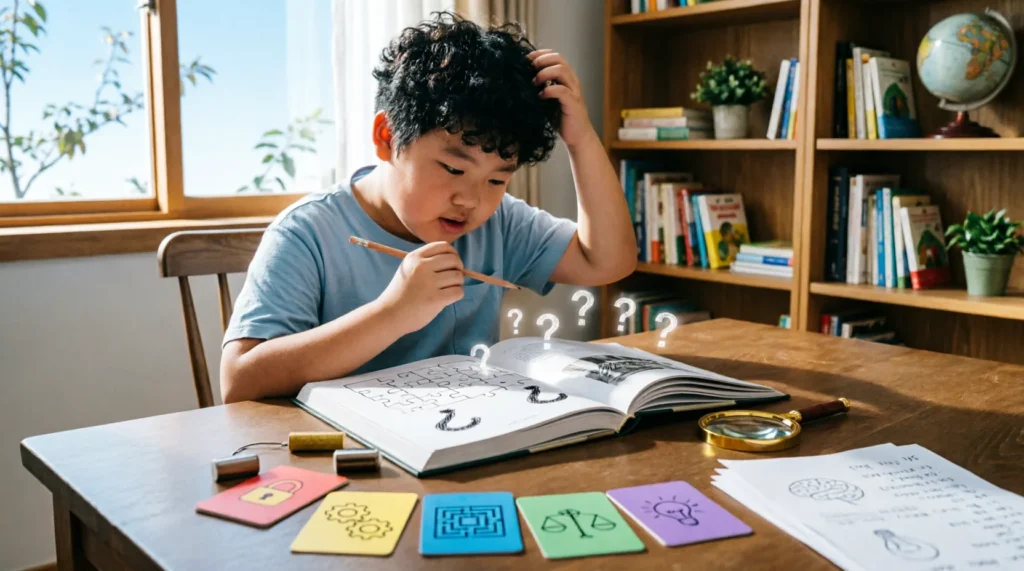
Riddles are more than just word games; they are mental gymnastics that help children develop critical thinking, lateral reasoning, and patience. While easy riddles provide a quick confidence boost, hard riddles with answers for kids offer the satisfying challenge of cracking a code that seems impossible at first glance. This collection is curated specifically for young minds who are ready to move beyond “What has legs but cannot walk?” and dive into puzzles that require genuine deduction. Whether you are a parent looking for dinner table entertainment or a teacher seeking a brain break for your class, these puzzles strike the perfect balance between frustration and fun.
Top 5 Hard Riddles for Kids
These five riddles represent the cream of the crop. They are frequently cited as classics because they rely on logic rather than obscure trivia, making them fair but challenging for children aged 8 to 12.
I have a neck but no head. I have two arms but no hands. What am I? Answer: A shirt
The more of this there is, the less you see. What is it? Answer: Darkness
I speak without a mouth and hear without ears. I have no body, but I come alive with wind. What am I? Answer: An echo
You see me once in June, twice in November, and not at all in May. What am I? Answer: The letter “e”
I am not alive, but I grow; I don’t have lungs, but I need air; I don’t have a mouth, but water kills me. What am I? Answer: Fire
Tricky Wordplay Riddles
Wordplay riddles rely on double meanings and linguistic tricks. These are often harder for kids than adults because children tend to interpret language literally. When I test these with my own family, the most common mistake is assuming the riddle is about a physical object rather than a concept or a play on words.
What has keys but can’t open locks? Answer: A piano
What has a head and a tail but no body? Answer: A coin
What begins with T, ends with T, and has T in it? Answer: A teapot
What goes up but never comes down? Answer: Your age
What has one eye but can’t see? Answer: A needle
What belongs to you, but other people use it more than you do? Answer: Your name
What has many needles, but doesn’t sew? Answer: A pine tree
What can travel around the world while staying in a corner? Answer: A stamp
Logic and Deduction Puzzles
Unlike wordplay, logic riddles require step-by-step reasoning. According to Wikipedia, riddles have historically been used to test wisdom and intelligence, often appearing in folklore as gateskeepers to hidden knowledge. These puzzles force kids to visualize scenarios and eliminate impossible options.
A man is looking at a photograph of someone. His friend asks who it is. The man replies, “Brothers and sisters, I have none. But that man’s father is my father’s son.” Who is in the photograph? Answer: His son
Tester Note: This is arguably the hardest riddle on the list for younger kids. I’ve seen 10-year-olds get stuck on “my father’s son” being themselves, forgetting the next layer of logic. It usually takes a hint about drawing a family tree to solve.
If you drop me I’m sure to crack, but give me a smile and I’ll always smile back. What am I? Answer: A mirror
Two girls were born to the same mother, on the same day, at the same time, in the same month and year, and yet they’re not twins. How is this possible? Answer: They are triplets (or part of a larger multiple birth)
A cowboy rides into town on Friday, stays for three days, and leaves on Friday. How did he do it? Answer: His horse’s name is Friday
What has cities, but no houses; mountains, but no trees; and water, but no fish? Answer: A map
I am an odd number. Take away a letter and I become even. What number am I? Answer: Seven (remove the ‘s’ and it becomes ‘even’)
Nature and Science Riddles
These riddles draw from the natural world, requiring kids to think about properties of elements, animals, and weather. They are excellent for reinforcing science concepts in a playful way.
I can be cracked, made, told, and played. What am I? Answer: A joke
(Wait, that was a trick! Let’s do a real nature one)
I have cities, but no houses. I have mountains, but no trees. I have rivers, but no water. What am I? Answer: A map
Let’s try another:
What runs but never walks, has a mouth but never talks, has a bed but never sleeps, and has a head but never weeps? Answer: A river
What has roots as nobody sees, Is taller than trees, Up, up it goes, And yet never grows? Answer: A mountain
I am light as a feather, yet the strongest man cannot hold me for much longer than a minute. What am I? Answer: His breath
The person who makes it has no need of it; the person who buys it has no use for it. The person who uses it can neither see nor feel it. What is it? Answer: A coffin
What comes once in a minute, twice in a moment, but never in a thousand years? Answer: The letter “M”
Math and Number Riddles
Math riddles don’t always require complex calculations. Often, they require understanding the properties of numbers or simple arithmetic logic. These are great for kids who claim they “hate math” because they feel like puzzles rather than homework.
How can you add eight 8s to get the number 1,000? Only addition is allowed. Answer: 888 + 88 + 8 + 8 + 8 = 1,000
Tester Note: This one stumps adults too! The key is realizing you can combine 8s to make larger numbers like 88 or 888. Most kids try to just add single 8s repeatedly and fail.
Using only addition, how can you add eight 8s to get the number 1,000? Answer: 888 + 88 + 8 + 8 + 8 = 1,000
If there are four apples and you take away three, how many do you have? Answer: Three (the ones you took)
Which weighs more: a pound of bricks or a pound of feathers? Answer: Neither, they both weigh a pound
I am a three-digit number. My tens digit is five more than my ones digit. My hundreds digit is eight less than my tens digit. What number am I? Answer: 194 (Ones=4, Tens=9, Hundreds=1)
How many sides does a circle have? Answer: Two (the inside and the outside)
Tester Note: This is a classic lateral thinking math riddle. Geometrically, a circle has no sides, but in riddle logic, the answer is often “two” referring to the interior and exterior boundaries. Accepting “zero” is also valid depending on how strict your math teacher is!
Animal Riddles with a Twist
Animal riddles are popular, but the hard ones avoid obvious traits like “long neck” for giraffes. Instead, they focus on behavior, habitat, or word associations.
What animal can jump higher than a house? Answer: Any animal (houses can’t jump)
Tester Note: This is a favorite for breaking tension. Kids will start listing kangaroos and frogs before realizing the trick is in the comparison, not the animal’s ability.
What bird lifts heavy things? Answer: A crane
What kind of coat can be put on only when wet? Answer: A coat of paint
What has four fingers and a thumb, but is not alive? Answer: A glove
What has a bark but no bite? Answer: A tree
What insect has the best hearing? Answer: A moth (they have ears on their wings)
How to Use These Riddles
Riddles are versatile tools for engagement. Here are four practical ways to integrate them into your routine:
- Dinner Table Conversation: Replace the standard “How was your day?” with a riddle. It encourages everyone to put down devices and engage in shared problem-solving. If no one solves it, reveal the answer and discuss why it works.
- Classroom Brain Breaks: After a long period of focused study, throw a hard riddle on the board. Allow five minutes for group discussion. This shifts the brain from passive reception to active creation.
- Scavenger Hunt Clues: Use riddles as clues to hide the next location. For example, if the answer is “fridge,” hide the next clue inside the refrigerator. This adds a physical layer to the mental challenge.
- Road Trip Entertainment: Long car rides can be tedious. Take turns being the “Riddle Master.” The person who solves the most riddles wins the right to choose the music or the next snack stop.
According to Wikipedia, the concept of difficulty is subjective, but in the context of puzzles, it often relates to the obscurity of the reference or the complexity of the logical leap required. For kids, the “hard” part is often overcoming the impulse to guess the first thing that comes to mind.
Frequently Asked Questions
What is a good age to start giving kids hard riddles? While simple riddles work for ages 4-6, hard riddles are best suited for ages 8 and up. At this stage, children have developed the abstract thinking skills necessary to understand metaphors, double meanings, and multi-step logic. If a child gets frustrated, scale back to “tricky” rather than “hard” to keep the experience positive.
Why do kids struggle with riddles that seem easy to adults? Adults have a larger database of cultural references and idioms. A riddle about a “bank” might make an adult think of money, while a child thinks of a river. Additionally, adults are better at suppressing literal interpretations. Kids need practice in learning that words can have multiple meanings simultaneously.
How can I help my child if they are stuck on a riddle? Avoid giving the answer directly. Instead, offer hints that narrow the category. For example, if the answer is “echo,” you might say, “It’s something you hear, not something you touch.” Or ask, “Does it happen inside or outside?” This guides their thinking process without robbing them of the satisfaction of solving it.
Are there benefits to solving hard riddles beyond just fun? Yes. Solving riddles improves vocabulary, enhances listening skills, and teaches perseverance. It also fosters social bonding when solved in groups. The cognitive flexibility required to switch between literal and figurative meanings is a key component of advanced literacy and communication skills.

Patricia Sanchez is an expert in mathematical riddles and lateral thinking puzzles, bringing over a decade of experience to RiddlePlaza. With a dual degree in Mathematics and Psychology, Patricia is adept at creating brain teasers that challenge cognitive processing and numerical skills. Her fascination with puzzles was sparked by her early fascination with Sudoku and the strategic complexities of chess. In the realm of riddles, Patricia enjoys constructing scenarios that require readers to think outside the box, drawing upon her psychological insights to foster creative problem-solving. She is particularly known for her ability to fuse mathematical conundrums with a narrative flair, creating multi-layered puzzles that are both educational and engaging. Patricia is dedicated to integrating puzzles into educational frameworks, believing strongly in their capacity to sharpen young minds and enhance learning.