

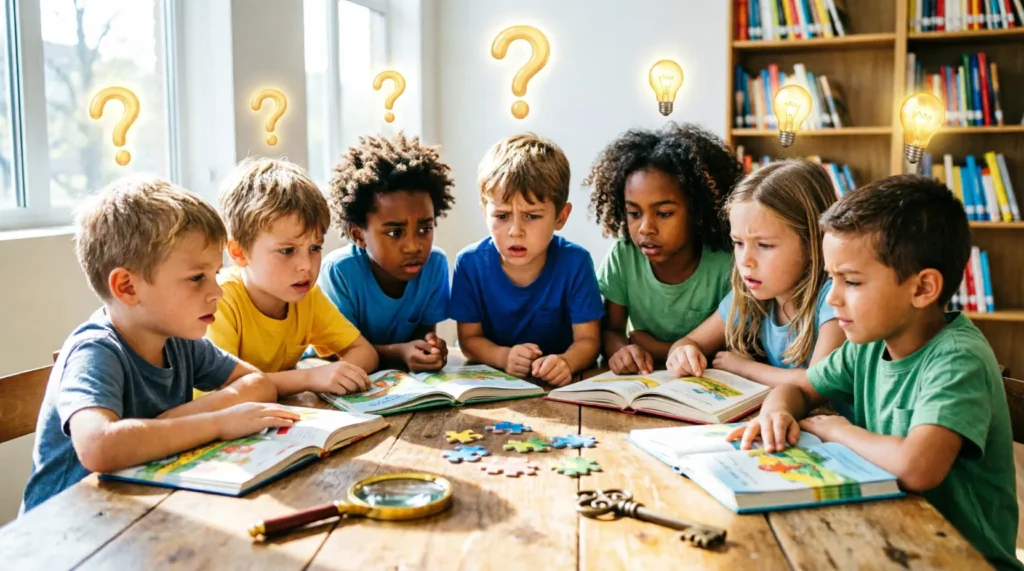
Riddles are a timeless way to spark curiosity and laughter, and having them in a printable format makes sharing even easier. This collection brings together the best English riddles with answers for kids PDF seekers, organized so you can jump right into the fun.
Top 5 English Riddles with Answers for Kids
1. What has hands but cannot clap? Answer: A clock
2. What gets wet while drying? Answer: A towel
3. What can you catch but not throw? Answer: A cold
4. What has a head and a tail but no body? Answer: A coin
5. What room can no one enter? Answer: A mushroom
Easy English Riddles for Younger Kids
These riddles work perfectly for children ages 5-8 who are just discovering the joy of wordplay.
1. What has eyes but cannot see? Answer: A potato
2. What goes up but never comes down? Answer: Your age
3. What has a neck but no head? Answer: A bottle
4. What can fill a room but takes up no space? Answer: Light
5. What has many keys but can’t open a single lock? Answer: A piano
6. What can travel around the world while staying in a corner? Answer: A stamp
7. What has words but never speaks? Answer: A book
When I test these with first graders, the potato riddle almost always gets “a needle” as the first guess, which leads to great laughs.
Funny English Riddles That Make Kids Laugh
Humor is the secret ingredient that keeps kids engaged, and these silly riddles deliver giggles every time.
1. Why don’t scientists trust atoms? Answer: Because they make up everything
2. What do you call a bear with no teeth? Answer: A gummy bear
3. Why did the math book look so sad? Answer: Because it had too many problems
4. What do you call cheese that isn’t yours? Answer: Nacho cheese
5. Why can’t you give Elsa a balloon? Answer: Because she will let it go
6. What do you call a sleeping dinosaur? Answer: A dino-snore
7. Why did the cookie go to the doctor? Answer: Because it felt crumbly
8. What do you call a fake noodle? Answer: An impasta
The “nacho cheese” riddle is deceptively simple, but when I run this one at family game nights, even the adults groan before laughing. That’s the mark of a good pun riddle.
Tricky English Riddles to Challenge Sharp Minds
These riddles look easy but require careful thinking. They’re perfect for kids who think they’ve mastered the simpler ones.
1. What can you hold in your left hand but not in your right? Answer: Your right hand
2. What has a bottom at the top? Answer: Your legs
3. What can you break without touching it? Answer: A promise
4. What belongs to you but others use it more? Answer: Your name
5. What can you keep after giving it to someone? Answer: Your word
6. What has holes but still holds water? Answer: A sponge
7. What goes through cities and fields but never moves? Answer: A road
8. What can you see in the middle of March and April but not at the beginning or end of either month? Answer: The letter “R”
the tradition of using tricky language to create puzzles dates back thousands of years, and these modern examples follow that same pattern of playing with expectations.
Animal Riddles for Kids Who Love Creatures
Animal-themed riddles are perennial favorites because they connect to things kids already know and love.
1. What has a trunk but no luggage? Answer: An elephant
2. What has a tail and a head but no body? Answer: A coin (or a tadpole, depending on how you think about it!)
3. What kind of dog never bites? Answer: A hot dog
4. What has wings but isn’t a bird? Answer: An airplane (or a butterfly, or many other things!)
5. What animal can jump as high as a house? Answer: Any animal, because houses can’t jump
6. What has four legs in the morning, two legs in the afternoon, and three legs in the evening? Answer: A human (crawling as a baby, walking as an adult, using a cane when old)
7. What do you call a fish wearing a crown? Answer: A king fish
8. What has a shell but isn’t a turtle? Answer: A nut (or a snail, or many other things)
The “animal that jumps as high as a house” riddle is a classic trick question. When I use this with third graders, they always start naming kangaroos or frogs before someone realizes the trick. That “aha!” moment is priceless. For more, see English.
Math and Number Riddles for Logical Thinkers
These riddles combine wordplay with basic math concepts, perfect for kids who love numbers.
1. What number do you get when you multiply all the numbers on a telephone keypad? Answer: Zero (because anything multiplied by zero is zero)
2. What has a face and two hands but no arms or legs? Answer: A clock
3. What is the only number that has the same number of letters as its value? Answer: Four
4. What can you add between 4 and 5 to make the result greater than 4 but less than 5? Answer: A decimal point (4.5)
5. What number comes next: 1, 11, 21, 1211, 111221? Answer: 312211 (each number describes the previous one: one 1, two 1s, one 2 one 1, etc.)
6. If two’s company and three’s a crowd, what are four and five? Answer: Nine
7. What has a head and a tail but no body, and is worth less than a dime? Answer: A penny
English, as described on Wikipedia, is full of these playful ambiguities where numbers and words intersect in surprising ways, making it perfect for riddle-making.
Short and Sweet Riddles for Quick Brain Breaks
Sometimes you need a riddle that takes ten seconds to ask and answer. These are perfect for that.
1. What is always coming but never arrives? Answer: Tomorrow
2. What has a ring but no finger? Answer: A phone (or a bell)
3. What can run but never walks? Answer: Water (or a river)
4. What has a bank but no money? Answer: A riverbank
5. What has a bed but never sleeps? Answer: A river
6. What has a mouth but cannot eat? Answer: A river
7. What has a tongue but cannot talk? Answer: A shoe
The river riddles are a great example of how one answer can work for multiple questions, which I love pointing out to kids to show them how language can be stretched and played with.
How to Use These Riddles
At birthday parties: Print out a selection and turn them into a scavenger hunt where each solved riddle reveals the location of the next clue.
In the classroom: Use them as warm-up activities to get students thinking critically before diving into lessons. They work especially well for transition times.
On road trips: Keep a printed list in the car and take turns asking riddles. The person who solves the most wins a small prize or gets to choose the next rest stop snack. For more, see Riddle.
At family game night: Create teams and have a riddle competition. Keep score and award points for correct answers within a time limit.
As homework alternatives: Instead of traditional worksheets, send home a few riddles for kids to solve with their families. It makes learning feel like play.
Frequently Asked Questions
What is a good riddle for 7-year-olds?
Seven-year-olds thrive on riddles that play with familiar objects but twist expectations slightly. Riddles about animals, food, and everyday items like “What has hands but cannot clap?” work perfectly because they know clocks well but might not immediately make the connection.
How do riddles help children learn English?
Riddles expose kids to vocabulary, homophones, multiple meanings of words, and sentence structure in a low-pressure, fun context. They encourage careful listening and precise thinking about language, which builds comprehension skills naturally.
Can I print these riddles as a PDF for my classroom?
Absolutely! That’s exactly what this collection is designed for. Simply copy the riddles you want, paste them into a document, and save as PDF. You can also add your own formatting, illustrations, or space for kids to write their answers.
What’s the hardest riddle on this list?
The number sequence riddle (1, 11, 21, 1211…) tends to stump even adults because it requires recognizing a pattern that’s completely different from typical math sequences. It’s genuinely challenging, not just tricky wording.

Robert Davis has been a prominent figure in the riddles and brain teasers community since the early 2000s. Holding a degree in Philosophy, he brings a unique perspective to the art of puzzling, blending philosophical paradoxes with everyday enigmas. Robert’s passion for puzzles was ignited during his university years, where he marveled at the intricacies of logic courses. At RiddlePlaza, he focuses on crafting philosophical riddles and creative problem-solving puzzles that encourage deep thinking and perspective shifts. Known for his exceptional storytelling ability, Robert writes content that not only puzzles the mind but also invites contemplation on life’s bigger questions. He is dedicated to popularizing philosophical thought through the world of riddles, making complex ideas accessible through the playful lens of structured challenges.