

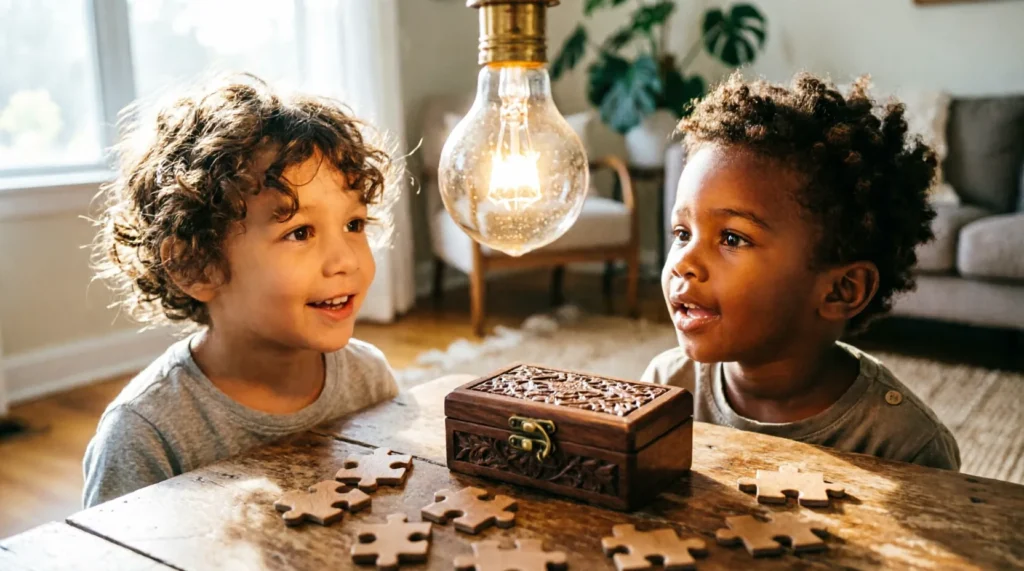
Riddles are one of the simplest ways to get kids laughing while stretching their brains. Whether you’re a parent looking for rainy-day activities or a teacher planning a classroom icebreaker, this collection of examples of riddles with answers for kids has you covered with tested favorites that actually work.
Top 5 Examples of Riddles with Answers for Kids
These are the riddles I reach for again and again—they’re the ones that get the biggest “Aha!” moments from kids aged 6-12.
1. What has to be broken before you can use it? Answer: An egg
2. What has hands but can’t clap? Answer: A clock
3. What gets wet while drying? Answer: A towel
4. What can you catch but not throw? Answer: A cold
5. What has a head and a tail but no body? Answer: A coin
Easy Riddles for Younger Kids
These are perfect for ages 5-8 or when you want quick wins that build confidence. simple wordplay and familiar objects make the best starting points for young solvers.
1. What room can no one enter? Answer: A mushroom
2. What has many teeth but can’t bite? Answer: A comb
3. What goes up but never comes down? Answer: Your age
4. What has one eye but can’t see? Answer: A needle
5. What falls but never breaks? Answer: Night
6. What can you hold in your right hand but never in your left? Answer: Your left hand
7. What has a neck but no head? Answer: A bottle
8. What gets sharper the more you use it? Answer: Your brain
9. What can travel around the world while staying in a corner? Answer: A stamp
10. What has words but never speaks? Answer: A book
Tested note: When I run #4 with first-graders, they always shout “a cyclops!” before someone figures out it’s a needle. The “eye” of a needle is concrete enough for them to grasp once you show them one.
Funny Riddles That Make Kids Laugh
These lean into silly answers and unexpected twists—the kind that get giggles even after kids hear the solution.
1. Why don’t scientists trust atoms? Answer: Because they make up everything
2. What do you call a bear with no teeth? Answer: A gummy bear
3. What do you call cheese that isn’t yours? Answer: Nacho cheese
4. Why did the scarecrow win an award? Answer: Because he was outstanding in his field
5. What do you call a fake noodle? Answer: An impasta
6. Why can’t you give Elsa a balloon? Answer: Because she’ll let it go
7. What do you call a sleeping dinosaur? Answer: A dino-snore
8. Why did the math book look sad? Answer: Because it had too many problems
9. What do you call a dog magician? Answer: A labracadabrador
10. Why don’t eggs tell jokes? Answer: They’d crack each other up
Tested note: #2 is my most reliable crowd-pleaser with ages 6-9. Every single time, someone yells “Gumby!” before the right answer clicks. The connection to the candy makes it stick.
Animal Riddles Kids Love
These focus on creatures kids already know and love, making them accessible while still requiring that mental stretch.
1. What has a tail and a head but no body? Answer: A coin (trick question! But if we’re talking animals: a tadpole)
2. What animal can jump higher than a house? Answer: Any animal—houses can’t jump
3. What do you call a fish wearing a crown? Answer: A king fish
4. What has four legs in the morning, two legs in the afternoon, and three legs in the evening? Answer: A human (crawling as a baby, walking as an adult, using a cane when old)
5. What do you call a pig that knows karate? Answer: A pork chop
6. What animal is always at a baseball game? Answer: A bat
7. What do you call a cat that eats lemons? Answer: A sour puss
8. What has a beak but isn’t a bird? Answer: A platypus (or a squid’s beak, for advanced solvers)
9. What do you call a cow with no legs? Answer: Ground beef
10. What animal can you never play chess with? Answer: A cheetah (they’re always spotted)
Tested note: #4 is the classic Sphinx riddle and genuinely stumps most 8-10 year olds on first hearing. I’ve seen kids argue for “a centaur” or “a robot” before the lightbulb moment. It’s harder than it looks, which makes the victory sweeter. For more, see 130 Clever Riddles for Smart Kids (With Answers).
Tricky Riddles That Stump (But Don’t Frustrate)
These require lateral thinking—the kind where the answer seems obvious once you hear it, but impossible before. The definition of a riddle itself, as noted on Wikipedia, emphasizes this puzzle-like quality where the solution requires creative interpretation rather than straightforward logic.
1. What can you break without touching it? Answer: A promise
2. What comes once in a minute, twice in a moment, but never in a thousand years? Answer: The letter “M”
3. What can fill a room but takes up no space? Answer: Light
4. What belongs to you but others use it more? Answer: Your name
5. What has cities but no houses, mountains but no trees, and water but no fish? Answer: A map
6. What can you keep after giving it to someone? Answer: Your word
7. What gets bigger the more you take away? Answer: A hole
8. What can run but never walks, has a mouth but never talks, has a head but never weeps, has a bed but never sleeps? Answer: A river
9. What is always coming but never arrives? Answer: Tomorrow
10. What can you see in the middle of March and April that you can’t see at the beginning or end of either month? Answer: The letter “R”
Tested note: #2 is deceptively hard. I’ve watched adults struggle with this one for minutes while 7-year-olds sometimes blurt it out immediately. It’s all about whether your brain goes literal or linguistic first.
Short One-Liners for Quick Rounds
Perfect for car rides, waiting rooms, or when you need a riddle that takes 10 seconds max to deliver and solve.
1. What is full of holes but still holds water? Answer: A sponge
2. What question can you never answer yes to? Answer: “Are you asleep?”
3. What is always in front of you but can’t be seen? Answer: The future
4. What can’t talk but will reply when spoken to? Answer: An echo
5. What has a bottom at the top? Answer: Your legs
6. What goes through towns and over hills but never moves? Answer: A road
7. What can you break just by saying its name? Answer: Silence
8. What has a ring but no finger? Answer: A telephone (or a bell)
9. What is so fragile that saying its name breaks it? Answer: Silence
10. What has a thumb and four fingers but isn’t alive? Answer: A glove
How to Use These Riddles
At Birthday Parties: Run a riddle relay where teams race to solve three riddles before moving to the next party activity. The top 5 section works perfectly for this—short enough to keep energy high.
In the Classroom: Start morning meetings with one riddle as a brain warm-up. I’ve seen teachers write them on the board and let kids mull them over during the first five minutes of class. The animal riddles section tends to get the most hands shooting up. For more, see Riddle.
On Road Trips: Take turns being the “riddle master.” The short one-liners are ideal here because they don’t require anyone to remember long setups while navigating highway exits.
For Scavenger Hunts: Hide riddles at each checkpoint where the answer reveals the next location. “What has a neck but no head?” could lead kids to search near a bottle-shaped decoration or water fountain.
At Family Game Night: Make it competitive with points for speed and creativity. Award bonus points for the funniest wrong answer before someone gets it right—the “gummy bear” response to the toothless bear riddle always deserves extra credit.
Frequently Asked Questions
What is a good riddle for a 7-year-old?
Start with the easy riddles section, particularly #1 (mushroom), #2 (comb), and #7 (bottle). These use familiar objects and straightforward wordplay without requiring abstract thinking. Seven-year-olds typically solve these within 30 seconds, which keeps frustration low and confidence high.
How do riddles help kids develop?
Riddles build critical thinking by forcing kids to consider multiple meanings of words and approach problems from different angles. They also strengthen vocabulary, improve listening skills, and teach kids that first impressions aren’t always correct. The “aha” moment when a solution clicks releases dopamine, making learning feel like play.
What’s the difference between a riddle and a joke?
While both aim to entertain, riddles pose a question that requires problem-solving to answer, whereas jokes deliver a punchline for immediate laughter. That said, the funny riddles section blurs this line intentionally—they’re structured as riddles but land with the comedic timing of a joke.
Should I give hints when kids are stuck?
Yes, but strategically. Instead of revealing the answer, offer a category hint (“It’s something you use every day”) or a sound-alike clue (“Think about words that sound the same”). This preserves the satisfaction of solving while preventing frustration. I typically wait 60-90 seconds before offering the first hint.

Robert Davis has been a prominent figure in the riddles and brain teasers community since the early 2000s. Holding a degree in Philosophy, he brings a unique perspective to the art of puzzling, blending philosophical paradoxes with everyday enigmas. Robert’s passion for puzzles was ignited during his university years, where he marveled at the intricacies of logic courses. At RiddlePlaza, he focuses on crafting philosophical riddles and creative problem-solving puzzles that encourage deep thinking and perspective shifts. Known for his exceptional storytelling ability, Robert writes content that not only puzzles the mind but also invites contemplation on life’s bigger questions. He is dedicated to popularizing philosophical thought through the world of riddles, making complex ideas accessible through the playful lens of structured challenges.