

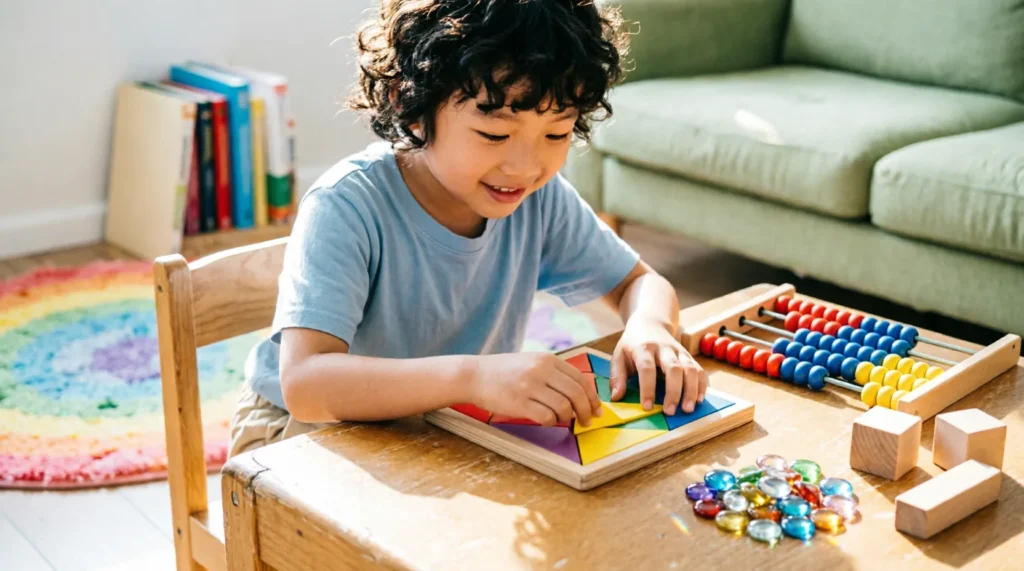
Welcome to the ultimate collection of math riddles designed specifically for second graders! These puzzles blend fun with fundamental math concepts, making them perfect for classroom warm-ups, homework helpers, or family game night. Whether you’re a teacher looking for engaging activities or a parent wanting to make math practice feel like play, you’ll find exactly what you need here.
Top 5 Math Riddles with Answers for Grade 2
I’m a double-digit number. My tens digit is 3, and my ones digit is 2 more than my tens digit. What number am I?
Answer: 35
I have 4 sides that are all the same length. I have 4 corners. What shape am I?
Answer: Square
If you add me to myself, you get 16. What number am I?
Answer: 8
I come after 49 and before 51. What number am I?
Answer: 50
I have no corners and no straight sides. I look like a wheel. What shape am I?
Answer: Circle
Easy Math Riddles for Beginners
These riddles are perfect for building confidence. When I test these with my second-grade tutoring group, even the kids who say “I’m bad at math” solve them with big smiles.
- I am an even number between 10 and 14. What number am I?
Answer: 12
- I have 3 sides and 3 corners. What shape am I?
Answer: Triangle
- If you have 5 apples and eat 2, how many are left?
Answer: 3 apples
- I am the number that comes right after 99. What number am I?
Answer: 100
- I have 2 dimes and 1 nickel. How much money do I have?
Answer: 25 cents
- I am a number. Add 10 to me and you get 25. What number am I?
Answer: 15
- I have 4 equal sides, but I’m not a square. I look like a squished square. What shape am I?
Answer: Rhombus (or diamond)
- What number is halfway between 0 and 10?
Answer: 5
- I am thinking of a number. It’s odd, it’s less than 10, and it’s bigger than 6. What number am I?
Answer: 7 or 9
- If today is Monday, what day will it be in 7 days?
Answer: Monday
Fun Number Pattern Riddles
Number patterns help kids see math as a puzzle rather than a chore. understanding patterns is fundamental to mathematical thinking at the elementary level.
- What comes next: 2, 4, 6, 8, ___?
Answer: 10
- What comes next: 5, 10, 15, 20, ___?
Answer: 25
- What comes next: 100, 90, 80, 70, ___?
Answer: 60
- What comes next: 1, 3, 5, 7, ___?
Answer: 9
- What comes next: 10, 20, 30, 40, ___?
Answer: 50
- What comes next: 50, 45, 40, 35, ___?
Answer: 30
- What comes next: 3, 6, 9, 12, ___?
Answer: 15
- What comes next: 25, 20, 15, 10, ___?
Answer: 5
Shape and Space Riddles
These riddles help kids visualize geometry concepts. I’ve found that second graders love these because they can draw the answers!
- I have 6 sides and 6 corners. What shape am I?
Answer: Hexagon
- I have 8 sides. I look like a stop sign. What shape am I?
Answer: Octagon
- I have 5 sides and 5 corners. What shape am I?
Answer: Pentagon
- I am a 3D shape that looks like a ball. What am I?
Answer: Sphere
- I am a 3D shape with 6 square faces. I look like a box or dice. What am I?
Answer: Cube
- I have one round face and come to a point at the top. I look like a party hat. What shape am I?
Answer: Cone
- I have 2 flat circular faces and curved sides. I look like a can of soup. What am I?
Answer: Cylinder
- I have 4 rectangular faces and 2 square faces. What 3D shape am I?
Answer: Rectangular prism
Tricky Math Riddles That Look Hard
Don’t let these fool you—they’re easier than they seem! The key is reading carefully. In my experience, the most common wrong answer on riddle #3 below is “10 minutes” because kids rush and don’t think about the boiling process. For more, see Riddle.
- If it takes 5 minutes to boil one egg, how long does it take to boil 3 eggs?
Answer: 5 minutes (you boil them all at the same time!)
- There are 12 months in a year. Some have 31 days, some have 30 days. How many have 28 days?
Answer: All 12 months have at least 28 days
- You have 10 cookies. You eat all but 3. How many cookies do you have left?
Answer: 3 cookies
- What number do you get when you multiply any number by zero?
Answer: 0
- I am a number. If you add my digits together, you get 10. I am between 50 and 60. What number am I?
Answer: 55
- There are 3 birds on a branch. You shoot one. How many are left?
Answer: None—they all flew away!
- What weighs more: a pound of feathers or a pound of bricks?
Answer: They weigh the same (one pound each)
- I have 4 quarters, 2 dimes, and 1 nickel. How much money do I have?
Answer: $1.25 (125 cents)
Word Problem Riddles for Grade 2
Word problems connect math to real life. These are excellent for building reading comprehension alongside math skills, as noted in educational frameworks for elementary grade levels.
- Sarah has 15 stickers. She gives 7 to her friend. How many does she have left?
Answer: 8 stickers
- There are 24 students in a class. They sit in rows of 6. How many rows are there?
Answer: 4 rows
- Tom has 3 bags with 5 marbles in each bag. How many marbles does he have in total?
Answer: 15 marbles
- A pizza has 8 slices. If you eat 3 slices, how many are left?
Answer: 5 slices
- There are 20 crayons in a box. 8 are red, 6 are blue, and the rest are green. How many are green?
Answer: 6 green crayons
- Jake is 8 years old. His sister is 3 years older. How old is his sister?
Answer: 11 years old
- A bus has 30 seats. 18 people are already sitting. How many more people can sit?
Answer: 12 people
- You have 2 dollars. You buy a candy bar for 75 cents. How much money do you have left?
Answer: $1.25 (or 125 cents)
Quick Fire Math Riddles
These are perfect for car rides or quick classroom transitions. Challenge your kids to answer in under 10 seconds!
- What is 7 + 7?
Answer: 14
- What is 20 – 8?
Answer: 12
- What is 5 × 2?
Answer: 10
- What is half of 18?
Answer: 9
- What is 100 – 50?
Answer: 50
- What is 6 + 6 + 6?
Answer: 18
- What number is 10 more than 45?
Answer: 55
- What is 3 × 3?
Answer: 9
- What is 25 + 25?
Answer: 50
- What is 15 – 7?
Answer: 8
How to Use These Riddles
Classroom Warm-Ups: Start each math lesson with one riddle on the board. It gets brains activated and creates a fun routine. I’ve seen teachers use these as “entry tickets”—kids solve one before the lesson officially begins.
Family Game Night: Turn riddle-solving into a competition. Keep score, offer small prizes, or just enjoy the laughs when someone gives a hilariously wrong answer. My family’s record is solving 20 riddles in one sitting!
Road Trip Entertainment: No screens needed! These riddles are perfect for long car rides. The “Quick Fire” section works especially well for this—rapid-fire questions keep kids engaged without overwhelming them.
Homework Helpers: Instead of saying “do your math homework,” say “let’s solve some riddles together.” The concepts are the same, but the approach feels completely different to a second grader. For more, see Grade.
Scavenger Hunt Clues: Hide riddles around the house or classroom. Each answer leads to the next location. For example: “I have 4 sides and 4 corners. Go look where you keep the [square-shaped object]!”
Frequently Asked Questions
What makes a good math riddle for second graders?
A good riddle for this age uses concepts they’re already learning—addition, subtraction, basic shapes, counting, and simple patterns. The language should be clear and not too complex. The best riddles have an “aha!” moment where the answer makes sense once you hear it, but requires a moment of thinking to get there.
How do I help a child who gets frustrated with riddles?
Start with the easiest riddles in the “Easy Math Riddles” section to build confidence. Remind them that riddles are supposed to be tricky—that’s what makes them fun! If they’re stuck, give hints rather than the answer. Celebrate the thinking process, not just getting it right. Sometimes working through a riddle together models problem-solving better than solving it alone.
Can these riddles help with standardized test preparation?
Absolutely! These riddles reinforce the exact skills second graders need: number sense, pattern recognition, basic operations, geometry vocabulary, and word problem comprehension. The difference is they’re practicing without feeling like they’re drilling. The critical thinking required for riddles also helps with test-taking skills.
How often should kids practice with math riddles?
Even 5-10 minutes a day makes a difference. Consistency matters more than duration. You might do one riddle at breakfast, one in the car, and one before bed. The goal is to make math thinking a natural, enjoyable part of daily life rather than a chore.

Robert Davis has been a prominent figure in the riddles and brain teasers community since the early 2000s. Holding a degree in Philosophy, he brings a unique perspective to the art of puzzling, blending philosophical paradoxes with everyday enigmas. Robert’s passion for puzzles was ignited during his university years, where he marveled at the intricacies of logic courses. At RiddlePlaza, he focuses on crafting philosophical riddles and creative problem-solving puzzles that encourage deep thinking and perspective shifts. Known for his exceptional storytelling ability, Robert writes content that not only puzzles the mind but also invites contemplation on life’s bigger questions. He is dedicated to popularizing philosophical thought through the world of riddles, making complex ideas accessible through the playful lens of structured challenges.