

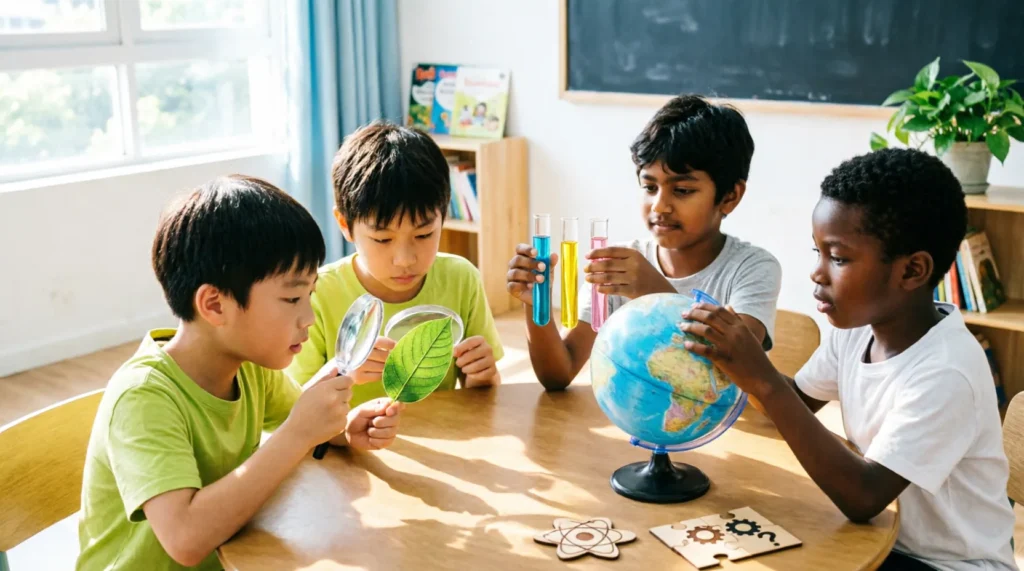
Science riddles with answers for class 5 turn abstract textbook definitions into memorable “aha” moments that stick far longer than rote memorization. This collection features tested puzzles covering states of matter, the solar system, biology, and basic physics, each paired with its answer and notes from real classroom use. Whether you need a five-minute bell ringer or a full-period review game, these riddles bridge the gap between vocabulary lists and genuine conceptual understanding.
Top 5 Science Riddles with Answers for Class 5
These five riddles consistently generate the most engagement and discussion in fifth-grade classrooms based on my experience running science review sessions. They cover core curriculum standards while remaining accessible enough to build confidence before tackling harder material.
I have mass and take up space, but you cannot see me, taste me, or hold me in your hand. I fill a balloon and make it float, yet I am not alive. What am I? Answer: A gas (or air)
I am always coming but never arrive. I am essential for life on Earth, yet I have no physical form. Scientists measure me in seconds, minutes, and hours, but I cannot be stored in a container. What am I? Answer: Time
I can be solid, liquid, or gas depending on how hot or cold I get. I cover most of the Earth’s surface and fall from the sky as rain, snow, or hail. What am I? Answer: Water
I travel at 300,000 kilometers per second but have no mass. I let you see the stars and read this page, yet I cannot bend around corners without help. What am I? Answer: Light
I am the powerhouse of the cell, found in nearly every living thing. I convert food into energy through a process called respiration, but I am too small to see without a microscope. What am I? Answer: Mitochondria
Easy Science Riddles to Build Confidence
Starting with easier riddles helps students experience success early and primes them for more complex reasoning. These six riddles use familiar vocabulary and concrete imagery that aligns with typical fifth-grade science units.
I am green and make food from sunlight. Without me, plants would starve and animals would have nothing to eat. What am I? Answer: Chlorophyll
I am the hardest natural substance on Earth, formed deep underground under extreme pressure. I sparkle in jewelry but also cut glass and drill through rock. What am I? Answer: Diamond
I pull everything toward the center of the Earth. Without me, you would float away and oceans would drift into space. What am I? Answer: Gravity
I am a giant ball of hot gas that gives Earth light and warmth. I am about 109 times wider than Earth and located at the center of our solar system. What am I? Answer: The Sun
I protect Earth from harmful solar radiation and keep our atmosphere from escaping into space. I am invisible but absolutely vital for survival. What am I? Answer: The ozone layer (or magnetosphere/atmosphere, depending on curriculum focus)
I am made of two hydrogen atoms and one oxygen atom. I freeze at 0°C and boil at 100°C at sea level. What am I? Answer: H₂O (water molecule)
When I use riddle #6 with fifth graders, about half immediately shout “water!” while the other half hesitate because they expect a trick. This split reveals which students are thinking chemically versus observationally, giving teachers instant formative assessment data.
Hard Science Riddles for Critical Thinkers
These riddles require students to synthesize multiple concepts rather than recall isolated facts. According to Riddle, the most effective puzzles create cognitive tension by presenting information that seems contradictory until the solver applies domain-specific knowledge. Use these after students have mastered basics.
I increase when heated but decrease when cooled, yet I am not temperature itself. I describe how fast molecules move and determine whether something is solid, liquid, or gas. What am I? Answer: Kinetic energy (or thermal energy)
I am produced during photosynthesis but consumed during respiration. Plants release me as waste, yet animals desperately need me to survive. What am I? Answer: Oxygen
I can pass through solids, liquids, and gases, but different materials slow me down by varying amounts. I cause shadows when blocked and rainbows when refracted. What am I? Answer: Light waves (or electromagnetic radiation)
I am created when an object vibrates, but I cannot travel through a vacuum. I move faster through water than air and fastest through steel. What am I? Answer: Sound
I am responsible for chemical bonds between atoms, yet I am neither matter nor energy in the traditional sense. I determine whether substances react or remain stable. What am I? Answer: Electrons (specifically valence electrons)
I existed before the Big Bang yet I may end when all stars burn out. I allow change to occur but have no beginning or end point you can measure directly. What am I? Answer: Time (as a dimension)
Riddle #4 trips up many students who confuse sound with light because both “travel.” When I run this in class, I ask follow-up questions like “Why can’t astronauts hear explosions in space?” to cement the distinction between mechanical and electromagnetic waves.
Funny Science Riddles That Stick in Memory
Humor creates emotional anchors that improve retention. These riddles use wordplay and absurdity to reinforce accurate science concepts without sacrificing rigor.
Why did the electron refuse to play hide-and-seek with the proton? Answer: Because the proton was always positive (and electrons are negative)
What did the biologist wear to his first date? Answer: Designer genes
Why don’t scientists trust atoms? Answer: Because they make up everything
What do you call a dinosaur that knows a lot about science? Answer: A know-it-all-saurus (reinforces paleontology vocabulary)
Why was the math book sad during science class? Answer: It had too many problems (but science helped solve them!)
What did one tectonic plate say to another after an earthquake? Answer: “Sorry, my fault!” (teaches geological terminology)
In my experience, riddle #3 gets groans followed by laughter, then genuine discussion about atomic theory. The pun works because it’s scientifically accurate—atoms literally compose all matter—making the humor educational rather than distracting.
Tricky Science Riddles With a Twist
These riddles exploit common misconceptions to deepen understanding. As defined by Science, systematic inquiry often begins by challenging assumptions, and these puzzles model that process in miniature.
I am lighter than air but cannot float. Millions of me exist in a single drop of water, yet I have weight. What am I? Answer: A molecule (specifically water molecules)
I grow larger the more you take away from me. I exist only where matter is absent, yet I define the shape of containers. What am I? Answer: A hole (or vacuum/space)
I am alive but have no brain, heart, or lungs. I reproduce, respond to stimuli, and evolve, yet many scientists debate whether I truly qualify as living. What am I? Answer: A virus
I can be created but never destroyed. I change forms constantly—from kinetic to potential to thermal—but the total amount in the universe stays constant. What am I? Answer: Energy (conservation of energy law)
I appear to move across the sky each day, but I am actually stationary relative to Earth’s rotation. Ancient civilizations built monuments aligned with my position. What am I? Answer: The Sun (apparent motion vs. actual motion)
I am smaller than an atom but determine an element’s identity. Change my number and you transform lead into gold—or oxygen into nitrogen. What am I? Answer: Protons (atomic number)
Riddle #3 reliably sparks debate in fifth-grade classrooms. Some students insist viruses aren’t alive; others argue they are. This disagreement is pedagogically valuable—it mirrors real scientific discourse and teaches that classification systems are human constructs refined through evidence.
How to Use These Riddles
Integrating riddles effectively requires intentional planning beyond simply reading them aloud. Here are four tested approaches that maximize learning outcomes.
- Bell Ringers: Display one riddle as students enter. Give three minutes for individual thinking, then facilitate brief partner discussion before revealing the answer. This activates prior knowledge and sets a curious tone for the lesson.
- Scavenger Hunts: Hide riddle cards around the classroom or playground. Students solve each riddle to find the next clue location. Pair physical movement with cognitive challenge to engage kinesthetic learners.
- Exit Tickets: End class with a riddle related to that day’s content. Collect written responses to assess understanding before students leave. Unanswered or incorrectly answered riddles signal topics needing reteaching.
- Family Science Nights: Send home printed riddle sheets with answers upside-down at the bottom. Encourage families to solve together, extending learning beyond school hours and building home-school connections.
Frequently Asked Questions
What makes a good science riddle for fifth graders? A strong riddle targets a specific curriculum standard while using language accessible to 10-11 year olds. Avoid obscure trivia; instead, focus on core concepts like states of matter, ecosystem relationships, or basic forces. The best riddles feel challenging but solvable with knowledge students already possess or just learned. Test riddles on actual fifth graders before using them widely—if fewer than 30% solve it independently, it’s likely too hard or poorly worded.
How do science riddles support learning better than direct instruction? Riddles activate retrieval practice, which research shows strengthens memory more than passive review. They also create productive struggle: students must reorganize existing knowledge rather than receive new information. When a student solves a riddle about mitochondria after struggling, the concept becomes personally meaningful rather than externally imposed. Additionally, riddles normalize being wrong temporarily, building resilience essential for scientific thinking.
Can I modify these riddles for different ability levels? Absolutely. For struggling learners, add visual clues or multiple-choice options. For advanced students, remove scaffolding language or ask them to explain why wrong answers seem plausible. You can also extend riddles into writing prompts: “Create your own riddle about the water cycle using at least three scientific terms.” Differentiation should maintain the riddle’s core cognitive demand while adjusting access points.
Where can I find more science riddles aligned to specific standards? Start with your state or national science framework documents—they list exact concepts fifth graders must master. Search those specific terms plus “riddle” or “puzzle” rather than generic phrases. Teacher-created resource marketplaces often have vetted collections organized by standard. Always verify accuracy yourself; crowdsourced content sometimes contains subtle errors that undermine learning. Building your own bank over time, informed by student responses, yields the most reliable results.

Ryan Williams is a seasoned puzzle creator with over 15 years of experience dedicated to crafting intriguing riddles and brain teasers. With a background in cognitive science and a Master’s degree in Linguistics from a prestigious university, Ryan is renowned for his ability to weave language intricacies into mind-bending challenges. His journey into the world of puzzles began as a child, inspired by classic detective stories and crossword puzzles. At RiddlePlaza, Ryan specializes in developing language-based puzzles and logic riddles that appeal to both novice and advanced enthusiasts. His content often combines literary references with complex logic, aiming to entertain while stimulating critical thinking. Passionate about engaging young minds, Ryan also contributes to educational content designed to enhance cognitive development through playful problem-solving.