

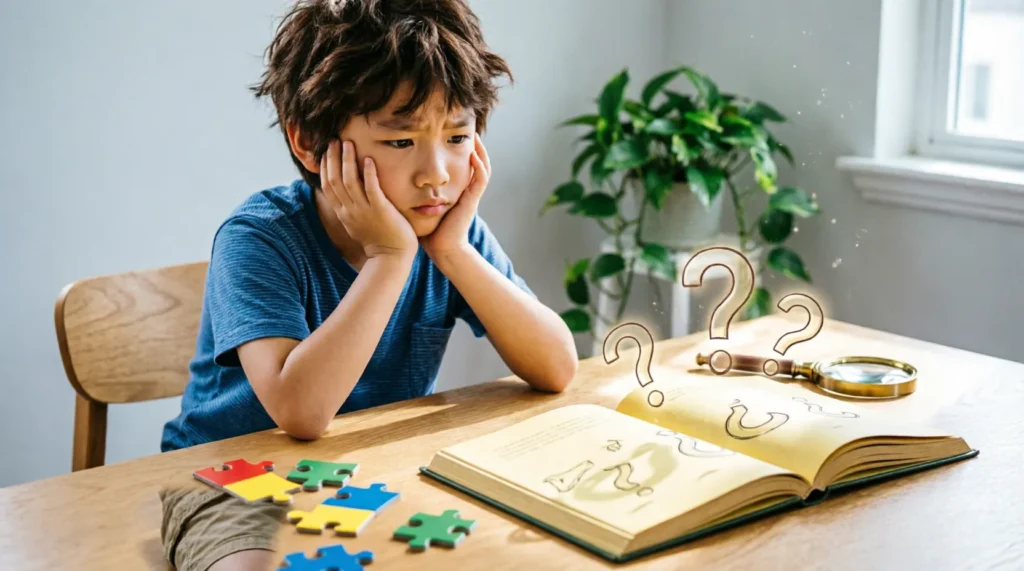
Nine-year-olds are at a magical cognitive crossroads. They have moved past simple nursery rhymes but aren’t quite ready for the abstract logic puzzles that stump adults. This is the age where lateral thinking begins to click, where they start to enjoy the “aha!” moment of solving a puzzle that initially seemed impossible. Whether you are a parent looking to keep your child entertained on a long car ride, a teacher seeking a fun brain break for your fourth-grade class, or a relative wanting to impress a clever kid at a family gathering, this collection is designed specifically for that sweet spot of development. These riddles balance humor, wordplay, and logic without being so obscure that they cause frustration.
Top 5 Best Riddles for 9 Year Olds
These five riddles represent the gold standard for this age group. They are popular because they rely on concepts nine-year-olds understand—school, animals, time, and basic objects—but twist them in a way that requires a shift in perspective.
I have a neck but no head. I have two arms but no hands. What am I? Answer: A shirt
When I run this one with kids, the immediate guess is often “a snake” or “a monster.” The trick here is personification. Nine-year-olds are learning about body parts and clothing simultaneously, making this a perfect bridge between concrete and abstract thinking.
What has keys but can’t open locks? Answer: A piano
This is a classic for a reason. It plays on homonyms. Kids know what keys are, and they know what locks are. The leap to a musical instrument requires them to think about the function of the object rather than just its name. It’s usually solved quickly once they stop thinking about doors.
I speak without a mouth and hear without ears. I have no body, but I come alive with wind. What am I? Answer: An echo
This riddle introduces a bit of science. At nine, children are often learning about sound waves or nature. The imagery is poetic but grounded in physical reality. If they get stuck, hint that it happens in caves or large empty halls.
What goes up but never comes down? Answer: Your age
This is arguably the most relatable riddle for a nine-year-old. They are acutely aware of growing older, celebrating birthdays, and moving up grade levels. It’s a simple concept, but the phrasing makes it feel like a trick question. Most kids love the confidence boost when they realize the answer is something personal to them.
The more of this there is, the less you see. What is it? Answer: Darkness
This riddle works well because it defies typical object logic. Usually, “more” of something means you see more of it (like toys or cookies). Here, the relationship is inverse. It’s a great introduction to logical opposites.
Easy Riddles to Build Confidence
Start with these if you are warming up a group or if the child is new to riddles. These rely on straightforward word associations and common knowledge.
What has to be broken before you can use it? Answer: An egg
I’m tall when I’m young, and I’m short when I’m old. What am I? Answer: A candle
What month of the year has 28 days? Answer: All of them
This is a favorite trap. Kids will often shout “February!” immediately. When you reveal that every month has at least 28 days, their faces light up as they realize they were technically correct but missed the broader truth.
What is full of holes but still holds water? Answer: A sponge
What question can you never answer yes to? Answer: Are you asleep?
What is always in front of you but can’t be seen? Answer: The future
I have cities, but no houses. I have mountains, but no trees. I have water, but no fish. What am I? Answer: A map
What can you catch but not throw? Answer: A cold
Funny Riddles for Giggles
Humor is a powerful motivator for nine-year-olds. These riddles rely on puns and silly imagery. The goal here isn’t just to solve the puzzle, but to enjoy the joke.
Why did the scarecrow win an award? Answer: Because he was outstanding in his field!
What do you call a fake noodle? Answer: An impasta
Why can’t a bicycle stand up by itself? Answer: It’s two tired!
What do you call a bear with no teeth? Answer: A gummy bear
Why did the cookie go to the hospital? Answer: Because he felt crummy
What do you call a sleeping bull? Answer: A bulldozer
Why did the math book look sad? Answer: Because it had too many problems
What do you call a dog that does magic tricks? Answer: A labracadabrador
When I use these in a classroom setting, the laughter often helps lower anxiety around getting answers wrong. It creates a low-stakes environment where guessing is part of the fun.
Tricky Riddles That Require Lateral Thinking
These riddles are designed to trip up the solver. They rely on assumptions that need to be challenged. According to Riddle, the essence of a riddle is often to conceal the answer through metaphorical or ambiguous language, forcing the solver to look beyond the literal meaning.
- A man is pushing his car along a road when he comes to a hotel. He shouts, “I’m bankrupt!” Why? Answer: He is playing Monopoly
This is a heavy hitter for nine-year-olds. Many haven’t played Monopoly recently, or they don’t make the connection between the board game token and the real-world action. If they don’t know Monopoly, swap the context to “He is playing a board game.”
- Some months have 30 days, some have 31. How many have 28? Answer: All 12 months
As mentioned earlier, this is a logic trap. It tests attention to detail rather than calendar memorization.
- What belongs to you, but other people use it more than you do? Answer: Your name
This requires a bit of social awareness. Nine-year-olds are developing a stronger sense of identity, so the concept of “ownership” vs. “usage” is a fascinating philosophical nugget for them to chew on.
- I have branches, but no fruit, trunk, or leaves. What am I? Answer: A bank
This plays on the double meaning of “branch.” Kids know tree branches, but they might not immediately connect it to a bank branch unless they’ve been to one with their parents.
What can travel all around the world without leaving its corner? Answer: A stamp
The person who makes it has no need of it; the person who buys it has no use for it. The person who uses it can neither see nor feel it. What is it? Answer: A coffin
This one is slightly morbid, but nine-year-olds are often fascinated by the macabre. It’s a classic logical progression riddle. If you feel it’s too dark, replace it with: “What has a bed but never sleeps?” (A river).
Animal Riddles
Animals are a perennial favorite. These riddles combine biological facts with wordplay.
- What has four legs in the morning, two legs in the afternoon, and three legs in the evening? Answer: A human (crawling as a baby, walking as an adult, using a cane in old age)
This is the famous Sphinx riddle. It’s complex, but nine-year-olds can grasp the lifecycle concept if you break it down.
I have a tail and a head, but no body. What am I? Answer: A coin
What kind of room has no doors or windows? Answer: A mushroom
I am not alive, but I grow; I don’t have lungs, but I need air; I don’t have a mouth, but water kills me. What am I? Answer: Fire
What has one eye but can’t see? Answer: A needle
I fly without wings. I cry without eyes. Whenever I go, darkness flies. What am I? Answer: A cloud
What animal is always at a baseball game? Answer: A bat
Math and Logic Riddles
These riddles introduce basic arithmetic and spatial reasoning without feeling like homework. They are excellent for kids who enjoy patterns and numbers.
- How many sides does a circle have? Answer: Two (the inside and the outside)
This is a geometric trick. While mathematically a circle has infinite points or no straight sides, in riddle logic, the “inside” and “outside” are the accepted playful answer.
- If you have a bowl with six apples and you take away four, how many do you have? Answer: Four
The trick is the wording. You have the four you took. The bowl has two left, but you have four.
- What number do you get when you multiply all the numbers on a telephone keypad? Answer: Zero
Because the keypad includes the number 0, and anything multiplied by zero is zero. This teaches them to look for the “trap” number before doing mental math.
I am an odd number. Take away a letter and I become even. What number am I? Answer: Seven (remove the ‘s’ and it becomes ‘even’)
How can you add eight 8s to get the number 1,000? Answer: 888 + 88 + 8 + 8 + 8 = 1,000
This requires some trial and error. It’s a great activity for a piece of paper and a pencil.
- What weighs more: a pound of bricks or a pound of feathers? Answer: They weigh the same (one pound)
This is a classic physics misconception buster. Kids often intuitively feel bricks are “heavier,” but the unit of measurement is identical.
How to Use These Riddles
Riddles are versatile tools. Here are a few ways to integrate them into your daily routine:
- Car Ride Entertainment: Instead of screens, try a “Riddle Relay.” One person asks a riddle, and the first to solve it gets to ask the next one. It keeps everyone engaged and reduces motion sickness from reading.
- Classroom Brain Breaks: Teachers can use one tricky riddle at the start of class to wake up students’ brains. It transitions them from playground energy to focused learning mode.
- Scavenger Hunt Clues: Write these riddles on cards and hide them around the house or yard. The answer to each riddle leads to the location of the next clue. For example, if the answer is “fridge,” hide the next clue near the fridge.
- Dinner Table Conversation: Replace the standard “How was your day?” with a riddle. It encourages critical thinking and conversation among siblings and parents alike.
Frequently Asked Questions
What is a good riddle for a 9 year old who loves science? Try the fire riddle (“I don’t have lungs, but I need air”) or the echo riddle. These connect directly to basic scientific principles like combustion and sound waves, making them educational as well as entertaining.
How do I help my child if they can’t solve a riddle? Avoid giving the answer immediately. Instead, offer a category hint. For example, if the answer is “a piano,” say, “It’s something you find in a music room.” If they are still stuck, give a phonetic hint or explain the wordplay. The goal is to guide their thinking process, not just provide the solution.
Are riddles good for brain development? Yes. Riddles encourage lateral thinking, vocabulary expansion, and patience. They teach children to listen carefully to wording and to consider multiple meanings of words. engaging with language play like riddles supports literacy and cognitive flexibility during these formative Year cycles of development.
What if my child gets frustrated? Switch to the “Funny” section. Humor lowers the stakes. Remind them that riddles are meant to be tricky, and that getting it wrong is part of the game. You can also let them look up the answer if they are truly stuck, then discuss why that answer makes sense.

Patricia Sanchez is an expert in mathematical riddles and lateral thinking puzzles, bringing over a decade of experience to RiddlePlaza. With a dual degree in Mathematics and Psychology, Patricia is adept at creating brain teasers that challenge cognitive processing and numerical skills. Her fascination with puzzles was sparked by her early fascination with Sudoku and the strategic complexities of chess. In the realm of riddles, Patricia enjoys constructing scenarios that require readers to think outside the box, drawing upon her psychological insights to foster creative problem-solving. She is particularly known for her ability to fuse mathematical conundrums with a narrative flair, creating multi-layered puzzles that are both educational and engaging. Patricia is dedicated to integrating puzzles into educational frameworks, believing strongly in their capacity to sharpen young minds and enhance learning.