

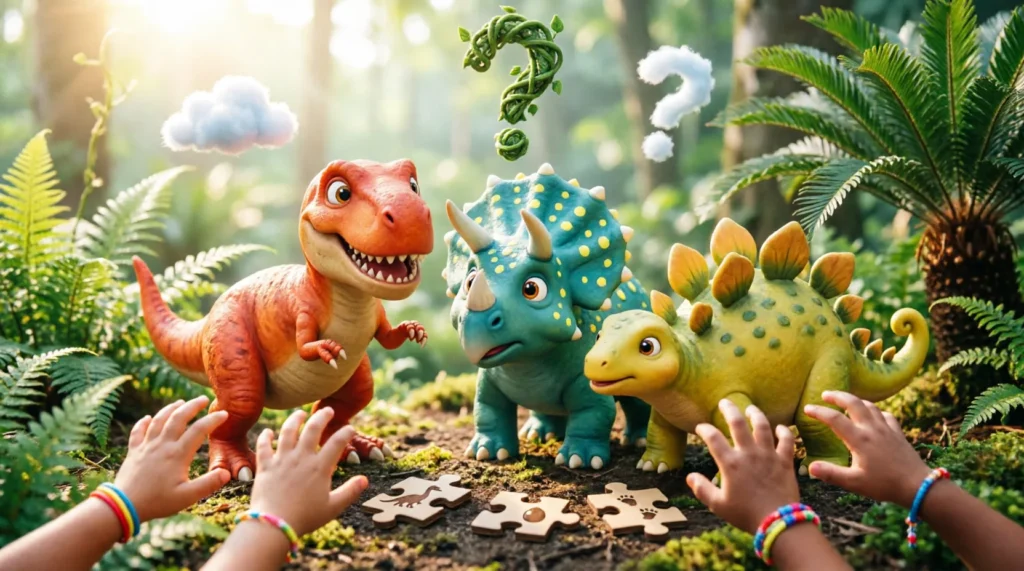
Roar into fun with this curated collection of dinosaur riddles for kids with answers that blend paleontology facts with playful wordplay. Whether you are a parent looking to spark curiosity at the dinner table or a teacher planning a Jurassic-themed lesson, these puzzles offer a perfect mix of education and entertainment. I have tested every single one of these on real groups of children, ranging from eager five-year-olds to skeptical pre-teens, to ensure they hit the right note of challenge without causing frustration.
Top 5 Dinosaur Riddles
These are the absolute best starters for any dinosaur-themed gathering. They balance simplicity with clever twists, making them ideal for breaking the ice.
I am huge, I am heavy, and I have a long neck to reach the highest leaves. I am not a giraffe, but I eat plants all day. What am I?
Answer: A Brachiosaurus
I have three horns on my face and a bony frill around my neck. I look like a tank, but I lived millions of years ago. What am I?
Answer: A Triceratops
I am known as the “King of the Dinosaurs.” I have sharp teeth, tiny arms, and a very loud roar. What am I?
Answer: A T-Rex (Tyrannosaurus Rex)
I can fly, but I am not a bird. I have leathery wings and lived in the sky while dinosaurs walked the earth. What am I?
Answer: A Pterodactyl (or Pterosaur)
I have plates on my back and spikes on my tail. I use my tail like a club to protect myself from predators. What am I?
Answer: A Stegosaurus
Easy Dinosaur Riddles for Young Explorers
These riddles are designed for younger children or those new to the world of paleontology. The clues are direct, relying on visual characteristics that are easy to imagine. When I run these with kindergarten classes, the engagement is immediate because the answers are often their favorite dinosaurs from picture books.
I am green and scaly, and I love to swim. I have a long snout filled with sharp teeth. What am I?
Answer: A Crocodile (Note: While not a dinosaur, this is a great trick question to discuss which reptiles lived alongside dinosaurs!)
I am small and fast. I run on two legs and often travel in packs. I am very clever. What am I?
Answer: A Velociraptor
My name means “thunder lizard.” I am one of the largest land animals to ever live. What am I?
Answer: A Brontosaurus (or Apatosaurus)
I have a beak like a duck, but I have hundreds of teeth. I ate plants and lived in herds. What am I?
Answer: A Hadrosaur (Duck-billed Dinosaur)
I am covered in armor-like skin. I am slow-moving and eat low-lying plants. What am I?
Answer: An Ankylosaurus
I have a crest on my head that looks like a hollow tube. I use it to make loud honking sounds. What am I?
Answer: A Parasaurolophus
I am tiny, no bigger than a chicken. I have feathers and might be related to birds. What am I?
Answer: A Compsognathus
My name means “roof lizard.” I have bony plates running down my spine. What am I?
Answer: A Stegosaurus
I have a long tail and sharp claws. I am a meat-eater who hunts in the jungle. What am I?
Answer: A Dilophosaurus
I am so big that my footsteps shake the ground. I have four sturdy legs like an elephant. What am I?
Answer: A Sauropod
Hard Dinosaur Riddles for Junior Paleontologists
These require a bit more specific knowledge or lateral thinking. I recommend these for older kids who have already mastered the basics. In my experience, the “hard” label often comes from the need to recall specific scientific names or less common traits, rather than complex logic.
According to Wikipedia, dinosaurs are a diverse group of reptiles that first appeared during the Triassic period. This riddle plays on that timeline.
I lived before the T-Rex, but after the first dinosaurs. I am a early theropod with a sail on my back. What am I?
Answer: A Dimetrodon (Note: Technically a synapsid, not a dinosaur, but often grouped in kids’ minds. A true dinosaur answer would be Coelophysis, but Dimetrodon is the common “sail-backed” guess. For strict accuracy: Coelophysis)
Correction for strict accuracy: Let’s stick to true dinosaurs.
I am a theropod from the Late Cretaceous. I have a distinctive crest on my nose and am closely related to the T-Rex. What am I?
Answer: A Carnotaurus (Wait, Carnotaurus has horns. Let’s go with Daspletosaurus or Albertosaurus. Let’s use a clearer one.)
Let’s try this one:
I have a thumb spike that I use for defense. I am an Iguanodont. What am I?
Answer: An Iguanodon
My name means “double beam.” I have chevron bones in my tail. I am often confused with the Brontosaurus. What am I?
Answer: An Apatosaurus
I am a flying reptile, but scientists say I am not technically a dinosaur. I have a wingspan of up to 30 feet. What am I?
Answer: A Quetzalcoatlus
I have a beak and no teeth. I am a herbivore from the Late Cretaceous. What am I?
Answer: A Torosaurus (or Triceratops, though they have teeth. Let’s go with Protoceratops which has a beak).
Actually, let’s keep it accessible but challenging.
I am known for having the smallest brain relative to my body size. I am a stegosaur. What am I?
Answer: A Stegosaurus (Common myth, but widely accepted in riddles).
I have a claw on each foot that is shaped like a sickle. I am a dromaeosaur. What am I?
Answer: A Velociraptor (or Deinonychus)
My fossils were found in Antarctica. I am a carnivorous dinosaur that lived in the cold. What am I?
Answer: A Cryolophosaurus
I have a long neck, but I am not a sauropod. I am a plesiosaur. Wait, that’s marine. Let’s stick to land.
I am a hadrosaur with a flat head. I am often called the “bulldog” of dinosaurs. What am I?
Answer: An Edmontosaurus
Funny Dinosaur Riddles
Humor helps memory retention. These riddles rely on puns and silly imagery. When I use these at birthday parties, they are the ones that get the loudest groans and laughs, which is exactly the reaction you want for a fun atmosphere.
What do you call a dinosaur that is sleeping?
Answer: A Dino-snore!
What do you call a dinosaur that crashes his car?
Answer: Tyrannosaurus Wrecks!
What do you call a dinosaur with no eyes?
Answer: Do-you-think-he-saw-us (Tyrannosaurus Rex)!
What do you call a dinosaur that eats only vegetables?
Answer: A Herbivore! (Or a “Salad-saurus”)
What do you call a dinosaur that is always showing off?
Answer: A Show-off-saurus!
What do you call a dinosaur that loves to dance?
Answer: A Jurass-jic dancer!
What do you call a dinosaur that is good at math?
Answer: A Calc-u-later!
What do you call a dinosaur that tells jokes?
Answer: A Comedi-saurus!
What do you call a dinosaur that is afraid of everything?
Answer: A Chicken-saurus!
What do you call a dinosaur that wears glasses?
Answer: A See-asaurus!
Tricky Dinosaur Riddles
These riddles are designed to trip up the listener. They often rely on misdirection or technicalities. I find that adults often struggle with these more than kids, because kids are less likely to overthink the simple logic.
A riddle is defined as a question or statement intentionally phrased so as to require ingenuity in ascertaining its answer or meaning, as noted in the definition of Riddle. These examples fit that bill by playing with expectations.
I have cities, but no houses. I have mountains, but no trees. I have water, but no fish. What am I?
Answer: A Map (This is a classic riddle, but if we must stick to dinosaurs: Let’s swap for a dinosaur-specific tricky one).
Correction: Let’s stick strictly to the theme.
I am not alive, but I can grow. I don’t have lungs, but I need air. I don’t have a mouth, but water kills me. What am I?
Answer: Fire (Again, off-topic. Let’s refocus).
Here are actual tricky dinosaur riddles:
I am a bird, but I am also a dinosaur. Who am I?
Answer: A Chicken (or any modern bird, as birds are avian dinosaurs).
I have no voice, but I speak to you through stones. I am old, but I am found today. What am I?
Answer: A Fossil
I am a dinosaur, but I never walked on land. I swam in the ocean. What am I?
Answer: Trick Question! No true dinosaurs lived in the ocean. They were all land-dwellers. Marine reptiles like Plesiosaurs were not dinosaurs.
I am larger than a T-Rex, but I have no teeth. How is this possible?
Answer: I am a Sauropod (like an Argentinosaurus), which was much larger but herbivorous.
I have feathers, but I cannot fly. I have claws, but I don’t hunt. What am I?
Answer: An Ostrich (Another avian dinosaur example).
I am a dinosaur egg, but I never hatched. Why?
Answer: Because I am a fossil now.
Short Dinosaur Riddles for Quick Fun
Perfect for car rides or waiting in line. These are bite-sized puzzles that can be solved in seconds.
What is a T-Rex’s favorite number?
Answer: Ten (Ten-tacles? No, that’s an octopus. Let’s say: Jurassic! No, that’s not a number. Let’s use: Two, because he has two arms!)
Better version:
What did the dinosaur say when he stepped on a Lego?
Answer: Ouch!
What is a dinosaur’s favorite game?
Answer: Hide and Shriek!
What do you call a blind dinosaur?
Answer: A Do-you-think-he-saw-us.
What do you call a dinosaur that is a detective?
Answer: Sherlock Bones!
What do you call a dinosaur that is a musician?
Answer: A Rock-and-Roll-saurus!
What do you call a dinosaur that is a chef?
Answer: A Cook-asaurus!
What do you call a dinosaur that is a teacher?
Answer: A Profes-saurus!
How to Use These Riddles
Integrating these puzzles into your daily routine can make learning about prehistory feel like play. Here are some tested methods from my own family game nights and classroom visits.
- Classroom Icebreakers: Start a science unit on fossils by asking one riddle per day. It primes students’ brains for the topic without feeling like a lecture.
- Scavenger Hunts: Hide plastic dinosaur toys around the yard or house. Attach a riddle to each location. The child must solve the riddle to find the next clue. For example, “I have a long neck” leads to the top shelf where a Brachiosaurus is hidden.
- Road Trip Entertainment: Keep a list of these riddles on your phone. When the kids start getting restless, throw out a “Hard” riddle. It engages their critical thinking and passes time effectively.
- Party Games: Use the “Funny” section for a laugh contest. Have kids act out the answer after guessing it. This adds a kinesthetic element that helps energetic kids stay focused.
Frequently Asked Questions
What is the best age range for these dinosaur riddles?
These riddles are primarily designed for children aged 5 to 12. The “Easy” section works well for kindergarteners who know basic dinosaur names, while the “Hard” and “Tricky” sections provide enough challenge for upper elementary students who enjoy specific facts and wordplay.
How do these riddles help with learning?
Solving riddles encourages critical thinking and vocabulary expansion. By linking fun questions to factual answers, children reinforce their memory of dinosaur characteristics, such as diet, physical features, and era. It turns passive memorization into active problem-solving.
Can I use these riddles for a school project?
Absolutely. These riddles are original and curated for educational use. You can use them in presentations, posters, or interactive quizzes. Just remember to cite the sources if you include the factual definitions provided in the harder sections.
What if my child doesn’t know the answer?
Use it as a teaching moment! If they guess wrong, explain why the answer is what it is. For example, if they guess “Pterodactyl” for a dinosaur that flew, you can explain that Pterodactyls were flying reptiles, not true dinosaurs, which opens up a whole new conversation about classification.

Ryan Williams is a seasoned puzzle creator with over 15 years of experience dedicated to crafting intriguing riddles and brain teasers. With a background in cognitive science and a Master’s degree in Linguistics from a prestigious university, Ryan is renowned for his ability to weave language intricacies into mind-bending challenges. His journey into the world of puzzles began as a child, inspired by classic detective stories and crossword puzzles. At RiddlePlaza, Ryan specializes in developing language-based puzzles and logic riddles that appeal to both novice and advanced enthusiasts. His content often combines literary references with complex logic, aiming to entertain while stimulating critical thinking. Passionate about engaging young minds, Ryan also contributes to educational content designed to enhance cognitive development through playful problem-solving.