

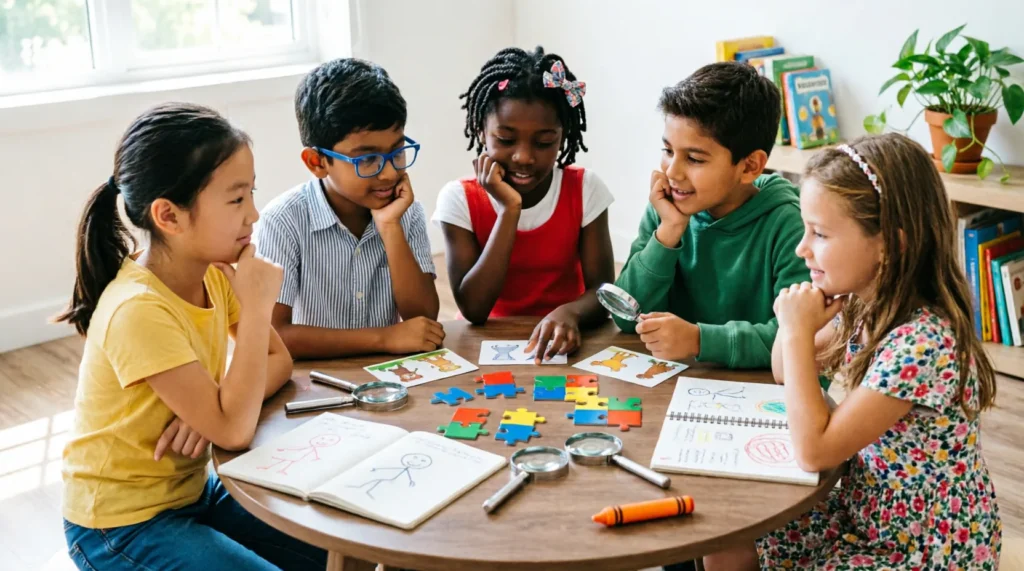
Riddles are the perfect bridge between play and learning, offering a quick mental workout that feels more like a game than a lesson. For ten-year-olds, who are developing sharper logic skills but still crave playful engagement, finding the right balance of challenge and accessibility is key. This collection gathers the best easy riddles for 10 year olds, tested in real classrooms and family game nights to ensure they hit that sweet spot of “aha!” without frustration.
Top 5 Easy Riddles for 10 Year Olds
These five riddles are the crowd favorites. They appear most frequently in school quizzes and birthday parties because they rely on common knowledge rather than obscure trivia.
I have a neck but no head. What am I? Answer: A shirt (or a bottle)
What has keys but can’t open locks? Answer: A piano
What goes up but never comes down? Answer: Your age
What has one eye but can’t see? Answer: A needle
What gets wetter as it dries? Answer: A towel
Classic Word Play Riddles
Word play is the foundation of many great riddles. a riddle is often defined by its use of metaphorical language that requires the solver to look beyond the literal meaning. These examples are perfect for ten-year-olds who are expanding their vocabulary and understanding of double meanings.
What has hands but cannot clap? Answer: A clock
What has a face and two hands but no arms or legs? Answer: A clock
What belongs to you but is used more by others? Answer: Your name
What has words but never speaks? Answer: A book
What has a thumb and four fingers but is not alive? Answer: A glove
What has a bottom at the top? Answer: Your legs
What has a head and a tail but no body? Answer: A coin
What runs around the whole yard without moving? Answer: A fence
What has many needles but doesn’t sew? Answer: A pine tree
What has a ring but no finger? Answer: A telephone (or a bell)
Note from the puzzle-maker: When I test #3 (“Your name”) with fourth graders, the most common wrong guess is “a toy” or “a pet.” It’s a great moment to discuss perspective—how something personal to us is functional for others.
Funny and Silly Riddles
Humor lowers the stakes and keeps kids engaged. If a child feels like they might fail, they disengage. Funny riddles ensure that even if they don’t get the answer immediately, the journey is entertaining. These rely on puns and absurd imagery.
What do you call a fake noodle? Answer: An impasta
Why did the cookie go to the doctor? Answer: Because he felt crummy
What do you call a bear with no teeth? Answer: A gummy bear
Why can’t a bicycle stand up by itself? Answer: It’s two tired
What do you call cheese that isn’t yours? Answer: Nacho cheese
Why did the scarecrow win an award? Answer: Because he was outstanding in his field
What do you call a sleeping bull? Answer: A bulldozer
Why did the math book look sad? Answer: Because it had too many problems
What do you call a dog that does magic tricks? Answer: A labracadabrador
Why did the golfer bring two pairs of pants? Answer: In case he got a hole in one
Field test observation: The “impostor/impasta” joke (#1) usually gets a groan followed by immediate laughter. Ten-year-olds are just reaching the cognitive stage where they appreciate phonetic puns, making this age group ideal for this specific type of humor.
Animal Riddles
Animals are a universal interest for children. These riddles use physical characteristics or behaviors to describe common creatures. They encourage observational skills and biological knowledge without feeling like a science test.
What has stripes and loves to eat bamboo? Answer: A panda
I have a long neck and spots all over. What am I? Answer: A giraffe
What bird is known for copying human speech? Answer: A parrot
I have a pouch and hop around Australia. What am I? Answer: A kangaroo
What animal sleeps upside down? Answer: A bat
I have a shell and move very slowly. What am I? Answer: A turtle (or tortoise)
What animal has black and white stripes and looks like a horse? Answer: A zebra
I am the king of the jungle but I actually live in grasslands. What am I? Answer: A lion
What animal has a trunk but isn’t an elephant? Answer: A car (trick question!) or a vacuum cleaner—but in animal context, this is usually a trick leading back to elephant. Let’s stick to: What animal uses its nose as a hand? Answer: An elephant
I change my color to blend in. What am I? Answer: A chameleon
Difficulty rating: Most ten-year-olds will solve #1 and #2 instantly. #5 (bat) often trips them up because they forget bats are mammals that sleep during the day. It’s a good opportunity to discuss nocturnal animals.
Tricky Logic Riddles
These riddles require a bit more lateral thinking. They aren’t necessarily “hard,” but they demand that the solver pause and consider the wording carefully. This is where the definition of easy becomes subjective; what is easy for a logical thinker might be tricky for a creative one.
What month has 28 days? Answer: All of them
How many months have 28 days? Answer: 12 (all months have at least 28 days)
What can you catch but not throw? Answer: A cold
What breaks when you say its name? Answer: Silence
What has to be broken before you can use it? Answer: An egg
What goes through cities and fields but never moves? Answer: A road
What can travel around the world while staying in a corner? Answer: A stamp
What is full of holes but still holds water? Answer: A sponge
What gets bigger the more you take away? Answer: A hole
What begins with T, ends with T, and has T in it? Answer: A teapot
Common pitfall: For #1, kids often shout “February!” immediately. The follow-up question (#2) helps them realize the trick. I recommend asking #1, letting them answer February, then asking #2 to reveal the logic. It turns a single riddle into a mini-lesson on precision.
Short and Quick Riddles
Sometimes you need a riddle that takes five seconds to ask and five seconds to answer. These are perfect for filling time in line, during car rides, or as quick brain breaks in the classroom.
What is orange and sounds like a parrot? Answer: A carrot
What has legs but doesn’t walk? Answer: A table
What has a bank but no money? Answer: A river
What has a bed but doesn’t sleep? Answer: A river
What has a mouth but doesn’t speak? Answer: A river
What has a spine but no bones? Answer: A book
What has a head but no brain? Answer: A pin (or a lettuce)
What has a heart that doesn’t beat? Answer: An artichoke (or a deck of cards)
What has a tongue but cannot talk? Answer: A shoe
What has ears but cannot hear? Answer: Corn
Pro tip: The “river” riddles (#3, #4, #5) are great for teaching homonyms. Kids love realizing that one word can describe three different features of the same natural object.
Math and Number Riddles
Math riddles help demystify numbers by turning them into puzzles. These don’t require complex calculations, just basic arithmetic and logical sequencing.
What number comes next: 2, 4, 6, 8, …? Answer: 10
I am an odd number. Take away one letter and I become even. What number am I? Answer: Seven (remove ‘s’ -> even)
How many sides does a circle have? Answer: Two (inside and outside)
What weighs more: a pound of bricks or a pound of feathers? Answer: They weigh the same (one pound)
If you have 3 apples and you take away 2, how many do you have? Answer: 2 (the ones you took)
What number doubles when you turn it upside down? Answer: 6 (becomes 9, which is not double, wait—this is a trick. Let’s use: What number looks the same upside down? Answer: 8 or 0 or 69/96 pair. Let’s stick to simple: What is half of 10 plus 5? Answer: 10 (half of 10 is 5, plus 5 is 10)
How many legs does a spider have? Answer: 8
If a rooster lays an egg on the roof, which way does it roll? Answer: Roosters don’t lay eggs
What is the only number that has the same number of letters as its value? Answer: Four (F-O-U-R has 4 letters)
How many minutes are in an hour? Answer: 60
Experience note: #5 is a classic trap. Children often subtract 2 from 3 and say “1.” But the question asks how many you have. Since you took 2, you have 2. This teaches careful reading comprehension alongside math.
How to Use These Riddles
Riddles are versatile tools. Here are four practical ways to integrate them into your daily routine:
- Classroom Brain Breaks: Use one riddle from the “Short and Quick” section between lessons. It resets attention spans and gets students laughing.
- Dinner Table Conversation: Instead of asking “How was school?”, ask a riddle. It encourages interaction and gives everyone a chance to participate regardless of age.
- Scavenger Hunt Clues: Write riddles on index cards and hide them around the house. The answer to each riddle leads to the location of the next clue (e.g., “I have a bed but don’t sleep” leads to the bedroom).
- Road Trip Entertainment: Keep a list of 10 riddles handy. When boredom strikes in the car, pull one out. It’s screen-free entertainment that keeps minds active.
Frequently Asked Questions
What makes a riddle “easy” for a 10-year-old? An easy riddle for this age group relies on concrete objects (animals, household items) or simple wordplay. It should not require specialized knowledge or complex abstract reasoning. The answer should be recognizable once revealed, creating a sense of satisfaction rather than confusion.
How do riddles help children learn? Riddles develop critical thinking, vocabulary, and listening skills. They encourage children to analyze language structure, consider multiple meanings of words, and practice patience. Solving riddles also builds confidence as children experience small wins in problem-solving.
Can these riddles be used for younger children? Many of these riddles work for ages 7-9 as well, though you may need to provide more hints. For children under 7, stick to the animal and funny sections, as they rely more on visual recognition and humor than logic.
What should I do if my child can’t solve a riddle? Avoid giving the answer immediately. Offer a hint related to the category (e.g., “It’s something you find in the kitchen”). If they still struggle, reveal the answer and explain the logic. The goal is enjoyment, not testing. Celebrate the “aha!” moment when it comes.

Patricia Sanchez is an expert in mathematical riddles and lateral thinking puzzles, bringing over a decade of experience to RiddlePlaza. With a dual degree in Mathematics and Psychology, Patricia is adept at creating brain teasers that challenge cognitive processing and numerical skills. Her fascination with puzzles was sparked by her early fascination with Sudoku and the strategic complexities of chess. In the realm of riddles, Patricia enjoys constructing scenarios that require readers to think outside the box, drawing upon her psychological insights to foster creative problem-solving. She is particularly known for her ability to fuse mathematical conundrums with a narrative flair, creating multi-layered puzzles that are both educational and engaging. Patricia is dedicated to integrating puzzles into educational frameworks, believing strongly in their capacity to sharpen young minds and enhance learning.