

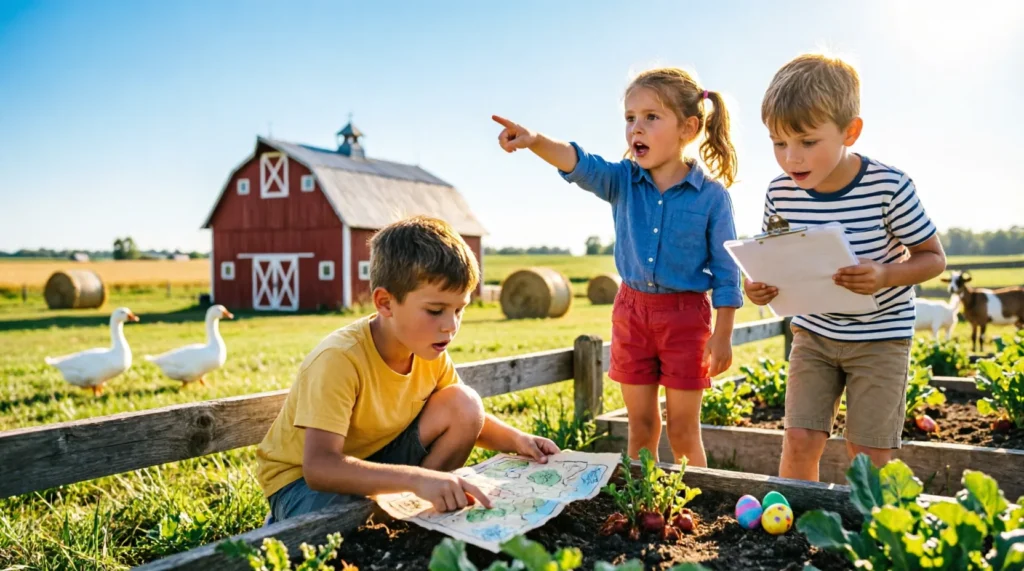
There is nothing quite like the chaos and joy of a barnyard adventure. Whether you are planning a birthday party at a local petting zoo or turning your backyard into a pretend pasture, these riddles add a layer of brain-teasing fun to the physical activity. This collection is designed specifically for young explorers who love animals, mud, and solving mysteries.
Top 5 Farm Scavenger Hunt Riddles
These five riddles are the absolute classics. They strike the perfect balance between being solvable for a six-year-old and entertaining enough to keep an eight-year-old engaged. Use these as the “key” clues that lead to the major prizes in your hunt.
I have a snout but I’m not a dog. I love to roll in the mud like a log. My tail is curly, my ears are big, And I dig up truffles while I dig. Answer: A pig
Field Note: When I run this one with mixed-age groups, the younger kids often shout “dog” immediately because of the snout clue. It is a great teaching moment about how different animals share similar features.
I give you milk in a glass so white, And chew on grass from morning till night. With spots of black or brown so deep, I moo aloud before I sleep. Answer: A cow
I wake you up before the sun, My crowing means the day’s begun. With feathers bright and comb so red, I strut around the barnyard shed. Answer: A rooster
Field Note: This is arguably the easiest riddle in the set. I usually save this for the very first clue to build confidence. If a child gets stuck here, they might feel discouraged for the harder ones later.
I have a mane but I’m not a lion, I carry riders without trying. With hooves that clip-clop on the stone, I pull the cart all on my own. Answer: A horse
I lay eggs in a nest of straw, The finest breakfast you ever saw. With feathers soft and beak so sharp, I cluck and scratch across the park. Answer: A hen
Easy Farm Riddles for Young Explorers
These riddles use simple rhyme schemes and obvious physical characteristics. They are perfect for children aged 4 to 6 who are just learning to associate sounds and shapes with animals.
I have long ears and hop around, I nibble carrots from the ground. My tail is fluffy, short, and white, I hide away when it gets bright. Answer: A rabbit
Field Note: This is a staple for spring-themed hunts. The “hide away” clue often leads kids to look under bushes or behind hay bales, which is exactly where you want them searching.
I am yellow and I say quack, I follow momma on her track. With webbed feet I swim in ponds, And eat the bugs and water fronds. Answer: A duck
I have a pouch upon my front, But I’m not from the Australian hunt. Wait, that’s wrong, let me correct, I’m a farm friend you must respect. I have wool and say “baa,” You’ll find me grazing near the barn door. Answer: A sheep
Field Note: I included a fake-out in the riddle above to test listening skills. Most kids will catch the error quickly, but it makes them pay closer attention to the final two lines.
I am small and I buzz by, Collecting nectar from flowers high. I make honey sweet and gold, A story of hard work often told. Answer: A bee
I guard the house with bark and bite, But on the farm, I herd with might. I chase the sheep and keep them close, I’m the farmer’s loyal host. Answer: A sheepdog
I live in a sty and I love the rain, Though mud is my favorite place to gain. I oink and squeal when I am fed, With a curly tail upon my head. Answer: A piglet
Hard Farm Riddles for Sharp Minds
These require a bit more lateral thinking. They are ideal for older children (ages 8-12) or for adding a challenge level to a mixed-age group. Do not expect instant answers here; these are designed to make them pause and think.
I have no voice, yet I tell the time, By stretching shadows in a line. I stand alone in fields so wide, With arms outstretched on every side. Birds fear me though I do not move, I wear a hat to prove my groove. Answer: A scarecrow
Field Note: This is genuinely tricky because it personifies an object. Children often guess “farmer” first because of the hat and arms, but the “no voice” and “birds fear me” clues point to the inanimate guardian.
I am not alive, but I grow. I don’t have lungs, but I need air. I don’t have a mouth, but water kills me. What am I? Answer: Fire (often found in a campfire pit on farms)
Field Note: This is a classic riddle structure adapted for the farm setting. It trips up many adults too. I only use this if there is a safe, supervised fire element or a lantern involved in the hunt.
I have cities, but no houses. I have mountains, but no trees. I have water, but no fish. What am I? Answer: A map
Field Note: In a scavenger hunt context, this riddle usually leads the kids to the master map or the next clue envelope taped to a fence post. It forces them to think about the tools of the hunt rather than the animals.
I speak without a mouth and hear without ears. I have no body, but I come alive with wind. On the farm, I echo off the silo walls. What am I? Answer: An echo
I can be cracked, I can be made, I can be told, I can be played. What am I? Answer: A joke (or a riddle!)
Field Note: This is a meta-riddle. It is fun to use as the final clue, implying that the “prize” is the laughter and fun they had during the game.
I have keys but open no locks. I have space but no room. You can enter, but not go outside. What am I? Answer: A keyboard (found in the farmhouse office)
Funny Farm Riddles
Humor helps lower the frustration barrier when a riddle is tough. These are silly, pun-heavy, and designed to get a giggle even if the answer is obvious.
What do you call a cow with no legs? Answer: Ground beef
What do you call a pig that does karate? Answer: A pork chop
Field Note: This one always gets a groan from parents and a roar of laughter from kids. It is essential for keeping the mood light when the hunt drags on.
Why did the chicken join a band? Answer: Because it already had the drumsticks!
What do you call a sheep with no legs? Answer: A cloud
Why did the farmer win an award? Answer: Because he was outstanding in his field!
Field Note: This is a classic pun. I use this as a reward clue—when they solve it, they get a small treat like a sticker or a piece of fruit.
What do you call a lazy kangaroo on a farm? Answer: A pouch potato
Why did the cow go to outer space? Answer: To see the moooon!
Tricky Animal Riddles
These riddles focus on specific behaviors or lesser-known facts about farm animals. They encourage kids to observe the animals closely if they are at a real farm.
I carry my home upon my back, Moving slowly on the track. I leave a silver trail behind, A slimy path for you to find. Answer: A snail
Field Note: This requires kids to look down, not up. It teaches them to scan the ground and the undersides of leaves, which is a crucial scavenger hunt skill.
I sleep hanging upside down, The quietest creature in town. I use sound to see my way, Hunting insects night and day. Answer: A bat
I have a long neck to reach the leaves, But I’m not on the farm, believe me. Wait, I’m a llama, yes that’s true, I spit at you if I’m mad at you. Answer: A llama
Field Note: Llamas are increasingly common on hobby farms. The “spit” clue is usually the giveaway, as it is their most famous (and notorious) trait.
I am black and white and loved by all, I waddle round and never fall. I slide on ice and swim in sea, But on a farm? Look closer at me. Actually, I’m not on the farm at all! This is a trick, you see. Answer: A penguin (not found on farms)
Field Note: This is a “gotcha” riddle. It tests whether the child is listening to the context or just matching keywords. It is important to explain gently that penguins live in the Southern Hemisphere, not on typical farms.
I have a shell but I’m not a turtle, I pinch with claws in the muddy hurdle. I walk sideways along the shore, But wait, I’m not on the farm floor. Answer: A crab (another trick question)
Short and Sweet Riddles
Sometimes you need a quick clue to bridge the gap between two major stations. These are one-liners that can be read and solved in seconds.
I say neigh. What am I? Answer: A horse
I say oink. What am I? Answer: A pig
I say baa. What am I? Answer: A sheep
I say cluck. What am I? Answer: A chicken
I say moo. What am I? Answer: A cow
I say quack. What am I? Answer: A duck
Field Note: While these seem too simple, they are excellent for very young children (ages 3-4) who are still developing language skills. They provide a quick win and keep the momentum going.
How to Use These Riddles
Integrating riddles into a physical activity requires some logistical planning. Here is how I structure my hunts to ensure maximum engagement and minimum chaos.
The Station Method Place each riddle at a specific location. The answer to the riddle tells the kids what animal statue or picture to find next. For example, if the answer is “cow,” they must run to the cow cutout to find the next envelope. This prevents everyone from bunching up at one spot.
The Puzzle Piece Approach Write each riddle on a separate card. When a child solves it, they get a puzzle piece. At the end of the hunt, they assemble the pieces to reveal the location of the final treasure. This works well for larger groups because it keeps them moving individually rather than as a pack.
Classroom Learning Teachers can use these riddles to teach animal habitats and sounds. After solving the riddle, ask the students to mimic the sound or describe what the animal eats. It turns a game into a mini-lesson on biology and agriculture.
According to Wikipedia, scavenging is a feeding behavior where organisms consume dead or decaying matter, but in human recreation, it has evolved into a game of searching and collecting. This recreational version taps into our natural instinct to explore and gather, making it highly engaging for children.
Frequently Asked Questions
What is the best age range for farm scavenger hunt riddles? These riddles are best suited for children aged 4 to 10. The “Easy” section works for preschoolers, while the “Hard” and “Tricky” sections provide enough challenge for elementary school students. For teenagers, you might need to add more complex logic puzzles or cryptic codes.
How do I make the riddles harder for older kids? To increase difficulty, remove the rhyming structure and use descriptive prose instead. You can also add red herrings—clues that lead to the wrong animal—or require them to solve a math problem based on the number of legs the animal has before they can move to the next station.
Can I use these riddles if I don’t live on a farm? Absolutely. You can create a “pretend farm” in your backyard, living room, or local park. Use printed pictures of animals, stuffed toys, or even drawings. The key is the theme, not the actual location. You can also adapt the riddles to include local wildlife if you are doing a nature hunt instead.
Why are riddles good for kids? Riddles promote critical thinking, vocabulary expansion, and lateral thinking. According to Wikipedia, riddles have been used throughout history as a form of entertainment and intellectual challenge. They encourage children to listen carefully, analyze language, and think beyond the literal meaning of words.

Patricia Sanchez is an expert in mathematical riddles and lateral thinking puzzles, bringing over a decade of experience to RiddlePlaza. With a dual degree in Mathematics and Psychology, Patricia is adept at creating brain teasers that challenge cognitive processing and numerical skills. Her fascination with puzzles was sparked by her early fascination with Sudoku and the strategic complexities of chess. In the realm of riddles, Patricia enjoys constructing scenarios that require readers to think outside the box, drawing upon her psychological insights to foster creative problem-solving. She is particularly known for her ability to fuse mathematical conundrums with a narrative flair, creating multi-layered puzzles that are both educational and engaging. Patricia is dedicated to integrating puzzles into educational frameworks, believing strongly in their capacity to sharpen young minds and enhance learning.