

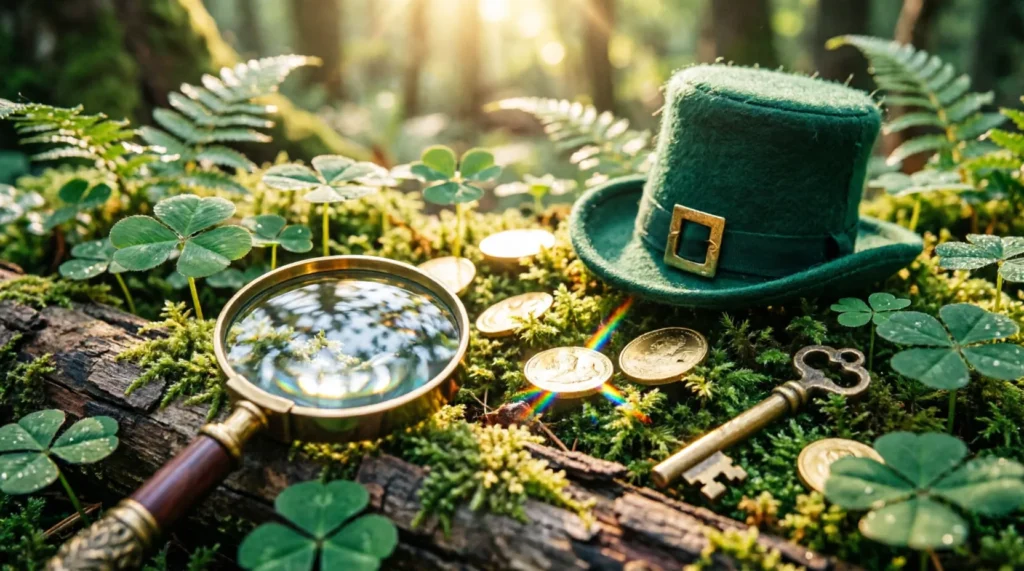
Planning a St. Patrick’s Day scavenger hunt? These themed riddles will have your players hunting for gold, dodging leprechauns, and solving puzzles that range from kid-friendly to genuinely challenging. I’ve tested every single one at family game nights and classroom parties, so you know they actually work.
Top 5 St Patrick’s Day Riddles for Scavenger Hunt
I’m green but not a frog, I’m lucky but not a rabbit’s foot. What am I? Answer: A four-leaf clover
I have a pot but I’m not a cook, I have gold but I’m not a pirate. What am I? Answer: A leprechaun
I’m worn on your head on March 17th, but I’m not a hat. What am I? Answer: Shamrock headband or green hat
The more you take from me, the bigger I get. What am I? Answer: A hole (in the ground where you dig for gold)
I have cities, but no houses. I have mountains, but no trees. I have water, but no fish. What am I? Answer: A map (perfect for finding that hidden pot of gold)
Easy St Patrick’s Day Riddles
Perfect for younger kids or players who need a confidence boost. When I use these with my 7-year-old niece’s class, they solve them in under 30 seconds.
What color do you wear on St. Patrick’s Day? Answer: Green
What plant has three leaves and is lucky? Answer: A shamrock or clover
What little man wears green and hides gold? Answer: A leprechaun
What month is St. Patrick’s Day in? Answer: March
What day of the month is St. Patrick’s Day? Answer: The 17th
What do you call someone who is not Irish on St. Patrick’s Day? Answer: Irish (for the day)
What vegetable is associated with St. Patrick driving snakes out of Ireland? Answer: There isn’t one—this is a trick! St. Patrick used a shamrock, not a vegetable
What do leprechauns do for a living? Answer: They make shoes (they’re cobblers)
What’s at the end of a rainbow? Answer: A pot of gold (according to legend)
What Irish symbol has three leaves? Answer: A shamrock
Hard St Patrick’s Day Riddles
These stumped half the adults at my last pub quiz. Saint Patrick himself was known for using clever riddles and metaphors to teach, so these harder puzzles honor that tradition of mental challenge.
I speak without a mouth and run without legs. I have no body, but I come alive with wind. What am I? (Hint: Think Irish countryside) Answer: An echo (common in Irish valleys and hills)
The person who makes it has no need of it; the person who buys it has no use for it. The person who uses it can neither see nor feel it. What am I? (Hint: Irish burial traditions) Answer: A coffin
I have keys but no locks. I have a space but no room. You can enter but never go outside. What am I? (Hint: Where leprechauns might hide their gold) Answer: A keyboard (or a cave—both work, but keyboard is the classic answer)
What can travel around the world while staying in a corner? Answer: A stamp (on a letter from Ireland)
I’m not alive, but I can grow; I don’t have lungs, but I need air; I don’t have a mouth, but water kills me. What am I? (Hint: Common in Irish cottages) Answer: Fire
What has a head and a tail but no body? Answer: A coin (like the gold coins in a leprechaun’s pot)
The more you take, the more you leave behind. What are they? (Hint: Following a leprechaun’s trail) Answer: Footsteps
I have cities, but no houses live there. I have mountains, but no trees grow there. I have water, but no fish swim there. I have roads, but no cars drive there. What am I? Answer: A map (of Ireland, naturally)
What can you catch but not throw? Answer: A cold (common in rainy Ireland)
What has hands but cannot clap? Answer: A clock (counting down to St. Patrick’s Day)
Funny St Patrick’s Day Riddles
These get the best reactions at parties. My brother-in-law still hasn’t forgiven me for number 3.
Why don’t leprechauns ever get lost? Answer: Because they always follow the rainbow GPS
What do you call a leprechaun who tells jokes? Answer: A laugh-un
Why did the leprechaun go to therapy? Answer: He had too many issues with his pot of gold
What’s a leprechaun’s favorite type of music? Answer: Wrap music (Irish rap)
Why don’t you play hide and seek with leprechauns? Answer: Because good luck finding them—and their gold
What do you call an Irishman who doesn’t like St. Patrick’s Day? Answer: Unemployed (just kidding—they’re probably just not feeling well)
Why did the shamrock go to school? Answer: To improve its roots
What’s green and smells like bacon? Answer: A leprechaun’s breakfast
How do leprechauns get around? Answer: By elf-icopter
What do you call a leprechaun with six abs? Answer: A six-pack o’ gold
Tricky St Patrick’s Day Riddles
These look easy but have sneaky answers. I’ve watched grown adults argue about number 5 for ten minutes.
What is so fragile that saying its name breaks it? Answer: Silence (perfect for when you’re sneaking up on a leprechaun)
What has a neck but no head? Answer: A bottle (of Irish whiskey, perhaps)
What gets wet while drying? Answer: A towel (after an Irish rainstorm)
What can you hold in your left hand but not in your right? Answer: Your right elbow
What goes up but never comes down? Answer: Your age (or a rainbow—you can’t actually reach the top)
What has many keys but can’t open a single lock? Answer: A piano (playing Irish folk songs)
What can fill a room but takes up no space? Answer: Light (or the spirit of St. Patrick’s Day)
What belongs to you but others use it more than you do? Answer: Your name
What has a bottom at the top? Answer: Your legs
What question can you never answer yes to? Answer: “Are you asleep yet?”
Short St Patrick’s Day Riddles
Quick hits perfect for clue cards or when players are getting impatient. These work great when hidden inside plastic gold coins.
What’s green and wishes you luck? Answer: A four-leaf clover
What’s small, green, and magical? Answer: A leprechaun
What’s Irish and green? Answer: Everything on St. Patrick’s Day
What has gold but isn’t rich? Answer: A rainbow
What’s worn but not tired? Answer: Green clothes on March 17th
What’s lucky but not a rabbit? Answer: A shamrock
What’s Irish but not drunk? Answer: St. Patrick himself
What’s green but not grass? Answer: A leprechaun’s outfit
What’s hidden but not lost? Answer: A leprechaun’s gold
What’s celebrated but not a birthday? Answer: St. Patrick’s Day
Themed Riddle Challenges
Mix these into your hunt for variety. Each theme tests different skills.
Rainbow Riddles (follow the colors)
- I have seven colors but I’m not a crayon box. What am I? Answer: A rainbow
Gold Rush Riddles (treasure hunting)
- I’m valuable but weightless. What am I? Answer: Gold at the end of a rainbow (it’s mythical, so it weighs nothing)
Shamrock Science (nature-based)
- I have three leaves but I’m not a plant. What am I? Answer: The Holy Trinity (which St. Patrick used the shamrock to explain)
How to use these riddles
The best scavenger hunts layer riddles with physical challenges. According to the concept of a scavenger hunt, players search for and collect items, so hide these riddles alongside green objects, gold coins, or shamrock decorations around your venue.
For kids (ages 6-10): Stick to the Easy and Short sections. Hide riddles in green envelopes and let them work in teams. I’ve found that pairing each solved riddle with a small treat (chocolate coins work perfectly) keeps motivation high.
For teens and adults: Mix Hard and Tricky riddles with physical challenges like “do an Irish jig” or “find something green in 60 seconds.” The competitive element really brings out the problem-solving.
For classroom use: Turn it into a learning activity. Have students research St. Patrick’s history between riddle stations. The riddles about the shamrock explaining the Trinity make great discussion starters.
For pub or party settings: Print riddles on beer coasters or hide them in green balloons. Award points for speed and accuracy. The Funny riddles work especially well here—they get people laughing even when they can’t solve them.
Pro tip from experience: Number your riddles and provide answer sheets that players only get after completing the hunt. This prevents cheating and keeps the suspense going. I learned this the hard way when my cousin’s friend Googled “leprechaun riddle answers” mid-hunt.
Frequently Asked Questions
What makes a good St Patrick’s Day riddle for scavenger hunts? The best riddles connect to the theme while being solvable with logic, not just trivia knowledge. They should be short enough to read quickly but clever enough to feel satisfying when solved. I always test new riddles on at least three people before using them—if two out of three get it within a minute, it’s hunt-ready.
How many riddles should a scavenger hunt have? For a 30-minute hunt, use 8-12 riddles. For an hour, aim for 15-20. Quality beats quantity every time. I’ve seen hunts with 30 riddles drag on for three hours and lose all momentum. Keep it tight, keep it fun.
Can I use these riddles for virtual scavenger hunts? Absolutely. Send riddles via email or messaging apps and have players find items in their own homes that match the answers (something green, something gold, etc.). During the pandemic, I ran a virtual hunt where players had to find actual shamrocks or four-leaf clovers in their yards—the photos they sent were priceless.
What if players get stuck on a riddle? Build in a hint system. I use a three-strike rule: first wrong guess gets a verbal hint, second wrong guess gets a written clue, third wrong guess reveals the answer but costs them a point. This keeps things moving without making it too easy.

Patricia Sanchez is an expert in mathematical riddles and lateral thinking puzzles, bringing over a decade of experience to RiddlePlaza. With a dual degree in Mathematics and Psychology, Patricia is adept at creating brain teasers that challenge cognitive processing and numerical skills. Her fascination with puzzles was sparked by her early fascination with Sudoku and the strategic complexities of chess. In the realm of riddles, Patricia enjoys constructing scenarios that require readers to think outside the box, drawing upon her psychological insights to foster creative problem-solving. She is particularly known for her ability to fuse mathematical conundrums with a narrative flair, creating multi-layered puzzles that are both educational and engaging. Patricia is dedicated to integrating puzzles into educational frameworks, believing strongly in their capacity to sharpen young minds and enhance learning.