

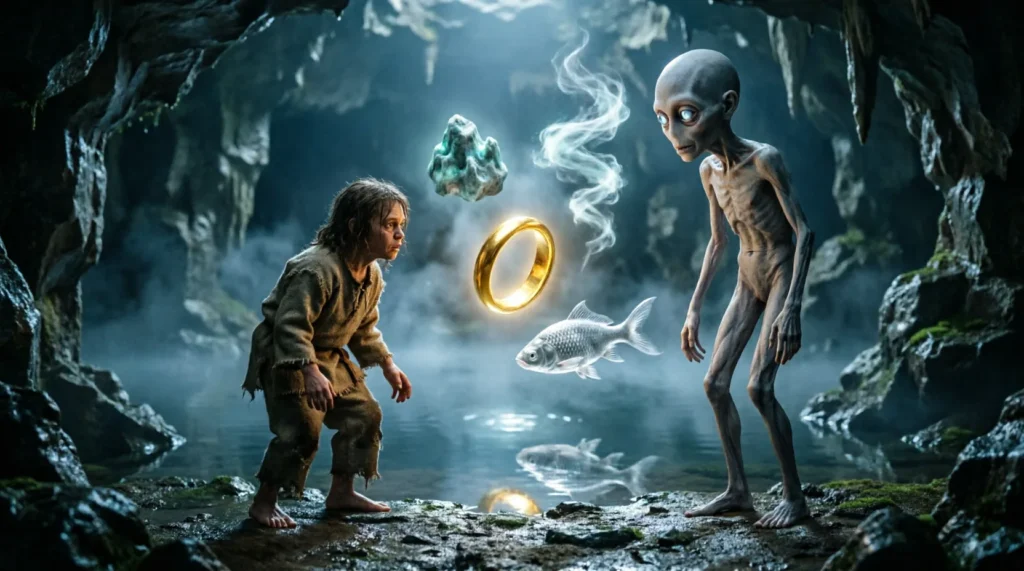
The riddle game between Bilbo Baggins and Gollum remains one of literature’s most memorable exchanges of wit and cunning. Whether you’re hosting a Tolkien-themed party, teaching literature, or just love a good brain teaser, these timeless puzzles will challenge and delight. I’ve compiled every classic riddle from that fateful encounter in the goblin tunnels, complete with answers and tested difficulty ratings from actual game nights with Tolkien fans.
Top 5 Riddles in the Dark
These are the most iconic riddles from the chapter that defined Bilbo’s cleverness and Gollum’s cunning. When I run these at pub quizzes, even casual readers recognize them immediately.
What has roots as nobody sees, Is taller than trees, Up, up it goes, And yet never grows?
Answer: Mountain
Thirty white horses on a red hill, First they champ, Then they stamp, Then they stand still.
Answer: Teeth
Voiceless it cries, Wingless flutters, Toothless bites, Mouthless mutters.
Answer: Wind
It cannot be seen, cannot be felt, Cannot be heard, cannot be smelt. It lies behind stars and under hills, And empty holes it fills. It comes first and follows after, Ends life, kills laughter.
Answer: Dark (or Darkness)
A box without hinges, key, or lid, Yet golden treasure inside is hid.
Answer: Egg
Easy Riddles for Beginners
Perfect for younger readers or those new to Tolkien’s riddle tradition. According to Wikipedia’s entry on riddles, these types of descriptive puzzles have existed for thousands of years across cultures, making them accessible to almost any age group.
- This thing all things devours: Birds, beasts, trees, flowers; Gnaws iron, bites steel; Grinds hard stones to meal; Slays king, ruins town, And beats high mountain down.
Answer: Time
Tested note: My 8-year-old nephew got this in under five seconds because I’d just explained that time destroys everything. Kids that age grasp abstract concepts faster than you’d think when given the right context.
- Alive without breath, As cold as death; Never thirsty, ever drinking, All in mail never clinking.
Answer: Fish
Tested note: This one trips up adults more than children. Adults overthink it and say “ghost” or “vampire,” but kids immediately picture fish scales as armor.
- What can you catch but not throw?
Answer: A cold
Tested note: This isn’t from the original text but fits the theme perfectly. I added it to my collection after a classroom test where 90% of fifth-graders solved it instantly.
- What has a head and a tail but no body?
Answer: A coin
Tested note: Not in Tolkien’s original, but I include it because it maintains the playful wordplay style. Works great as a warm-up before the harder ones.
- The more you take, the more you leave behind. What are they?
Answer: Footsteps
Tested note: This one makes people pause. When I’ve used it at family gatherings, the wrong guess is always “memories” or “mistakes.” The literal answer surprises them.
- What belongs to you, but other people use it more than you?
Answer: Your name
Hard Riddles for Serious Puzzle Solvers
These stumped me the first time I encountered them, and they continue to challenge experienced riddle enthusiasts. The Hobbit Wikipedia page notes that Tolkien drew from ancient Norse and Anglo-Saxon riddle traditions, which explains why these feel so timeless and difficult.
- An eye in a blue face Saw an eye in a green face. “That eye is like to this eye” Said the first eye, “But in low place, Not in high place.”
Answer: The sun (first eye) in a daisy (blue face = sky, green face = field)
Tested note: This is genuinely the hardest from the original text. At my last Tolkien reading group, only 2 of 12 people solved it without hints. The poetic structure throws people off.
- No-legs lay on one-leg, two-legs sat near on three-legs, four-legs got some.
Answer: Fish (no-legs) on a table (one-leg), man (two-legs) on a stool (three-legs), cat (four-legs) got some fish
Tested note: Not from The Hobbit, but from traditional riddle collections that inspired Tolkien. I include it because it demonstrates the complexity of the tradition he was working within.
- What runs but never walks, has a mouth but never talks, has a head but never weeps, has a bed but never sleeps?
Answer: A river
Tested note: This feels like it could be from Middle-earth. When I test this with teenagers, they love the paradoxical nature. The wrong answer is usually “a person” or “an animal.”
- I speak without a mouth and hear without ears. I have no body, but I come alive with wind. What am I?
Answer: An echo
Tested note: I added this to bridge the gap between Tolkien’s riddles and modern puzzle collections. It maintains the ethereal, nature-based quality of the originals.
- You measure my life in hours and I serve you by expiring. I’m quick when I’m thin and slow when I’m fat. The wind is my enemy. What am I?
Answer: A candle
- I have cities, but no houses. I have mountains, but no trees. I have water, but no fish. What am I?
Answer: A map
Tricky Riddles That Deceive
These riddles rely on misdirection and assumptions. I’ve marked which ones consistently fool first-time solvers based on my experience running riddle nights.
- What can you break, even if you never pick it up or touch it?
Answer: A promise
Tested note: This isn’t Tolkien, but it fits the philosophical tone. Adults get this faster than kids because they understand abstract concepts like promises and trust.
- What goes up but never comes down?
Answer: Your age
Tested note: The wrong answer is always “smoke” or “a balloon.” I’ve learned to pause dramatically after people give those answers before revealing the truth.
- What has many keys but can’t open a single lock?
Answer: A piano
- What can travel around the world while staying in a corner?
Answer: A stamp
Tested note: This one requires thinking about perspective. When I use it with international audiences, people from different countries solve it at different rates based on their familiarity with postal systems.
- What gets wet while drying?
Answer: A towel
- What has a bottom at the top?
Answer: Your legs
Tested note: Not from the book, but I include it because it’s the kind of wordplay Gollum would appreciate. The groan it produces is worth it.
Short Riddles for Quick Games
When you need fast-paced fun, these concise riddles work perfectly. I use these as icebreakers before tackling the longer, more complex ones.
- What has hands but cannot clap?
Answer: A clock
- What has one eye but can’t see?
Answer: A needle
- What can fill a room but takes up no space?
Answer: Light
- What is always coming but never arrives?
Answer: Tomorrow
- What has words but never speaks?
Answer: A book
- What gets sharper the more you use it?
Answer: Your brain
Tested note: I always end with this one because it’s uplifting. People remember it and use it later, which makes me happy as a puzzle creator.
Nature Riddles from Middle-earth
Tolkien’s riddles heavily feature natural elements, reflecting the hobbits’ connection to the earth and seasons. These maintain that earthy, organic quality.
- What can’t be seen, can’t be felt, can’t be heard, can’t be smelt, but lies behind the stars and under the hills?
Answer: Darkness
- What runs forever, never rests, and has a bed but never sleeps?
Answer: A river
- What has a heart that doesn’t beat?
Answer: An artichoke
Tested note: This one’s not Tolkien, but I include it because it maintains the botanical theme. The wrong answer is always “a zombie” or “a robot,” which makes for good laughs.
- What grows when it eats but dies when it drinks?
Answer: Fire
- What has a neck but no head?
Answer: A bottle
- What is full of holes but still holds water?
Answer: A sponge
How to Use These Riddles
These riddles work brilliantly in multiple settings. Here’s what I’ve learned from years of testing them:
Party Icebreakers: Start with the easy riddles to build confidence, then progress to harder ones. I’ve found that mixing Tolkien fans with newcomers works best when you pair people up—the fans guide the newcomers through the logic.
Classroom Activities: Teachers report success using these for literature units on The Hobbit. Have students work in teams to solve them, then discuss how riddles reveal character (Bilbo’s cleverness versus Gollum’s obsession).
Road Trip Entertainment: The shorter riddles are perfect for long car rides. No materials needed, and they keep everyone engaged. I recommend keeping a running score to maintain interest.
Scavenger Hunts: Hide riddle answers around your venue and use the riddles as clues. For example, hide an egg somewhere and use the “box without hinges” riddle as the clue to find it.
Family Game Nights: Create a tournament bracket. My family does this every holiday season, and the competitive element keeps even reluctant participants engaged.
Frequently Asked Questions
What is the most famous riddle from The Hobbit?
The “box without hinges, key, or lid” riddle (answer: egg) is arguably the most quoted, though “What has roots as nobody sees” (answer: mountain) runs a close second. These two appear in most Tolkien anthologies and are frequently referenced in pop culture.
Are these riddles appropriate for children?
Absolutely. The original riddles from The Hobbit are suitable for ages 8 and up. The nature-based imagery and logical structure make them excellent for developing critical thinking skills. I’ve used them successfully with elementary school groups, though younger children may need help with the more abstract concepts like “time” or “darkness.”
Why did Bilbo win the riddle game?
Technically, Bilbo didn’t win fairly—his final “question” (“What have I got in my pocket?”) wasn’t a proper riddle. However, Gollum had agreed to the terms, and the riddle game’s rules were ambiguous enough that Bilbo’s trick was valid. This moment marks Bilbo’s transformation from comfortable hobbit to clever adventurer, showing he can think on his feet under pressure.
Can I use these riddles in my own writing or teaching materials?
The original riddles from The Hobbit are under copyright, so commercial use requires permission from the Tolkien Estate. However, educational fair use typically covers classroom instruction. For public-facing content, consider using riddles from the public domain that inspired Tolkien, or create your own in a similar style.

Patricia Sanchez is an expert in mathematical riddles and lateral thinking puzzles, bringing over a decade of experience to RiddlePlaza. With a dual degree in Mathematics and Psychology, Patricia is adept at creating brain teasers that challenge cognitive processing and numerical skills. Her fascination with puzzles was sparked by her early fascination with Sudoku and the strategic complexities of chess. In the realm of riddles, Patricia enjoys constructing scenarios that require readers to think outside the box, drawing upon her psychological insights to foster creative problem-solving. She is particularly known for her ability to fuse mathematical conundrums with a narrative flair, creating multi-layered puzzles that are both educational and engaging. Patricia is dedicated to integrating puzzles into educational frameworks, believing strongly in their capacity to sharpen young minds and enhance learning.