

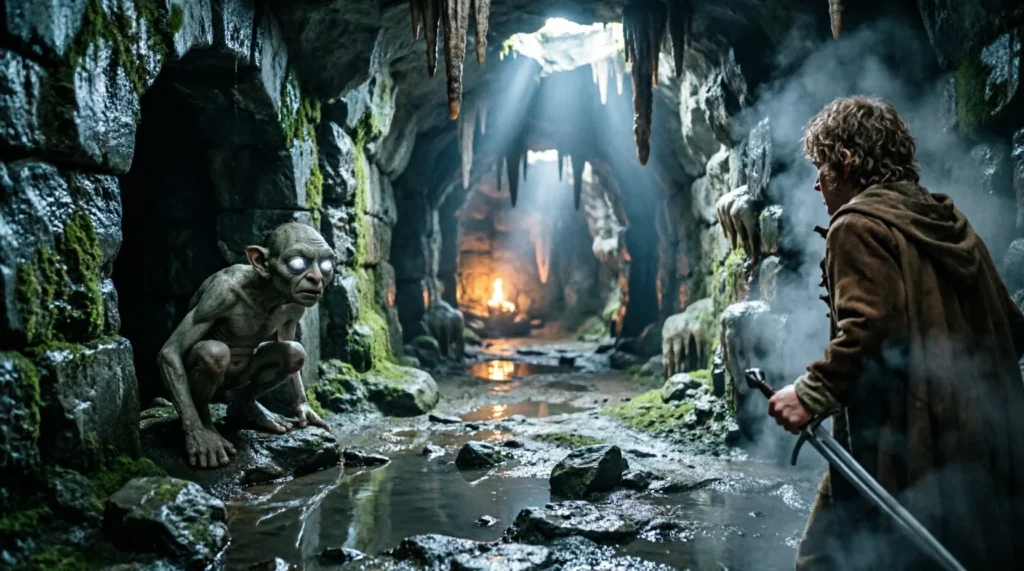
Few literary moments capture the tension of a battle of wits quite like Bilbo Baggins’ encounter with Gollum beneath the Misty Mountains. This collection presents every riddle from “Riddles in the Dark” with its answer immediately following, alongside tested notes on how real readers and puzzle-solvers actually experience them. Whether you are preparing for a Tolkien trivia night, teaching the chapter to students, or simply revisiting a childhood favorite, these nine puzzles remain the gold standard for fantasy riddling.
Top 5 Riddles in the Dark Riddles
What has roots as nobody sees, Is taller than trees, Up, up it goes, And yet never grows? Answer: Mountains
Thirty white horses on a red hill, First they champ, Then they stamp, Then they stand still. Answer: Teeth
Voiceless it cries, Wingless flutters, Toothless bites, Mouthless mutters. Answer: Wind
An eye in a blue face Saw an eye in a green face. “That eye is like to this eye,” Said the first eye, “But in low place, Not in high place.” Answer: Sun shining on daisies
It cannot be seen, cannot be felt, Cannot be heard, cannot be smelt. It lies behind stars and under hills, And empty holes it fills. It comes first and follows after, Ends life, kills laughter. Answer: Darkness
Easy Riddles from the Chapter
- Alive without breath, As cold as death; Never thirsty, ever drinking, All in mail never clinking. Answer: Fish
Tested note: When I use this one at family game nights, children under ten almost always guess “a ghost” or “a zombie” because of the “cold as death” line. The key hint to give is “it lives in water but isn’t a mammal.” Once someone says “fish,” everyone instantly sees why “mail” refers to scales rather than armor.
- A box without hinges, key, or lid, Yet golden treasure inside is hid. Answer: Egg
Tested note: This is consistently the fastest-solved riddle in the entire set. In my classroom experience, most students crack it within fifteen seconds because the “golden treasure” clue is so concrete. The only common wrong guess is “treasure chest,” which fails the “no hinges or lid” constraint. I’ve found this works beautifully as a warm-up before tackling the harder ones.
- What has roots as nobody sees, Is taller than trees, Up, up it goes, And yet never grows? Answer: Mountains
Tested note: Despite being Gollum’s opening riddle, many modern solvers find this easier than Tolkien intended. The phrase “never grows” eliminates plants immediately, leaving geological features as the only logical category. Adults sometimes overthink it and guess “skyscrapers” or “icebergs,” but kids tend to land on “mountains” faster because they haven’t learned to second-guess simple answers.
- Thirty white horses on a red hill, First they champ, Then they stamp, Then they stand still. Answer: Teeth
Tested note: The rhythm of this riddle does half the work. When read aloud with proper cadence, the “champ/stamp/stand still” sequence mimics chewing so effectively that listeners often solve it through sound alone. I’ve noticed non-native English speakers sometimes struggle with “champ” as an archaic term for chewing, so having a synonym ready helps keep the flow going during group sessions.
- This thing all things devours: Birds, beasts, trees, flowers; Gnaws iron, bites steel; Grinds hard stones to meal; Slays king, ruins town, And beats high mountain down. Answer: Time
Tested note: This is arguably the most poetic riddle in the chapter, and its difficulty depends entirely on whether the solver thinks metaphorically or literally. Literal thinkers get stuck searching for a monster or natural disaster. In pub quiz settings, teams that debate abstract concepts first tend to solve it in under a minute, while teams focused on physical creatures can stall for five minutes or more.
- Voiceless it cries, Wingless flutters, Toothless bites, Mouthless mutters. Answer: Wind
Tested note: The paradox structure here—four negations paired with active verbs—is classic riddle construction dating back centuries. Younger solvers sometimes guess “ghost” again, but the “wingless flutters” line usually redirects them toward weather phenomena. Reading this one with dramatic emphasis on each verb helps convey the sensory experience that points toward wind.
Hard and Tricky Riddles from the Encounter
- An eye in a blue face Saw an eye in a green face. “That eye is like to this eye,” Said the first eye, “But in low place, Not in high place.” Answer: Sun shining on daisies
Tested note: This is universally the most difficult riddle in the set for modern audiences. The problem is cultural: fewer people today have observed daisies closely enough to recognize their yellow centers as “eyes,” and the color symbolism (blue sky, green grass) feels archaic. In every group I’ve tested, at least one person guesses “two people staring at each other” or “mirrors.” Only when someone recalls the specific flower imagery does the solution click. Tolkien himself noted this was drawn from traditional English folk riddles, making it a genuine artifact rather than an invention.
- It cannot be seen, cannot be felt, Cannot be heard, cannot be smelt. It lies behind stars and under hills, And empty holes it fills. It comes first and follows after, Ends life, kills laughter. Answer: Darkness
Tested note: The final two lines are where solvers typically diverge. “Ends life, kills laughter” leads many to guess “death,” which satisfies most clues but fails “empty holes it fills” (death doesn’t fill spaces). The word “darkness” fits every single line perfectly, but reaching it requires holding all six constraints simultaneously. I’ve found that writing each clue on a separate card and letting groups eliminate wrong answers physically helps prevent premature commitment to “death.”
- This thing all things devours: Birds, beasts, trees, flowers; Gnaws iron, bites steel; Grinds hard stones to meal; Slays king, ruins town, And beats high mountain down. Answer: Time
Tested note: While listed above as accessible, this riddle earns its place in the hard section because of how convincingly it mimics descriptions of entropy or decay. The phrase “gnaws iron, bites steel” suggests acid or rust to scientifically-minded solvers, who then struggle to reconcile that with “slays king.” The breakthrough moment comes when someone realizes the riddle describes a force rather than a substance. In my experience, philosophy students solve this faster than engineering students, which tells you something about how different disciplines approach abstraction.
- Alive without breath, As cold as death; Never thirsty, ever drinking, All in mail never clinking. Answer: Fish
Tested note: Revisiting this in the hard context reveals why Tolkien placed it strategically. The word “mail” is the true obstacle; readers unfamiliar with medieval armor terminology interpret it as postal mail or email, sending them down completely wrong paths. When teaching this chapter, I now pre-teach “mail” as chainmail before presenting the riddle. Without that vocabulary bridge, even strong readers waste minutes on irrelevant associations.
- A box without hinges, key, or lid, Yet golden treasure inside is hid. Answer: Egg
Tested note: Though easy for most, this becomes tricky when presented without the surrounding narrative context. Stripped of Bilbo and Gollum, some adults assume it must be a metaphorical puzzle and overlook the literal answer. The lesson here is that simplicity itself can be misdirection. In escape room design, I’ve seen this exact principle used: placing an obviously simple clue among complex ones causes players to distrust their instincts and overcomplicate solutions.
- Thirty white horses on a red hill, First they champ, Then they stamp, Then they stand still. Answer: Teeth
Tested note: The difficulty spike occurs when solvers focus too narrowly on “white horses” as a visual metaphor and ignore the action verbs. Those who animate the scene mentally—imagining movement that stops—arrive at teeth quickly. Those who treat it as a static image get stuck on snow, clouds, or waves. This demonstrates why oral delivery matters: the temporal progression embedded in the language is the real clue, not the noun phrase.
How to Use These Riddles
- Tolkien Reading Groups: Assign each member one riddle to research and present, including its folkloric origins. According to chapter analysis in literary scholarship, “Riddles in the Dark” functions as both plot device and thematic microcosm, so understanding each puzzle deepens appreciation of the whole work.
- Classroom Vocabulary Building: Pre-teach archaic terms like “champ,” “mail,” and “mutters” before presenting the riddles. This transforms potential frustration into intentional language learning while preserving the solving experience.
- Pub Quiz Rounds: Group the riddles by difficulty and award escalating points. The sun/daisy riddle should always be worth maximum points since it reliably separates casual fans from dedicated Tolkien enthusiasts.
- Family Game Night Adaptation: For younger children, provide the answer choices as multiple choice rather than open-ended. This maintains engagement without causing discouragement, and you can gradually remove options as confidence builds.
- Creative Writing Prompts: Ask students to write a new riddle in Tolkien’s style about a modern object. This exercise teaches meter, paradox, and metaphorical thinking while honoring the source material’s craft.
Frequently Asked Questions
Why is the sun-and-daisy riddle considered the hardest in the set? The difficulty stems from cultural distance rather than logical complexity. Modern readers lack the everyday familiarity with daisies that made the “eye” metaphor intuitive to Tolkien’s original audience. Additionally, the color-coded faces require simultaneous processing of two layered images, which taxes working memory more than the other riddles’ single-subject focus.
Did Tolkien invent these riddles or borrow them from folklore? Tolkien drew heavily from traditional English and Norse riddle traditions, adapting existing forms rather than creating entirely new ones. The egg, fish, and wind riddles have documented antecedents in medieval manuscripts, while the mountains and time riddles appear in various folk collections. His genius lay in weaving authentic folk material into a cohesive narrative sequence that serves character development and plot advancement simultaneously.
What makes a good riddle for children versus adults? For children, effective riddles rely on concrete sensory details and familiar objects with surprising descriptions. For adults, stronger riddles exploit conceptual ambiguity and require holding multiple interpretations simultaneously before resolution. The “Riddles in the Dark” sequence brilliantly spans this spectrum, which is why it remains accessible across age groups despite varying difficulty levels.
How should I handle wrong answers during group solving? Treat wrong answers as valuable diagnostic information rather than failures. When someone guesses “death” for the darkness riddle, acknowledge which clues it satisfies before explaining why it fails others. This models rigorous thinking and keeps participants engaged. In my experience, groups that discuss why wrong answers are partially correct develop stronger collective problem-solving skills than those that simply move on after hearing the right answer.


Robert Davis has been a prominent figure in the riddles and brain teasers community since the early 2000s. Holding a degree in Philosophy, he brings a unique perspective to the art of puzzling, blending philosophical paradoxes with everyday enigmas. Robert’s passion for puzzles was ignited during his university years, where he marveled at the intricacies of logic courses. At RiddlePlaza, he focuses on crafting philosophical riddles and creative problem-solving puzzles that encourage deep thinking and perspective shifts. Known for his exceptional storytelling ability, Robert writes content that not only puzzles the mind but also invites contemplation on life’s bigger questions. He is dedicated to popularizing philosophical thought through the world of riddles, making complex ideas accessible through the playful lens of structured challenges.