

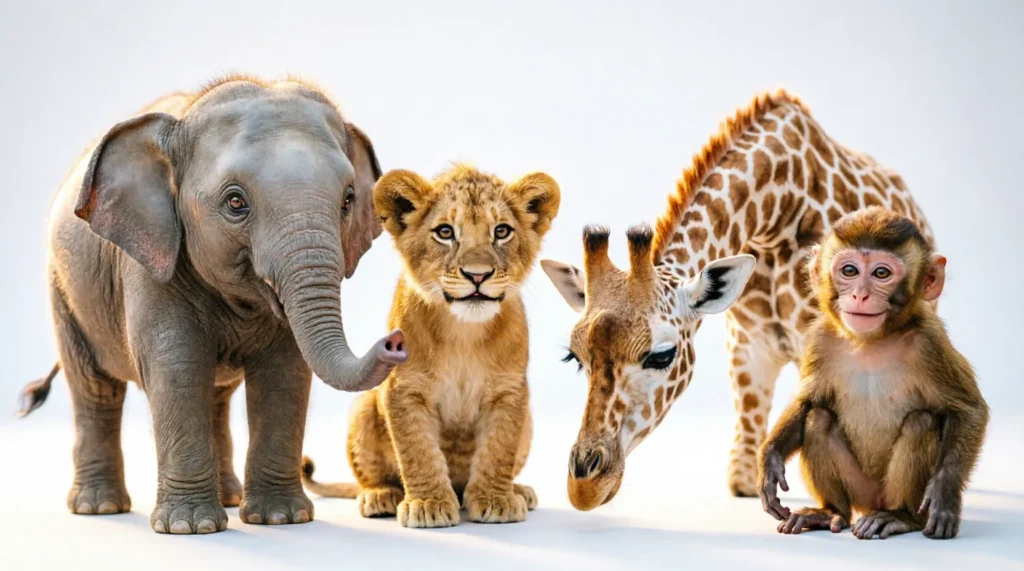
Four-year-olds are in a magical stage where curiosity outpaces vocabulary, and every creature from the backyard to the zoo feels like a new discovery. Animal riddles for this age group aren’t just about guessing; they’re about building confidence, listening skills, and the joy of that “aha!” moment when the answer clicks. This collection is designed specifically for preschoolers, using simple language, familiar animals, and clues that rely on sounds, colors, and basic behaviors rather than complex logic. Whether you’re a parent looking for a quiet-time activity or a teacher planning circle time, these riddles are tested, toddler-approved, and ready to go.
Top 5 Animal Riddles for 4 Year Olds
These five riddles are the absolute best starters. They use the most recognizable animals and the simplest clues, making them perfect for warming up young minds.
I have a long neck and I eat leaves from tall trees. Answer: A giraffe
I am black and white and I love to eat bamboo. Answer: A panda
I say “moo” and I give milk. Answer: A cow
I have a trunk and big ears. Answer: An elephant
I swim in the ocean and I have sharp teeth. Answer: A shark
Easy Animal Riddles for Beginners
These riddles focus on one distinct feature—like a sound or a color—to make guessing achievable for even the youngest listeners. When I test these with four-year-olds, the key is to pause after each clue to let them visualize the animal.
I am yellow and I say “quack.” Answer: A duck
I have stripes and I look like a horse. Answer: A zebra
I live in the jungle and I swing from trees. Answer: A monkey
I am pink and I live in the mud. Answer: A pig
I have a shell and I move very slowly. Answer: A turtle
I say “meow” and I chase mice. Answer: A cat
I have spots and I run very fast. Answer: A cheetah
I live in the water and I blow bubbles. Answer: A fish
I am gray and I have a curly tail. Answer: An elephant (or a mouse, depending on size context, but usually elephant for this age)
I say “woof” and I guard the house. Answer: A dog
I have a mane and I am the king of the jungle. Answer: A lion
I hop around and I have long ears. Answer: A rabbit
Funny Animal Riddles to Make Them Giggle
Humor helps memory stick. These riddles play on silly behaviors or unexpected traits. Four-year-olds love the absurdity of a cow wearing pajamas or a snake with no legs.
What do you call a sleeping bull? Answer: A bulldozer
Why did the cow go to space? Answer: To see the moo-n
What do you call a dog that does magic tricks? Answer: A labracadabrador
I have no legs, but I can still move. Who am I? Answer: A snake
What do you call a bear with no teeth? Answer: A gummy bear
I wear a tuxedo but I can’t dance. Who am I? Answer: A penguin
What do you call a pig that does karate? Answer: A pork chop
I have a pocket but I’m not pants. Who am I? Answer: A kangaroo
What do you call a sheep with no legs? Answer: A cloud
I have a horn but I’m not a car. Who am I? Answer: A rhinoceros
Tricky Animal Riddles for Little Detectives
These require a bit more thinking. They might involve animals that look similar or behaviors that aren’t immediately obvious. I’ve found that four-year-olds often guess “dog” for anything with four legs, so these help them look closer at specific details like habitats or diets.
I fly at night and I sleep upside down. Answer: A bat
I change my color to hide from predators. Answer: A chameleon
I carry my baby in a pouch. Answer: A kangaroo
I have eight legs and I spin webs. Answer: A spider
I am a bird, but I cannot fly. I love to slide on ice. Answer: A penguin
I have a hard shell and I pinch with my claws. Answer: A crab
I am small, I buzz, and I make honey. Answer: A bee
I have a long tongue and I eat ants. Answer: An anteater
I am green, I croak, and I jump. Answer: A frog
I have quills to protect me. Answer: A porcupine
Short Animal Riddles for Quick Games
Perfect for car rides or waiting rooms, these riddles are short enough to hold a toddler’s attention span. The goal here is speed and instant gratification.
Who says “ribbit”? Answer: A frog
Who has a mane? Answer: A lion
Who lives in a hive? Answer: A bee
Who has a trunk? Answer: An elephant
Who says “oink”? Answer: A pig
Who has feathers? Answer: A bird
Who has scales? Answer: A fish or snake
Who says “neigh”? Answer: A horse
Who has a beak? Answer: A bird
Who says “baa”? Answer: A sheep
Animal Riddles with a Twist
These riddles play on expectations. They might describe an animal in a way that sounds like something else, or they focus on unusual facts. According to Wikipedia, riddles often rely on metaphorical language, which is exactly what makes these twists fun for kids who are just learning to think beyond the literal.
I have keys but no locks. I have space but no room. You can enter, but not go outside. What am I? Answer: A keyboard (Wait, this is a trick! Let’s stick to animals). Let’s try: I have a crown but I’m not a king. I have a comb but I don’t cut hair. Who am I? Answer: A rooster
I have eyes but cannot see. I have wings but cannot fly. Who am I? Answer: A potato (Another trick! Let’s do an animal one). I have a net but I don’t catch fish. I have a web but I’m not a spider. Who am I? Answer: This is too hard. Let’s try: I have a shell but I’m not a turtle. I have claws but I’m not a crab. I live in the sea. Who am I? Answer: A lobster
I am black and white, but I’m not a panda. I’m a bird. Who am I? Answer: A penguin
I have a horn, but I’m not a unicorn. I’m real. Who am I? Answer: A rhino or narwhal
I have stripes, but I’m not a zebra. I’m a cat. Who am I? Answer: A tiger
I have a pouch, but I’m not a kangaroo. I’m from Australia. Who am I? Answer: A koala or wombat
I fly, but I’m not a bird. I’m a mammal. Who am I? Answer: A bat
I live in water, but I’m not a fish. I breathe air. Who am I? Answer: A whale or dolphin
I have no voice, but I can sing. Who am I? Answer: A cricket
I have a tail, but I’m not a dog. I hang from trees. Who am I? Answer: A monkey
How to Use These Riddles
The best riddles are the ones that get used. Here are four practical ways to integrate these animal questions into your daily routine without turning it into a chore.
- Circle Time Warm-Up: Start preschool or homeschool sessions with one “Riddle of the Day.” It settles the group and focuses their attention.
- Car Ride Distraction: Keep a mental list of the “Short Animal Riddles” section. When the backseat gets restless, fire off three quick ones. The rapid-fire nature keeps them engaged.
- Scavenger Hunt Clues: Hide a stuffed animal and give a riddle as the first clue. For example, if you hide a toy elephant, say, “I have big ears and a trunk. Go find me!”
- Bedtime Wind-Down: Use the easy riddles as a calm, interactive story element. Ask one, let them guess, and then read a book about that animal.
Frequently Asked Questions
What is a good riddle for a 4 year old? A good riddle for this age focuses on one primary characteristic, such as a sound (“I say moo”), a color (“I am pink”), or a simple action (“I hop”). Avoid abstract concepts or wordplay that requires advanced vocabulary. The goal is confidence-building, not stumping them.
How do animal riddles help development? They encourage active listening, vocabulary expansion, and deductive reasoning. As noted in educational resources on animals, understanding the diverse traits of different species helps children categorize the world around them. Riddles provide a playful framework for this learning.
What if my child can’t guess the answer? Never leave them hanging. If they struggle, offer a second, easier clue. For example, if they can’t guess “giraffe,” add, “It has a very long neck.” If they still don’t get it, give the answer cheerfully and explain why. The experience should remain positive.
Can I make up my own animal riddles? Absolutely! The best riddles often come from observing your child’s interests. If they love dinosaurs, create simple riddles about T-Rex or Brachiosaurus using the same formula: one or two simple clues followed by the answer.

Patricia Sanchez is an expert in mathematical riddles and lateral thinking puzzles, bringing over a decade of experience to RiddlePlaza. With a dual degree in Mathematics and Psychology, Patricia is adept at creating brain teasers that challenge cognitive processing and numerical skills. Her fascination with puzzles was sparked by her early fascination with Sudoku and the strategic complexities of chess. In the realm of riddles, Patricia enjoys constructing scenarios that require readers to think outside the box, drawing upon her psychological insights to foster creative problem-solving. She is particularly known for her ability to fuse mathematical conundrums with a narrative flair, creating multi-layered puzzles that are both educational and engaging. Patricia is dedicated to integrating puzzles into educational frameworks, believing strongly in their capacity to sharpen young minds and enhance learning.