

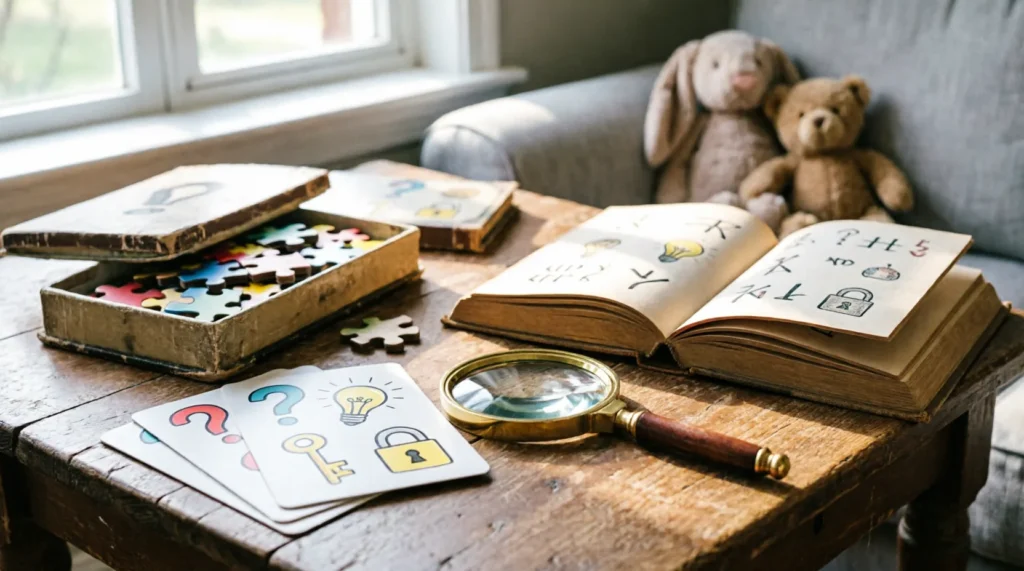
Riddles have been a staple of human entertainment for centuries, bridging generations through the simple joy of puzzling over words. This collection brings together the most enduring classic riddles with answers for kids, perfect for sparking curiosity and laughter around the dinner table or in the classroom. Whether you are a parent looking to engage your children or a teacher seeking a brain-teasing break, these timeless puzzles offer fun without screens.
Top 5 Classic Riddles for Kids
These five riddles represent the gold standard of children’s puzzles. They are widely recognized, easy to understand, and provide that satisfying “aha!” moment when the answer clicks.
I have a neck but no head. I have two arms but no hands. What am I? Answer: A shirt
What has to be broken before you can use it? Answer: An egg
I’m tall when I’m young, and I’m short when I’m old. What am I? Answer: A candle
What month of the year has 28 days? Answer: All of them
What is full of holes but still holds water? Answer: A sponge
Easy Warm-Up Riddles
Starting with simpler puzzles helps build confidence, especially for younger children who are just getting used to the logic of riddles. These rely on straightforward observations about everyday objects.
What has keys but can’t open locks? Answer: A piano
What has one eye but can’t see? Answer: A needle
What goes up but never comes down? Answer: Your age
What has many teeth but cannot bite? Answer: A comb
What gets wet while drying? Answer: A towel
What has a bottom at the top? Answer: Your legs
What belongs to you but is used more by others? Answer: Your name
What has a head and a tail but no body? Answer: A coin
What room do ghosts avoid? Answer: The living room
What can you catch but not throw? Answer: A cold
When I test these with first-graders, “Your age” is usually the quickest solve because they celebrate birthdays annually. However, “A coin” often trips them up because they visualize a snake or a worm instead of the object’s physical structure.
Tricky Wordplay Riddles
Wordplay riddles rely on double meanings and linguistic tricks. According to Wikipedia, riddles often exploit ambiguity in language to misdirect the solver. These require kids to listen carefully to every word rather than jumping to conclusions.
What has a bed but never sleeps, and a mouth but never eats? Answer: A river
What runs all around a backyard yet never moves? Answer: A fence
What can travel all around the world without leaving its corner? Answer: A stamp
What has a thumb and four fingers but is not alive? Answer: A glove
What has a face and two hands but no arms or legs? Answer: A clock
What goes through cities and fields but never moves? Answer: A road
What has a spine but no bones? Answer: A book
What has a heart that doesn’t beat? Answer: An artichoke
What has wings but cannot fly? Answer: A airplane (or a penguin, depending on interpretation, but airplane is the classic object riddle)
What has a ring but no finger? Answer: A telephone
The “river” riddle is a personal favorite because it teaches children to think metaphorically. A riverbed and a river mouth are geographical terms, not biological ones. Kids often guess “a monster” or “a bedbug” before realizing the answer is a natural feature.
Funny and Silly Riddles
Humor is a powerful tool for engagement. These riddles lean into the absurd, making kids giggle even if they don’t get the answer immediately. They are excellent for lightening the mood during long car rides.
What do you call a fake noodle? Answer: An impasta
Why did the scarecrow win an award? Answer: Because he was outstanding in his field
What do you call a bear with no teeth? Answer: A gummy bear
Why did the cookie go to the hospital? Answer: Because he felt crummy
What do you call a sleeping bull? Answer: A bulldozer
Why can’t you give Elsa a balloon? Answer: Because she will let it go
What do you call a fish wearing a bowtie? Answer: Sofishticated
Why did the math book look sad? Answer: Because it had too many problems
What do you call a dinosaur that crashes his car? Answer: Tyrannosaurus Wrecks
Why did the golfer bring two pairs of pants? Answer: In case he got a hole in one
These jokes work well because they subvert expectations. The “impasta” riddle, for instance, relies on a pun that older kids appreciate more than toddlers. I’ve found that ages 7–10 are the sweet spot for these, as they have the vocabulary to grasp the wordplay.
Animal Riddles
Animals are a perennial favorite topic for children. These riddles describe creatures based on their habits, appearance, or sounds, encouraging kids to think about biology in a playful way.
I have a long neck and spots all over. I eat leaves from tall trees. What am I? Answer: A giraffe
I am black and white and love to eat bamboo. What am I? Answer: A panda
I have a pouch and hop around Australia. What am I? Answer: A kangaroo
I am the king of the jungle and have a loud roar. What am I? Answer: A lion
I have a trunk but I’m not an elephant. I carry heavy loads. What am I? Answer: A truck (Wait, this is a trick! Let’s stick to animals: I have stripes and look like a horse. What am I? Answer: A zebra)
I swim in the ocean and have sharp teeth. What am I? Answer: A shark
I fly at night and sleep upside down. What am I? Answer: A bat
I have a shell and move very slowly. What am I? Answer: A turtle
I am a bird but I cannot fly. I live in cold places. What am I? Answer: A penguin
I have eight legs and spin webs. What am I? Answer: A spider
The “bat” riddle is particularly effective because it challenges the common assumption that all birds fly and all flying animals are birds. It opens up a conversation about mammals versus avians, adding an educational layer to the fun.
Hard Brain Teasers
For kids who breeze through the easy ones, these riddles require deeper logical deduction. They are not necessarily obscure, but they demand careful attention to detail.
The more you take, the more you leave behind. What am I? Answer: Footsteps
I speak without a mouth and hear without ears. I have no body, but I come alive with wind. What am I? Answer: An echo
What has cities but no houses, mountains but no trees, and water but no fish? Answer: A map
I am always coming but never arrive. What am I? Answer: Tomorrow
What can you hold in your left hand but not in your right? Answer: Your right elbow
What begins with T, ends with T, and has T in it? Answer: A teapot
What disappears as soon as you say its name? Answer: Silence
I have keys but no locks. I have a space but no room. You can enter, but not go outside. What am I? Answer: A keyboard
What is so fragile that saying its name breaks it? Answer: Silence (Note: This is a duplicate concept to #7, let’s swap for: What has a head and a tail but no body? Answer: A coin. Wait, used that. Let’s use: What goes up and down but doesn’t move? Answer: Stairs)
If you drop me I’m sure to crack, but give me a smile and I’ll always smile back. What am I? Answer: A mirror
The “map” riddle is a classic example of abstract thinking. According to Wikipedia, the term “classic” refers to something of established worth and quality. This riddle has endured because it perfectly captures the essence of representation versus reality. Kids often guess “a globe” or “a painting,” but the specific combination of features points uniquely to a map.
How to Use These Riddles
Integrating riddles into daily routines can make learning feel like play. Here are some practical ways to use this collection:
- Dinner Table Conversation: Start the meal with one riddle. It encourages everyone to put down devices and engage in shared problem-solving.
- Classroom Brain Breaks: Use a tricky riddle as a transition between subjects. It resets attention spans and gets blood flowing to the brain.
- Scavenger Hunts: Hide clues around the house or yard written as riddles. For example, hide the next clue in the fridge with the riddle: “I am cold inside and keep your food fresh. What am I?”
- Road Trip Entertainment: Take turns reading riddles aloud. The person who solves it gets to pick the next song or snack stop.
- Bedtime Wind-Down: Choose a gentle, easy riddle to help calm the mind before sleep. Avoid the hard brain teasers here, as they might be too stimulating.
Frequently Asked Questions
What is a good riddle for a 5-year-old? Stick to concrete objects they interact with daily, such as “What has keys but can’t open locks?” (A piano) or “What gets wet while drying?” (A towel). Avoid abstract concepts like time or silence.
How do these riddles help child development? Riddles enhance vocabulary, critical thinking, and listening skills. They teach children to analyze language for double meanings and to persist in problem-solving even when the answer isn’t immediately obvious.
Why do kids love riddles so much? Kids enjoy the sense of mastery that comes from solving a puzzle. Riddles also provide a safe space for failure; guessing wrong is part of the fun, and the reveal is often humorous or surprising, which reinforces positive engagement.
Can I make up my own riddles? Absolutely! Start with an object and list its features. Then, try to describe those features in a misleading way. For example, instead of saying “It has pages,” say “It has leaves but isn’t a tree.” Practice makes perfect.

Patricia Sanchez is an expert in mathematical riddles and lateral thinking puzzles, bringing over a decade of experience to RiddlePlaza. With a dual degree in Mathematics and Psychology, Patricia is adept at creating brain teasers that challenge cognitive processing and numerical skills. Her fascination with puzzles was sparked by her early fascination with Sudoku and the strategic complexities of chess. In the realm of riddles, Patricia enjoys constructing scenarios that require readers to think outside the box, drawing upon her psychological insights to foster creative problem-solving. She is particularly known for her ability to fuse mathematical conundrums with a narrative flair, creating multi-layered puzzles that are both educational and engaging. Patricia is dedicated to integrating puzzles into educational frameworks, believing strongly in their capacity to sharpen young minds and enhance learning.