

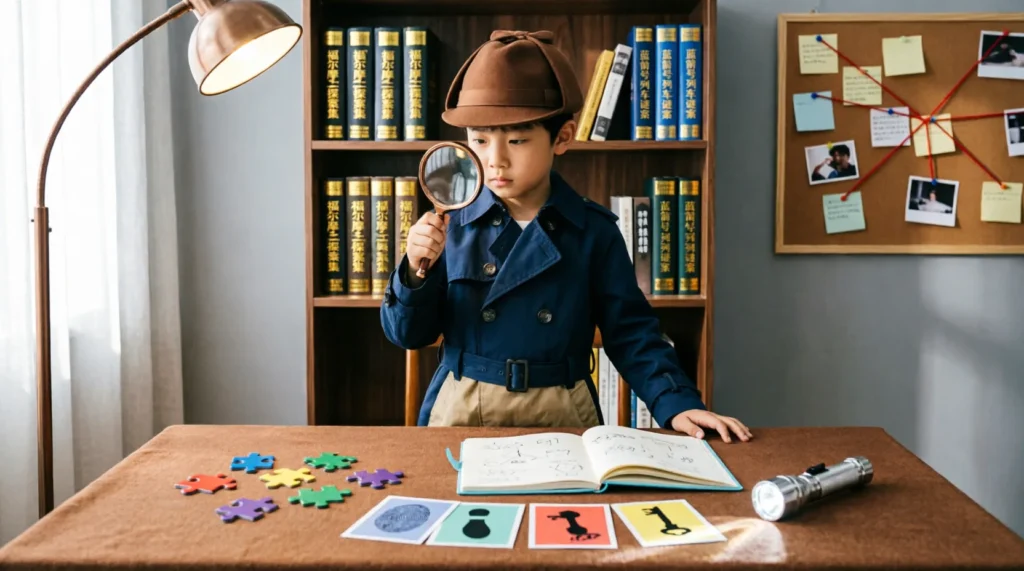
Grab your magnifying glass and put on your trench coat, because we are about to solve some mysteries. This collection of detective riddles for kids with answers is designed to turn your living room into a crime scene investigation unit or your classroom into a junior detective academy. Whether you are hosting a birthday party or just need a quiet activity for a rainy afternoon, these puzzles will sharpen observation skills and logical reasoning without feeling like homework.
Top 5 Detective Riddles
These are the cream of the crop—the riddles that get the most “aha!” moments when I test them out at family game nights. They strike the perfect balance between being tricky enough to require thought but fair enough that kids don’t get frustrated.
I am taken from a mine and shut up in a wooden case, from which I am never released, and yet I am used by almost every person. What am I?
Answer: Pencil lead (graphite)
The more of this there is, the less you see. What is it?
Answer: Darkness
David’s father has three sons: Snap, Crackle, and ____. Who is the third son?
Answer: David
Note: When I ask this one, kids almost always shout “Pop!” because of the candy reference. It is a classic trap that tests listening skills rather than pure logic.
What has keys but can’t open locks?
Answer: A piano
I speak without a mouth and hear without ears. I have no body, but I come alive with wind. What am I?
Answer: An echo
Easy Detective Mysteries
These riddles are perfect for younger detectives, roughly ages 5 to 8. They rely on simple wordplay and everyday objects, making them great confidence builders before moving on to the harder cases.
What has to be broken before you can use it?
Answer: An egg
What goes up but never comes down?
Answer: Your age
What has many needles but doesn’t sew?
Answer: A pine tree
What belongs to you but is used more by others?
Answer: Your name
What has one eye but can’t see?
Answer: A needle
If you drop me I’m sure to crack, but give me a smile and I’ll always smile back. What am I?
Answer: A mirror
Note: This is a favorite among my 6-year-old testers because they love the idea of a smiling object. It is also a gentle introduction to personification in riddles.
What gets wet while drying?
Answer: A towel
What can you catch but not throw?
Answer: A cold
Hard Detective Cases
These puzzles require a bit more lateral thinking. I recommend these for kids aged 9 and up, or for mixed-age groups where the older kids can help guide the younger ones. The logic here is less about wordplay and more about understanding physical properties or abstract concepts.
A man is looking at a photograph of someone. His friend asks who it is. The man replies, “Brothers and sisters, I have none. But that man’s father is my father’s son.” Who is in the photograph?
Answer: His son
Note: This is widely considered one of the hardest riddles for kids because it requires untangling a family tree mentally. I usually give a hint: “Who is ‘my father’s son’ if he has no brothers?”
The person who makes it has no need of it; the person who buys it has no use for it. The person who uses it can neither see nor feel it. What is it?
Answer: A coffin
What can travel around the world while staying in a corner?
Answer: A stamp
I have cities, but no houses. I have mountains, but no trees. I have water, but no fish. What am I?
Answer: A map
What begins with T, ends with T, and has T in it?
Answer: A teapot
You see a boat filled with people. It has not sunk, but when you look again you don’t see a single person on the boat. Why?
Answer: All the people were married
Note: This is a tricky one because kids often look for a supernatural answer, like ghosts or invisibility. The solution relies on the double meaning of the word “single.”
What has a head and a tail but no body?
Answer: A coin
Funny Detective Blunders
Not all mysteries are serious. These riddles are designed to elicit groans and giggles. They are excellent for breaking the tension during a long car ride or keeping the mood light at a party.
Why did the detective go to the bank?
Answer: To check his balance
What do you call a fake noodle?
Answer: An impasta
Why couldn’t the bicycle stand up by itself?
Answer: It was two tired
What do you call a bear with no teeth?
Answer: A gummy bear
Why did the scarecrow win an award?
Answer: Because he was outstanding in his field
What do you call a sleeping bull?
Answer: A bulldozer
Note: My 8-year-old niece loves this one. It is simple, pun-based, and easy to remember, making it a great “starter” riddle for kids who are new to the genre.
Why did the math book look sad?
Answer: Because it had too many problems
Tricky Logic Puzzles
These riddles test attention to detail. In real detective work, missing a small clue can ruin a case. These puzzles train kids to read carefully and question their assumptions.
A cowboy rides into town on Friday, stays for three days, and leaves on Friday. How is this possible?
Answer: His horse’s name is Friday
Which month has 28 days?
Answer: All of them
Note: This is a classic “gotcha” riddle. Most kids will immediately say “February,” forgetting that every month has at least 28 days. It teaches them to consider all possibilities, not just the most obvious one.
How many letters are in the alphabet?
Answer: 11 (T-H-E-A-L-P-H-A-B-E-T)
Note: Be careful with this one. If they ask how many letters are in the alphabet, the answer is 11. If they mean the English alphabet, it is 26. I specify “the alphabet” to make it a wordplay trick.
What occurs once in a minute, twice in a moment, but never in a thousand years?
Answer: The letter M
Some months have 30 days, some have 31. How many have 28?
Answer: 12
If there are three apples and you take away two, how many do you have?
Answer: Two (you took them)
Note: Kids often answer “one” because they are doing subtraction (3-2=1). But the question asks how many you have, not how many are left in the original group. It is a subtle shift in perspective.
Animal Detective Clues
Animals are always a hit with kids. These riddles combine biological facts with wordplay, making them educational as well as entertaining. According to Wikipedia, riddles have been used throughout history to teach cultural knowledge and language skills, and animal riddles are a prime example of this tradition.
What has a neck but no head?
Answer: A shirt (or a bottle)
Wait, that was a trick! Here is an animal one:
What animal can jump higher than a house?
Answer: Any animal (houses can’t jump)
What has four legs in the morning, two legs in the afternoon, and three legs in the evening?
Answer: A human (crawling as a baby, walking as an adult, using a cane in old age)
Note: This is the famous Riddle of the Sphinx. It is a bit complex for very young kids, but 10-year-olds usually love the historical connection.
What bird lifts heavy things?
Answer: A crane
What kind of dog does a magician have?
Answer: A labracadabrador
What do you call a fish wearing a bowtie?
Answer: Sofishticated
Where do polar bears keep their money?
Answer: In a snow bank
How to Use These Riddles
Having a list of detective riddles for kids with answers is great, but knowing how to deploy them makes the experience memorable. Here are a few ways I have used these in real-world settings.
Classroom Icebreakers Start the day with one “Riddle of the Day.” Write it on the board and let students submit answers in a box. Reveal the answer after lunch. It builds anticipation and gets brains working early.
Scavenger Hunt Clues Instead of writing “Look under the sofa,” write a riddle whose answer is “sofa.” For example: “I have four legs but cannot walk. I have cushions but cannot sleep. What am I?” This turns a standard hunt into a brain-teasing adventure.
Road Trip Entertainment Print these out on cards or save them on your phone. When the kids start getting restless, pull out a “Hard Detective Case.” It keeps them engaged without screens. I find that competitive teams (Mom vs. Kids) work best to keep everyone involved.
Party Game: Detective Duel Split the kids into two teams. Read a riddle. The first team to buzz in (or raise a hand) gets to answer. If they get it wrong, the other team can steal. Keep score with little badge stickers.
Frequently Asked Questions
What is a good age to start giving kids detective riddles? Most children can enjoy simple riddles starting around age 5 or 6. At this age, they understand basic wordplay and concrete objects. For the harder logic puzzles involving abstract concepts or multi-step reasoning, ages 8 to 10 are ideal. The key is to start easy and gradually increase the difficulty to avoid frustration.
How do these riddles help with learning? Solving riddles enhances critical thinking, vocabulary, and lateral thinking skills. As noted in the study of Detectives, investigation requires piecing together disparate clues to form a coherent picture. Riddles mimic this process on a micro scale, teaching kids to analyze information, question assumptions, and look for hidden meanings.
What should I do if my child can’t solve a riddle? Never leave them stuck. Offer a hint that narrows the field without giving the answer. For example, if the answer is “piano,” you might say, “It is found in a music room.” If they still struggle, reveal the answer and explain the logic. The goal is enjoyment and learning, not testing IQ.
Can I make up my own detective riddles? Absolutely! The best riddles often come from observing everyday life. Look at an object, think about its features, and describe it without naming it. Test it on your family. If they guess it too quickly, make it harder. If they can’t guess it at all, make it easier. It is a fun creative exercise for the whole family.

Patricia Sanchez is an expert in mathematical riddles and lateral thinking puzzles, bringing over a decade of experience to RiddlePlaza. With a dual degree in Mathematics and Psychology, Patricia is adept at creating brain teasers that challenge cognitive processing and numerical skills. Her fascination with puzzles was sparked by her early fascination with Sudoku and the strategic complexities of chess. In the realm of riddles, Patricia enjoys constructing scenarios that require readers to think outside the box, drawing upon her psychological insights to foster creative problem-solving. She is particularly known for her ability to fuse mathematical conundrums with a narrative flair, creating multi-layered puzzles that are both educational and engaging. Patricia is dedicated to integrating puzzles into educational frameworks, believing strongly in their capacity to sharpen young minds and enhance learning.