

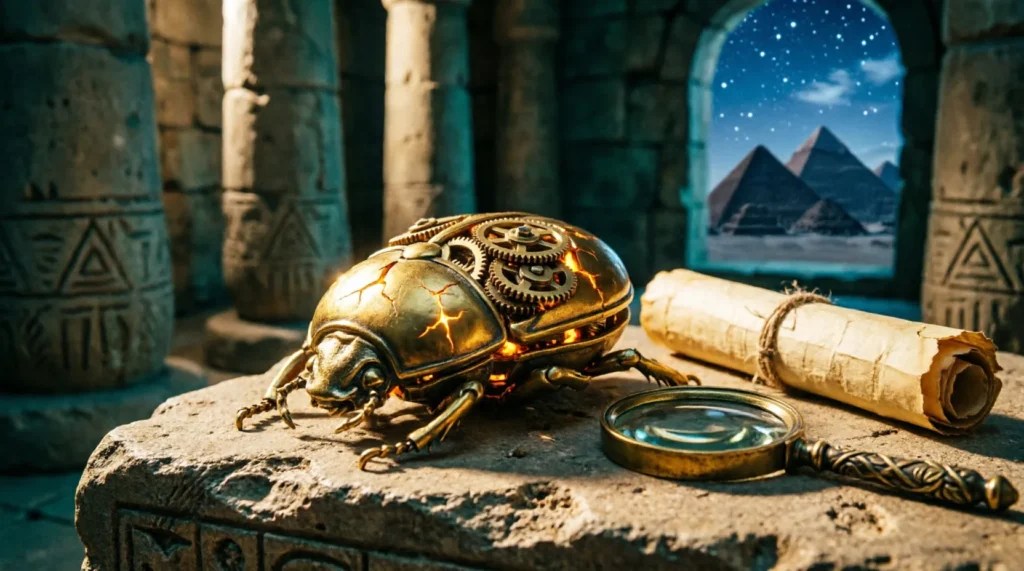
Step into the shadow of the pyramids and test your wit against puzzles that have survived millennia. This collection of egyptian riddles with answers for adults blends historical intrigue with lateral thinking, perfect for trivia nights or quiet contemplation. Whether you are a history buff or just love a good brain teaser, these enigmas will challenge your perception of ancient logic.
Top 5 Egyptian Riddles
These five selections represent the cream of the crop, balancing historical accuracy with clever wordplay. They are designed to stump even seasoned puzzle solvers who think they know their hieroglyphs from their hieratics.
I have no voice, yet I tell stories of kings. I have no hands, yet I hold the weight of centuries. What am I? Answer: A Pyramid
I am born in the mud, yet I rise above the water. I close my eyes at night and open them to the sun. The pharaohs wore me on their crowns. What am I? Answer: A Lotus Flower
I have cities, but no houses. I have mountains, but no trees. I have rivers, but no water. What am I? Answer: A Map of Egypt
I am always coming, but never arrive. I am the promise of the flood that feeds the land. What am I? Answer: Tomorrow (or The Next Season)
I speak without a mouth and hear without ears. I have no body, but I come alive with the wind in the desert. What am I? Answer: An Echo
Hard Historical Enigmas
These riddles require a bit more than just quick wit; they demand a familiarity with Egyptian mythology and geography. When I use these in adult trivia groups, the silence is usually deafening until someone connects the mythological dots.
I am the jackal-headed guide who weighs the heart against a feather. I stand by the scales in the hall of two truths. Who am I? Answer: Anubis
I flow north, though most rivers flow south. I bring life to the desert with my annual gift of black silt. What am I? Answer: The Nile River
I was built to point to the stars, yet I sit in the sand. My face has eroded, but my mystery remains. What am I? Answer: The Great Sphinx
I am the writing of the gods, carved in stone and painted on papyrus. To the uninitiated, I am just pictures; to the priest, I am speech. What am I? Answer: Hieroglyphs
I am the container of the soul’s organs, four jars standing guard. I am not the mummy, but I hold what was taken out. What am I? Answer: Canopic Jars
I am the eye that sees all, lost and restored, a symbol of protection and royal power. What am I? Answer: The Eye of Horus
I am the beetle that rolls the sun across the sky, a symbol of rebirth and creation. What am I? Answer: A Scarab Beetle
Tricky Wordplay & Logic
These puzzles rely on double meanings and linguistic traps. They are less about historical knowledge and more about how you process language. In my experience, these are the ones that cause the most arguments because the answer seems obvious only after it is revealed.
What has a head and a tail but no body, often found in the tomb of a king? Answer: A Coin (or a Pharaoh’s headdress, but coin is the classic riddle answer)
The more you take from me, the bigger I get. What am I, often dug in the desert sands? Answer: A Hole
What can travel around the world while staying in a corner of the Giza plateau? Answer: A Stamp
I am light as a feather, yet the strongest man in Egypt cannot hold me for more than a few minutes. What am I? Answer: Breath
What belongs to you, but other people use it more than you do, especially when introducing yourself to a scribe? Answer: Your Name
I have keys but no locks. I have space but no room. You can enter, but not go inside. What am I, used by modern historians? Answer: A Keyboard
Funny & Lighthearted Puzzles
Not every riddle needs to be solemn. These offer a playful twist on Egyptian themes, great for breaking the ice at a themed party. They are designed to elicit a groan followed by a laugh.
Why did the mummy go to school? Answer: To improve his wrapping skills
What do you call a fake stone in the desert? Answer: A sham-rock
Why didn’t the skeleton fight the pharaoh? Answer: He didn’t have the guts
What is a pharaoh’s favorite type of music? Answer: Wrap music
How does Moses make his coffee in the desert? Answer: Hebrews it
What did one pyramid say to the other? Answer: “You look sharp today!”
Short & Quick Fire
These are designed for speed. Use them when you need a quick mental reset or a fast-paced round in a game. The brevity makes them deceptive; simplicity often hides the trick.
I am dry, yet I am full of water. What am I? Answer: A Sponge (or a Desert Oasis, depending on interpretation)
What goes up but never comes down? Answer: Your Age
What has many needles, but doesn’t sew? Answer: A Palm Tree
What gets wet while drying? Answer: A Towel
What has one eye, but can’t see? Answer: A Needle
What begins with T, ends with T, and has T in it? Answer: A Teapot
Riddles With a Twist
These puzzles subvert expectations. They sound like they are about ancient artifacts, but the answer is often mundane or metaphorical. According to Riddle, the essence of a good riddle is the misdirection of the listener’s assumptions, and these examples lean heavily into that tradition.
I am not alive, but I grow; I don’t have lungs, but I need air; I don’t have a mouth, but water kills me. What am I, often used in desert camps? Answer: Fire
I am always hungry, I must always be fed. The finger I touch will soon turn red. What am I? Answer: Fire
What can you catch, but not throw? Answer: A Cold
What has to be broken before you can use it? Answer: An Egg
I am not a bird, but I can fly through the air. I am not a river, but I have a bed. What am I? Answer: A Cloud
What has words, but never speaks? Answer: A Book
How to Use These Riddles
Integrating these puzzles into your social gatherings can elevate the experience from simple conversation to interactive entertainment. Here are a few proven methods to deploy them effectively.
- Dinner Party Icebreakers: Place a card with one riddle at each setting. Guests must solve it before they can start eating. It sparks immediate conversation and debate.
- Scavenger Hunts: Hide clues around your home or venue. Each clue is an Egyptian riddle, and the answer leads to the next location. For example, if the answer is “Pyramid,” hide the next clue under a triangular object.
- Classroom Engagement: Teachers can use these to introduce history lessons. Start with a riddle about the Nile or Hieroglyphs to gauge prior knowledge and spark curiosity before diving into the textbook material.
- Road Trip Entertainment: Keep passengers engaged during long drives. Take turns reading a riddle, and the first person to solve it gets to choose the next song or snack stop.
Frequently Asked Questions
What makes a riddle suitable for adults? Adult riddles often rely on double entendres, complex vocabulary, or specialized knowledge, such as history or mythology. Unlike children’s riddles, which are usually straightforward observations, adult riddles require lateral thinking and the ability to dismiss obvious but incorrect assumptions.
Can these riddles be used for educational purposes? Absolutely. Many of these riddles reference real historical figures, geographical features, and cultural practices. Using them in a classroom setting can serve as a engaging hook to introduce topics like Ancient Egyptian religion, architecture, or daily life. As noted in Egyptian historical records, storytelling and puzzles were integral to their intellectual culture.
How do I create my own Egyptian-themed riddles? Start with a specific artifact, god, or concept. Identify its key characteristics, then describe those traits metaphorically. Avoid naming the object directly. Instead, focus on what it does, what it looks like, or what it symbolizes. Test it on friends to ensure the misdirection is effective but the answer is logically sound.
Are there right and wrong ways to guess? In casual settings, creativity is encouraged. If a guest provides an answer that is technically correct based on your wording, even if it isn’t the intended answer, accept it. The goal is engagement and fun, not rigid adherence to a single solution. However, for competitive games, establish the rules clearly beforehand.

Patricia Sanchez is an expert in mathematical riddles and lateral thinking puzzles, bringing over a decade of experience to RiddlePlaza. With a dual degree in Mathematics and Psychology, Patricia is adept at creating brain teasers that challenge cognitive processing and numerical skills. Her fascination with puzzles was sparked by her early fascination with Sudoku and the strategic complexities of chess. In the realm of riddles, Patricia enjoys constructing scenarios that require readers to think outside the box, drawing upon her psychological insights to foster creative problem-solving. She is particularly known for her ability to fuse mathematical conundrums with a narrative flair, creating multi-layered puzzles that are both educational and engaging. Patricia is dedicated to integrating puzzles into educational frameworks, believing strongly in their capacity to sharpen young minds and enhance learning.