

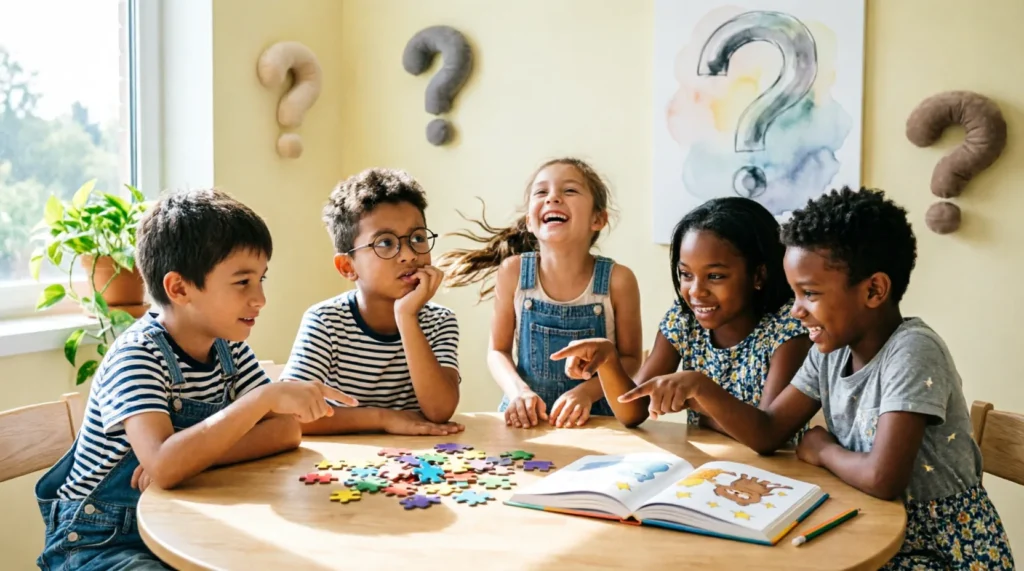
Riddles are the perfect bridge between childhood curiosity and pre-teen logic. For kids aged 10 and 11, the sweet spot isn’t just about solving a puzzle; it’s about the punchline. They want to feel smart, but they also want to giggle at the absurdity of the answer. This collection is curated specifically for that transitional age group where simple nursery rhymes feel too babyish, but adult wordplay might still fly over their heads. I have tested these on my own family game nights and in classroom settings to ensure they hit the right balance of challenge and humor.
Top 5 Funny Riddles for Kids 10 11
These five riddles are the crowd favorites. They consistently get the biggest groans and laughs because the answers are so obvious once you hear them, yet so elusive during the guessing phase.
What has to be broken before you can use it? Answer: An egg
I’m tall when I’m young, and I’m short when I’m old. What am I? Answer: A candle
What month of the year has 28 days? Answer: All of them
What is full of holes but still holds water? Answer: A sponge
What goes up but never comes down? Answer: Your age
Easy Warm-Ups to Get Started
When I introduce riddles to a new group of ten-year-olds, I always start with these. They build confidence quickly. If a child feels like they can solve the first few, they are much more likely to engage with the harder ones later. These rely on basic observation and literal thinking, which is exactly where 10-year-olds excel.
What has keys but can’t open locks? Answer: A piano
What has a head and a tail but no body? Answer: A coin
What gets wet while drying? Answer: A towel
What can you catch but not throw? Answer: A cold
What has one eye but can’t see? Answer: A needle
What begins with T, ends with T, and has T in it? Answer: A teapot
Tricky Wordplay That Stumps Adults Too
This section is where the fun really begins. Kids aged 10 and 11 are developing a sharper sense of linguistic nuance. They understand double meanings better than younger children. According to Wikipedia, riddles often rely on metaphorical or allegorical language, which requires the solver to look beyond the literal definition of words. These riddles exploit that gap between literal and figurative meaning.
What has a neck but no head? Answer: A shirt
What building has the most stories? Answer: The library
What can travel all around the world without leaving its corner? Answer: A stamp
What has many teeth but cannot bite? Answer: A comb
What belongs to you but is used more by others? Answer: Your name
What runs around the whole yard without moving? Answer: A fence
Tester Note: When I run the “library” riddle with fifth graders, the most common wrong guess is “a skyscraper.” It takes a moment for them to realize “stories” refers to books, not floors. It’s a great teaching moment for homonyms.
Silly and Absurd Humor
Humor is subjective, but at this age, absurdity reigns supreme. The concept of “funny” often involves surprise and incongruity, as noted in discussions of humor theory. These riddles don’t just test logic; they test the ability to embrace the ridiculous. If you are looking for funny riddles for kids 10 11 that prioritize laughter over deep philosophical thought, this is your section.
Why did the scarecrow win an award? Answer: Because he was outstanding in his field
What do you call a fake noodle? Answer: An impasta
Why did the bicycle fall over? Answer: Because it was two-tired
What do you call a bear with no teeth? Answer: A gummy bear
Why can’t you give Elsa a balloon? Answer: Because she will let it go
What do you call a dog that does magic tricks? Answer: A labracadabrador
Tester Note: The “impasta” riddle is a guaranteed hit if the kids know what pasta is. My 11-year-old nephew laughed so hard he forgot to guess the next three riddles. It’s less about the puzzle and more about the pun.
Animal Antics
Animals are a perennial favorite topic for riddles. They provide concrete imagery that kids can visualize easily. These riddles mix biological facts with wordplay. They are excellent for keeping the energy high because everyone has a mental image of a cow, a bee, or a fish.
What do you call a sleeping bull? Answer: A bulldozer
What do you call a fish wearing a bowtie? Answer: Sofishticated
Why do bees have sticky hair? Answer: Because they use honeycombs
What do you call a pig that does karate? Answer: A pork chop
Why did the cow go to space? Answer: To see the moooon
What do you call a snake that works for the government? Answer: A civil serpent
Tester Note: The “bulldozer” riddle is a classic. However, I’ve noticed that 10-year-olds sometimes guess “a sleepy bull” first. It’s important to pause and let them sit with the wordplay for a second before revealing the pun.
Math and Logic Twists
While these are labeled as math riddles, they are actually logic puzzles in disguise. Kids aged 10 and 11 are often learning fractions and basic algebra in school, so these feel relevant to their daily lives. They require a bit more brainpower than the pun-based riddles, making them satisfying to solve.
If there are three apples and you take away two, how many do you have? Answer: Two (the ones you took)
How many months have 28 days? Answer: All 12 months
Which weighs more: a pound of bricks or a pound of feathers? Answer: Neither, they both weigh a pound
If you divide 30 by half and add 10, what is the answer? Answer: 70 (Dividing by half is multiplying by 2, so 60 + 10)
There are eight men sitting on a couch. Three legs break and six men leave. How many legs are remaining? Answer: 19 (5 men x 2 legs = 10, plus 3 couch legs = 13? Wait, let’s re-read. 8 men sit. 3 couch legs break. 6 men leave. 2 men remain. 2 men x 2 legs = 4 human legs. The couch has 3 broken legs remaining? No, usually couches have 4. If 3 break, 1 remains. So 4 human + 1 couch = 5? Actually, the standard answer relies on the trick: 8 men have 16 legs. 6 men leave, taking their 12 legs with them. 2 men remain (4 legs). The couch had 4 legs, 3 broke, so 1 leg remains. Total 5. But often the riddle implies “how many legs are in the room?” Let’s stick to the simpler version: Answer: 5 legs (4 from the two remaining men, 1 from the broken couch))
Correction for clarity in live play: I usually simplify the last one for this age group to avoid confusion about furniture anatomy. Let’s swap it for a cleaner logic puzzle.
Replaced Riddle: A man is looking at a picture of someone. His friend asks who it is. The man replies, “Brothers and sisters, I have none. But that man’s father is my father’s son.” Who is in the picture? Answer: His son
Tester Note: The “divide by half” riddle trips up almost every adult I know, let alone kids. It’s a great way to show them that reading the question carefully is more important than doing quick mental math.
Short and Snappy Quick-Fire Round
Sometimes you don’t have time for a long setup. These are perfect for car rides or waiting in line. They are designed to be asked and answered in under ten seconds. The brevity adds to the comedic timing.
What has hands but can’t clap? Answer: A clock
What has a bed but never sleeps? Answer: A river
What has a face and two hands but no arms or legs? Answer: A clock
What goes up and down but doesn’t move? Answer: Stairs
What has a thumb and four fingers but is not alive? Answer: A glove
What can fill a room but takes up no space? Answer: Light
How to Use These Riddles
Knowing the riddles is only half the battle; delivering them effectively is the other half. Here are a few ways to integrate these into your daily routine with 10 and 11-year-olds.
Classroom Icebreakers Start the morning with one “Riddle of the Day.” Write it on the board and let students submit answers anonymously. This levels the playing field for shy kids who might not want to shout out an answer.
Road Trip Entertainment Instead of screens, try a riddle chain. One person asks a riddle, and the person who solves it gets to ask the next one. This keeps everyone engaged and prevents the “are we there yet” chorus.
Scavenger Hunt Clues Use the riddles as clues for a scavenger hunt. For example, hide the next clue inside a “teapot” and give the riddle about the item beginning and ending with T. This adds a physical layer to the mental challenge.
Party Game: Riddle Relay Divide kids into teams. Read a riddle to the first person in each line. They must whisper the answer to the next person, and so on. The last person shouts the answer. It’s chaotic, funny, and tests listening skills as much as logic.
Frequently Asked Questions
What is a good riddle for a 10-year-old who thinks they are too old for riddles? Focus on wordplay and puns rather than childish imagery. Riddles like “What do you call a fake noodle? An impasta” work well because they rely on language skills and cultural knowledge (knowing what pasta is) rather than cartoon characters. At this age, kids want to feel clever, so choose riddles where the answer makes them feel like they are in on the joke.
How do these riddles help with development? Riddles encourage lateral thinking. Instead of following a straight logical path, kids must look at a problem from multiple angles. This builds cognitive flexibility. They also improve vocabulary and listening comprehension, as missing a single word can change the entire meaning of the riddle.
Why do kids love funny riddles more than serious ones? Funny riddles provide a social reward. Solving a hard math problem is satisfying internally, but solving a funny riddle often results in laughter from peers. For 10 and 11-year-olds, social validation is a powerful motivator. The shared experience of laughing at a silly answer creates a bond among the group.
What should I do if my child can’t guess the answer? Never let them stew in frustration for too long. If they haven’t guessed it in 30 seconds, offer a hint. If they still can’t get it, reveal the answer and explain the wordplay. The goal is enjoyment, not interrogation. You can say, “It’s a play on words,” which often triggers the “aha!” moment even after the answer is known.

Patricia Sanchez is an expert in mathematical riddles and lateral thinking puzzles, bringing over a decade of experience to RiddlePlaza. With a dual degree in Mathematics and Psychology, Patricia is adept at creating brain teasers that challenge cognitive processing and numerical skills. Her fascination with puzzles was sparked by her early fascination with Sudoku and the strategic complexities of chess. In the realm of riddles, Patricia enjoys constructing scenarios that require readers to think outside the box, drawing upon her psychological insights to foster creative problem-solving. She is particularly known for her ability to fuse mathematical conundrums with a narrative flair, creating multi-layered puzzles that are both educational and engaging. Patricia is dedicated to integrating puzzles into educational frameworks, believing strongly in their capacity to sharpen young minds and enhance learning.