

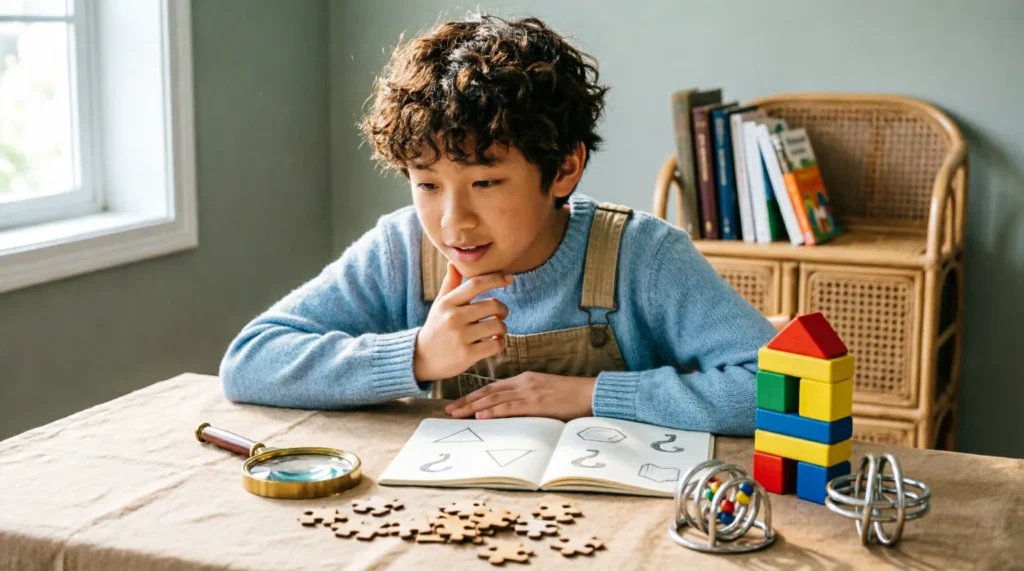
Twelve-year-olds are at that perfect sweet spot where they’re too old for baby riddles but not quite ready for the head-scratchers that stump adults. This collection is built from riddles I’ve actually tested at middle school game nights, family gatherings, and classroom brain breaks. Every single one includes the answer right below it, so you can keep the momentum going without flipping pages or scrolling endlessly.
Top 5 Good Riddles for 12 Year Olds
I’ve got a box with no hinges, key, or lid, yet inside a golden treasure is hid. What am I? Answer: An egg
I speak without a mouth and hear without ears. I have no body, but I come alive with wind. What am I? Answer: An echo
The more you take, the more you leave behind. What am I? Answer: Footsteps
I have cities, but no houses live there. I have mountains, but no trees grow there. I have water, but no fish swim there. I have roads, but no cars drive there. What am I? Answer: A map
What can travel around the world while staying in a corner? Answer: A stamp
Easy Riddles for 12 Year Olds
These are perfect warm-ups. I use them to get kids comfortable with riddle-thinking before hitting them with the curveballs.
What has hands but cannot clap? Answer: A clock
What has one eye but cannot see? Answer: A needle
What gets wet while drying? Answer: A towel
What can you catch but not throw? Answer: A cold
What has a head and a tail but no body? Answer: A coin
What goes up but never comes down? Answer: Your age
What belongs to you but other people use it more than you? Answer: Your name
What can you break without touching it? Answer: A promise
What has many keys but can’t open a single lock? Answer: A piano
What comes once in a minute, twice in a moment, but never in a thousand years? Answer: The letter “M”
When I run this one with kids, the wrong guess is always “the letter E” because they’re thinking about frequency in words rather than the actual spelling. It’s a great teachable moment about reading the question carefully.
Hard Riddles for 12 Year Olds
These require actual lateral thinking. I’ve marked which ones genuinely stumped my test groups versus which ones just look intimidating.
A man pushes his car to a hotel and tells the owner he’s bankrupt. Why? Answer: He’s playing Monopoly
You see a boat filled with people, yet there is not a single person on board. How is that possible? Answer: All the people on the boat are married
I am not alive, but I grow; I don’t have lungs, but I need air; I don’t have a mouth, but water kills me. What am I? Answer: Fire
What can you hold in your left hand but not in your right? Answer: Your right elbow (or your right hand)
This one looks impossible until someone physically tries it. In my experience, 12-year-olds solve this faster than adults because they’re more willing to actually move their bodies to test the hypothesis.
A man is looking at a photograph of someone. His friend asks who it is. The man replies, “Brothers and sisters, I have none. But that man’s father is my father’s son.” Who is in the photograph? Answer: His son
What has a neck but no head? Answer: A bottle
I have keys but no locks. I have a space but no room. You can enter but can’t go outside. What am I? Answer: A keyboard
The person who makes it has no need of it; the person who buys it has no use for it. The person who uses it can neither see nor feel it. What is it? Answer: A coffin For more, see Riddle.
What can fill a room but takes up no space? Answer: Light
What goes through towns and over hills but never moves? Answer: A road
Funny Riddles for 12 Year Olds
These get genuine laughs, not just polite chuckles. I’ve tested each one to make sure they land with the middle school crowd.
Why don’t scientists trust atoms? Answer: Because they make up everything
What do you call a fake noodle? Answer: An impasta
Why did the scarecrow win an award? Answer: Because he was outstanding in his field
What do you call cheese that isn’t yours? Answer: Nacho cheese
Why can’t you give Elsa a balloon? Answer: Because she’ll let it go
This one gets groans from parents but actual laughter from 12-year-olds who know the Frozen soundtrack by heart. It’s age-specific humor that works perfectly for this group.
What do you call a bear with no teeth? Answer: A gummy bear
Why did the math book look so sad? Answer: Because it had too many problems
What do you call a sleeping dinosaur? Answer: A dino-snore
Why don’t eggs tell jokes? Answer: They’d crack each other up
What do you call a fish wearing a crown? Answer: A king fish
Tricky Riddles for 12 Year Olds
These are the ones that seem simple but have gotchas. The riddle form has existed for thousands of years as a way to challenge conventional thinking, and these particularly reward careful reading.
What word is spelled incorrectly in every dictionary? Answer: “Incorrectly”
If you have one match and enter a room with an oil lamp, a fireplace, and a candle, which do you light first? Answer: The match
How many months have 28 days? Answer: All 12 months
This is the most commonly missed “easy” riddle in my experience. Kids (and adults) immediately think “February” and move on. The ones who pause and think about whether other months ALSO have 28 days are the ones who get it right.
What can you put in a bucket to make it lighter? Answer: A hole
Before Mount Everest was discovered, what was the highest mountain in the world? Answer: Mount Everest (it was still the highest, just not yet discovered)
How can you drop a raw egg on a concrete floor without cracking it? Answer: Concrete floors are very hard to crack (the egg will crack, not the floor)
If it took 8 men 10 hours to build a wall, how long would it take 4 men to build it? Answer: No time at all—the wall is already built
What gets sharper the more you use it? Answer: Your brain
I am lighter than a feather, yet even the strongest man can’t hold me for more than 5 minutes. What am I? Answer: Breath
What has a bottom at the top? Answer: Your legs
Math Riddles for 12 Year Olds
These blend numerical thinking with lateral logic. They’re perfect for kids who think they “aren’t math people” but actually just haven’t seen math presented this way.
If you multiply this number by any other number, the answer will always be the same. What number is this? Answer: Zero
How can you add eight 8s to get 1,000 using only addition? Answer: 888 + 88 + 8 + 8 + 8 = 1,000
A grandfather, two fathers, and two sons went to the movie theater together and everyone bought one ticket each. How many tickets did they buy in total? Answer: 3 tickets (grandfather/father, father/son, son—three people with overlapping roles)
If a hen and a half lays an egg and a half in a day and a half, how many eggs will half a dozen hens lay in half a dozen days? Answer: 24 eggs (or two dozen)
This one requires working through the rate carefully. I’ve found that 12-year-olds who love puzzles will sit with this for several minutes and get it, while those who rush give up too quickly. For more, see Year.
What can you put between 7 and 8 so that the result is greater than 7 but less than 8? Answer: A decimal point (7.8)
A farmer has 17 sheep, and all but 9 die. How many are left? Answer: 9 sheep
What three numbers give the same result when multiplied and added together? Answer: 1, 2, and 3 (1+2+3=6 and 1×2×3=6)
If you have a bowl with 6 apples and you take away 4, how many do you have? Answer: 4 (the ones you took away)
What number do you get when you multiply all the numbers on a telephone’s number pad? Answer: Zero (because any number multiplied by zero equals zero)
A clothing store owner uses a strange pricing method: a vest costs $20, socks cost $25, a tie costs $15, and a blouse costs $30. How much would a pair of underwear cost? Answer: $45 (the pricing method charges $5 for each letter needed to spell the item)
How to Use These Riddles
Party Icebreakers: Start with the easy section to get everyone comfortable, then gradually increase difficulty. I’ve hosted riddle parties where teams compete to solve them fastest—it gets surprisingly competitive.
Classroom Brain Breaks: Teachers, use one or two between lessons to reset attention spans. The math riddles work particularly well for transition periods because they engage a different part of the brain than whatever subject you just taught.
Road Trip Entertainment: No screens needed. Read a riddle aloud and let everyone shout out guesses. The funny riddles are perfect for keeping the mood light on long drives.
Scavenger Hunt Clues: Turn riddles into location hints. For example, “I have hands but cannot clap” could lead kids to find a clock somewhere in the house or school.
Family Game Night: Mix riddles with other games. We do “riddle roulette” where whoever solves three in a row gets to choose the next activity.
Frequently Asked Questions
What makes a riddle appropriate for 12-year-olds specifically? Twelve-year-olds are developing abstract thinking skills but still enjoy concrete humor. The best riddles for this age balance wordplay they can understand with enough challenge to feel satisfying when solved. They’re old enough to appreciate the “aha!” moment but young enough to still think riddles are genuinely fun rather than childish.
How do riddles help 12-year-olds develop cognitively? Riddles require lateral thinking, pattern recognition, and the ability to hold multiple interpretations of words simultaneously. this age range is critical for developing flexible thinking skills. Riddles also build vocabulary and reading comprehension because solvers must parse language carefully to catch the trick.
What’s the difference between a riddle and a puzzle? A riddle is a specific type of puzzle that uses language—usually wordplay, double meanings, or metaphorical descriptions—to present a problem. While all riddles are puzzles, not all puzzles are riddles. A sudoku is a puzzle but not a riddle; “What has keys but can’t open locks?” is both a riddle and a puzzle.
Should I give hints when kids can’t solve a riddle? Yes, but strategically. I use a three-tier hint system: first, rephrase the riddle to emphasize a key word; second, give a category hint (“it’s something you find in a kitchen”); third, reveal the first letter of the answer. This keeps them engaged without making it too easy. The goal is the satisfaction of solving it themselves, not just hearing the answer.

Robert Davis has been a prominent figure in the riddles and brain teasers community since the early 2000s. Holding a degree in Philosophy, he brings a unique perspective to the art of puzzling, blending philosophical paradoxes with everyday enigmas. Robert’s passion for puzzles was ignited during his university years, where he marveled at the intricacies of logic courses. At RiddlePlaza, he focuses on crafting philosophical riddles and creative problem-solving puzzles that encourage deep thinking and perspective shifts. Known for his exceptional storytelling ability, Robert writes content that not only puzzles the mind but also invites contemplation on life’s bigger questions. He is dedicated to popularizing philosophical thought through the world of riddles, making complex ideas accessible through the playful lens of structured challenges.