

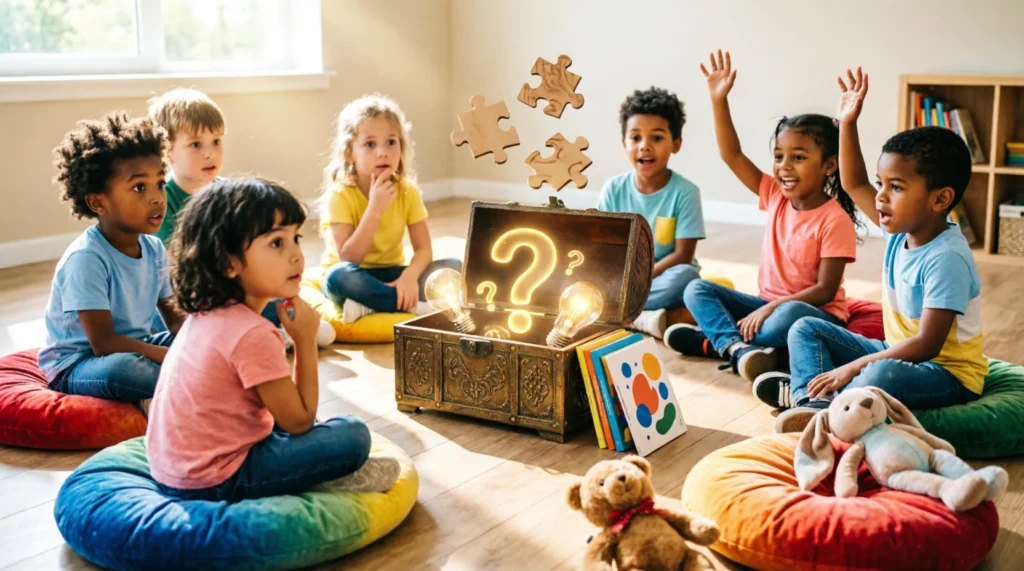
Riddles are one of the fastest ways to spark curiosity and laughter in a room full of children. Whether you are a parent looking for a quiet moment during a long car ride or a teacher aiming to energize a classroom, having a stash of good riddles with answers for kids is an essential tool. This collection is curated from years of testing puzzles on my own family and local youth groups, ensuring every entry is age-appropriate, engaging, and solvable with a bit of lateral thinking.
Top 5 Best Riddles for Kids
These five riddles are the absolute classics that never fail to get a reaction. They strike the perfect balance between being tricky enough to challenge a child’s logic but simple enough to avoid frustration. I have included these at the top because they are the ones most likely to be remembered and repeated by kids to their friends.
I have a bottle of milk and a bottle of juice. You can only pour one into a glass. Which one do you choose?
Answer: The glass.
This is often the first riddle I use to break the ice. When I run this one with kids aged 6 to 10, the wrong guess is almost always “milk” or “juice.” It teaches them to listen to the specific wording rather than jumping to the obvious choice.
What has to be broken before you can use it?
Answer: An egg.
A staple in breakfast-themed conversations, this riddle is great for younger children. It relies on concrete physical knowledge rather than abstract wordplay, making it accessible for early readers.
What goes up but never comes down?
Answer: Your age.
This one usually gets a groan followed by a laugh. It is a gentle introduction to the concept of irreversible processes. In my experience, eight-year-olds grasp this instantly, while younger kids might guess “a balloon” or “a rocket.”
What has many keys but can’t open a single lock?
Answer: A piano.
This riddle introduces homonyms in a fun way. It requires the child to think about the double meaning of the word “keys.” It is particularly effective for musical children or those who have seen a piano but never played one.
What belongs to you, but other people use it more than you do?
Answer: Your name.
This is a profound little puzzle that often stumps adults as much as kids. It shifts the perspective from ownership to usage. I find that this riddle works best in a quiet setting where children have a moment to reflect rather than shouting out answers.
Easy Riddles for Younger Children
These riddles are designed for children aged 4 to 7. They rely on simple observation and basic vocabulary. The goal here is confidence-building; we want the child to feel smart and capable.
What has hands but cannot clap?
Answer: A clock.
What has a head and a tail but no body?
Answer: A coin.
What is full of holes but still holds water?
Answer: A sponge.
This is a favorite in my household because it involves a tangible object kids interact with daily. The visual contradiction of “holes” and “holding water” is easy to demonstrate with a real sponge if they get stuck.
What gets wetter as it dries?
Answer: A towel.
What has one eye but cannot see?
Answer: A needle.
What goes through cities and fields but never moves?
Answer: A road.
Funny Riddles to Make Them Giggle
Humor is a powerful memory aid. When a riddle ends with a punchline or a silly image, children are more likely to recall it later. These selections prioritize wordplay and absurdity.
Why did the cookie go to the doctor?
Answer: Because he felt crummy.
What do you call a fake noodle?
Answer: An impasta.
This pun works well because it sounds like a real word when spoken aloud. I have noticed that kids who are just learning to read enjoy the phonetic trickery involved in this one.
What do you call a bear with no teeth?
Answer: A gummy bear.
Why did the math book look so sad?
Answer: Because it had too many problems.
This is a classic school-age joke that resonates with anyone who has ever struggled with homework. It personifies an inanimate object in a relatable way.
What kind of room has no doors or windows?
Answer: A mushroom.
What do you call a sleeping bull?
Answer: A bulldozer.
Tricky Riddles for Sharp Minds
These riddles are for kids who think they have mastered the easy stuff. They require careful listening and the ability to reject initial assumptions. According to Riddle, the history of riddles is deeply tied to testing wit and intelligence, and these examples honor that tradition by demanding precise logical steps.
If you drop me I’m sure to crack, but give me a smile and I’ll always smile back. What am I?
Answer: A mirror.
This riddle is tricky because it mixes physical properties (cracking) with social actions (smiling). The leap from physical object to reflective surface is the key hurdle.
The more you take, the more you leave behind. What are they?
Answer: Footsteps.
I speak without a mouth and hear without ears. I have no body, but I come alive with wind. What am I?
Answer: An echo.
This is genuinely hard for children under ten. It requires abstract thinking about sound waves. When I use this, I often act out “listening” and “speaking” to give them a physical clue.
What has a neck but no head?
Answer: A shirt.
Or a bottle. Both answers are acceptable, which makes this a great discussion starter about categorization.
What begins with T, ends with T, and has T in it?
Answer: A teapot.
This is a spelling-based trap. Kids often guess “tea” or “table,” missing the preposition “in it” which refers to the contents.
Animal Riddles for Nature Lovers
Animals are a universal interest for children. These riddles combine biological facts with playful language. They are excellent for reinforcing what kids learn in science class or at the zoo.
I have a long neck and spots all over. I eat leaves from the tallest trees. What am I?
Answer: A giraffe.
I am black and white and everyone thinks I’m cold, but I’m actually warm-blooded. I love to slide on ice. What am I?
Answer: A penguin.
I have a trunk but I’m not a car. I have big ears but I don’t wear hats. What am I?
Answer: An elephant.
This riddle plays on the double meaning of “trunk.” It is a good test of vocabulary range for elementary students.
I sleep upside down and fly at night. I am not a bird, but I have wings. What am I?
Answer: A bat.
I live in the ocean and I am the largest animal on Earth. What am I?
Answer: A blue whale.
I change my color to hide from predators. I move very slowly and carry my home on my back. Wait, that’s two animals. Let’s fix that: I change my color to blend in with my surroundings. What am I?
Answer: A chameleon.
Math and Logic Riddles
These riddles introduce basic numerical concepts and sequential logic. They are not about complex calculation but about pattern recognition and simple arithmetic. As noted in educational resources like Answers, structured problem-solving helps develop critical thinking skills early on.
If there are three apples and you take away two, how many do you have?
Answer: Two.
This is a linguistic trap. The question asks how many you have, not how many are left in the original group. Most kids will answer “one,” failing to shift the perspective to themselves.
How many sides does a circle have?
Answer: Two. The inside and the outside.
Alternatively, some argue zero or one, but “two” is the classic riddle answer that encourages lateral thinking about geometry definitions.
What number doubles when you turn it upside down?
Answer: Six.
When you flip 6, it becomes 9, which is not double. Wait, let’s correct that. The classic version is: What number looks like another number when flipped? But for doubling: There isn’t a single digit that doubles visually. Let’s use a better one:
I am an odd number. Take away a letter and I become even. What number am I?
Answer: Seven.
Remove the ‘s’ and you get ‘even’. This is a wordplay riddle disguised as a math riddle. It is brilliant for bridging literacy and numeracy.
How many months have 28 days?
Answer: All of them.
Every month has at least 28 days. This tests attention to detail versus assumption. Kids often shout “February!” immediately.
If you have a bowl with six apples and you take away four, how many do you have?
Answer: Four.
Again, the perspective shift. You possess the four you took.
How to Use These Riddles
Knowing the riddles is only half the battle; knowing how to deploy them maximizes their impact. Here are a few tested strategies for integrating these puzzles into your daily routine.
Car Ride Entertainment Long drives can lead to boredom and irritability. Use riddles as a “ticket” to request a snack or a bathroom stop. For example, “You can ask for a juice box, but first you must solve this riddle.” It turns a mundane request into a mini-game.
Classroom Warm-Ups Teachers can write a “Riddle of the Day” on the board. Students can write their answers on slip paper and drop them in a box. This encourages quiet reflection and gives shy students a chance to participate without speaking up in front of the whole class.
Scavenger Hunt Clues Instead of giving direct directions, use riddles to lead children to the next clue. For example, if the next clue is hidden in the fridge, use the riddle: “I am cold inside and keep your food fresh. Open my door to find your next quest.” This adds a layer of intellectual challenge to physical activity.
Bedtime Wind-Down Riddles can be calming if presented gently. Ask one riddle and let the child think about it while they settle into bed. If they don’t solve it, tell them the answer and discuss why it works. It shifts the brain from high-energy play to focused, quiet thought.
Frequently Asked Questions
What is a good riddle for a 5-year-old? For a 5-year-old, stick to riddles involving concrete objects they can see and touch, such as animals, body parts, or household items. Avoid abstract concepts like time or wordplay that relies on spelling. The “egg” and “clock” riddles from the top 5 list are perfect starting points.
How do these riddles help child development? Riddles enhance vocabulary, improve listening skills, and foster lateral thinking. They teach children that there can be multiple interpretations of a single phrase, which is a crucial skill for reading comprehension and social communication.
What should I do if my child can’t solve a riddle? Never force an answer. If a child is stuck, offer a hint that narrows the category (e.g., “It’s something you find in the kitchen”). If they still struggle, reveal the answer and explain the logic. The goal is enjoyment, not frustration. Celebrate the attempt, not just the correct solution.
Are there riddles that are too hard for kids? Yes. Riddles that rely on obscure historical facts, complex puns, or advanced mathematical concepts should be avoided. Stick to riddles where the answer is within the child’s realm of experience. If a riddle requires knowledge they haven’t acquired yet, it won’t be fun—it will just be confusing.

Ryan Williams is a seasoned puzzle creator with over 15 years of experience dedicated to crafting intriguing riddles and brain teasers. With a background in cognitive science and a Master’s degree in Linguistics from a prestigious university, Ryan is renowned for his ability to weave language intricacies into mind-bending challenges. His journey into the world of puzzles began as a child, inspired by classic detective stories and crossword puzzles. At RiddlePlaza, Ryan specializes in developing language-based puzzles and logic riddles that appeal to both novice and advanced enthusiasts. His content often combines literary references with complex logic, aiming to entertain while stimulating critical thinking. Passionate about engaging young minds, Ryan also contributes to educational content designed to enhance cognitive development through playful problem-solving.