

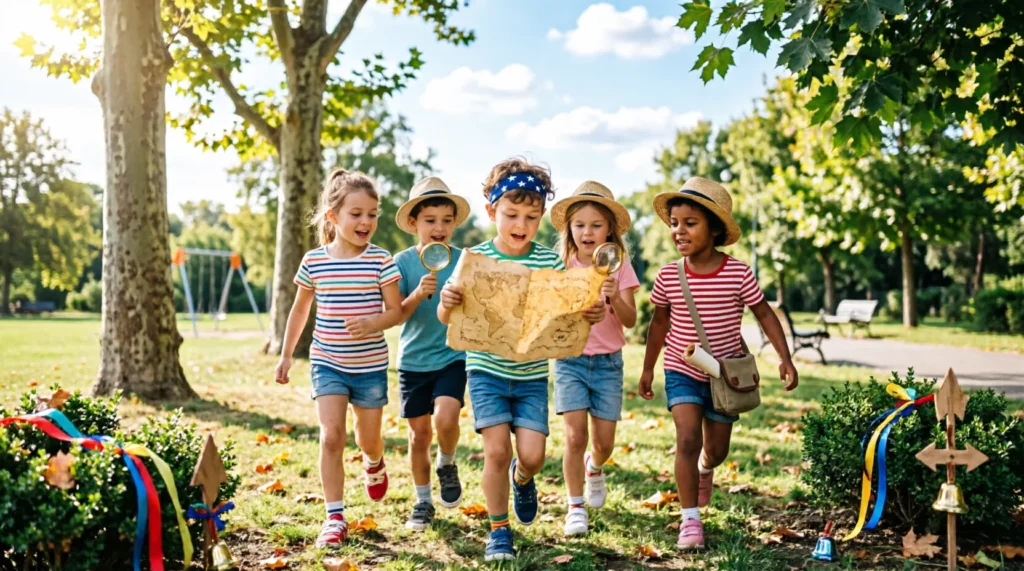
Setting up a scavenger hunt is one of the absolute best ways to get kids moving, thinking, and working together. A great puzzle turns a simple walk around the house or yard into an epic, memorable adventure. According to the long history of the Riddle, these clever word games have been testing human wit for centuries, making them the perfect brain-teaser for your next family event.
Top 5 riddles for kids for a scavenger hunt
These are the heavy hitters. When I design a hunt for a mixed-age group, I always start with these five because they strike the perfect balance between being recognizable and requiring a little bit of lateral thinking.
I have a light inside but I am not a lamp. I keep your snacks cold, but I am not winter. Find me where the milk lives. Answer: A refrigerator
I have a little flag but I belong to no country. I swallow your letters but I have no mouth. Look outside near the street. Answer: A mailbox When I run this one with kids, the wrong guess is always “a boat” because of the flag. I usually have to point out that boats don’t typically hold paper letters, which helps them pivot to the right answer.
I have a tongue but I cannot speak. I have a soul but I am not alive. You tie me up before you go outside. Answer: A shoe
I have bark but I do not bite. I have leaves but I am not a book. I stand tall in the yard and give you shade. Answer: A tree
I look at you, and you look at me. If you smile, I smile back, but I have no face of my own. Find me in the bathroom or hallway. Answer: A mirror
Easy Scavenger Hunt Riddles for Younger Kids
If you are playing with toddlers or early elementary kids, you want clues that rely on very obvious physical characteristics. These are straightforward, highly visual, and guaranteed to keep the momentum going without causing frustration.
I have four legs but I cannot walk. You sleep on me at night when you are tired. Answer: A bed My 5-year-old nephew always guesses “a chair” for this one. It is a great moment to remind him what we actually do on a bed versus a chair, guiding him to the correct solution.
I have a spine but no bones. I have many leaves but I am not a plant. You read me before bedtime. Answer: A book
I have a face and two hands, but no arms or legs. I tell you when it is time for dinner. Answer: A clock
I have bristles but I am not a pig. I visit your mouth every morning and night to fight the sugar bugs. Answer: A toothbrush
I go up when the rain comes down. I protect you from getting wet, but I am not a roof. Answer: An umbrella
I have hinges but I am not a joint. You open me to enter a room, and close me to keep the cold out. Answer: A door
Tricky Scavenger Hunt Riddles to Stump Older Kids
Once kids hit around eight or nine years old, they start seeing through the easy object-based clues. They need riddles that play with abstract concepts, wordplay, and double meanings. These look hard, but once the “aha” moment hits, they are incredibly satisfying.
I only come out when the sun is shining, but I disappear when it gets dark. I follow you everywhere but weigh nothing. Answer: A shadow
I speak without a mouth and I hear without ears. I have no body, but I come alive with the wind in the mountains. Answer: An echo
The more of me you take, the more you leave behind. You make me when you walk in the mud or sand. Answer: Footsteps
I am full of holes, but I can still hold water. You use me to wash the dishes. Answer: A sponge This one looks incredibly hard to younger kids, but it is actually quite simple once they understand physical properties. My 9-year-old solved this in ten seconds, while younger kids usually guess “a cloud” or “ice” until they realize those melt or evaporate.
I grow shorter as I grow older. I give off light and melt away when you blow on me. Answer: A candle
If you have me, you want to share me. If you share me, you do not have me anymore. Answer: A secret
Funny Scavenger Hunt Riddles with a Silly Twist
Sometimes the best way to break the tension of a competitive hunt is with a clue that makes everyone groan and laugh. These rely on silly puns and slightly absurd imagery that kids find hilarious.
I have a head and a tail, but I have no body. You flip me to make a choice. Answer: A coin The most common wrong guess here is a worm or a snake. It is a great teaching moment to talk about the anatomy of currency and how we use the terms “heads” and “tails” in everyday language.
I have ears but I cannot hear. I am yellow and sweet, and you eat me right off a cob. Answer: Corn
I have an eye but I cannot see. I am sharp and pointy, and you use me to sew a button. Answer: A needle
I have black and white keys, but I am not a computer keyboard or a door. You press me to make beautiful music. Answer: A piano
I wear a bright yellow coat, but I have no arms or legs. You peel me to eat my sweet inside. Answer: A banana
What gets wetter and wetter the more it dries? Answer: A towel
Outdoor Nature Scavenger Hunt Riddles
Taking the game outside changes the dynamic entirely. The scale is bigger, the hiding spots are wilder, and the clues need to match the environment. These nature-themed puzzles are perfect for parks, backyards, or camping trips.
I run all day but I have no legs. I have a bed but I never sleep. I flow through the woods and over the rocks. Answer: A river Kids almost always yell “water” or “a fish” when they hear this. I make them stop and think about the action of the word “run” versus the object itself, which is a fantastic exercise in lateral thinking.
I can howl and I can whisper, but I have no mouth. You cannot see me, but you can feel me shake the trees. Answer: The wind
I have no voice, but I can crack. I have no legs, but I can roll down a hill. I am hard and found all over the garden. Answer: A rock
I drink water through my roots and I reach for the sun. I bloom in bright colors and smell very sweet. Answer: A flower
I cover the ground like a soft green carpet. You mow me when I get too tall, and I tickle your bare feet. Answer: Grass
I come out in the morning to light up the sky. I am a giant ball of fire, but I do not burn the earth. Answer: The sun
How to use these riddles
A list of clues is only as good as the game you build around it. Over the years, I have tested these puzzles in a variety of settings, and adapting the delivery is just as important as the riddle itself. Here is how to get the most out of this collection.
For a Backyard Scavenger Hunt When organizing a game, remember that a Scavenger originally referred to someone who collected discarded items or cleaned streets, but today the term applies perfectly to our modern treasure-hunting games where kids collect hidden clues instead of trash. Print these riddles on index cards, hide them in sequential order around your yard, and have the final clue lead to a physical treasure chest or a bowl of snacks. The physical act of searching between reading the clues keeps their energy levels high and prevents the game from turning into a stationary quiz.
For a Classroom Activity Teachers can use these as excellent transition activities or brain breaks. Tape the riddles to the walls around the classroom and give students a clipboard with a numbered answer sheet. It gets them out of their seats, encourages quiet collaboration, and exercises their reading comprehension skills without feeling like a traditional worksheet. I usually time the activity and offer a small privilege to the first team that correctly identifies all the objects.
For a Birthday Party At a party, attention spans are short and excitement is high. Use the “Easy” and “Funny” sections to keep the momentum moving. Hand out one riddle at a time to the whole group, and the first child to shout out the correct answer gets to lead the group to the next hiding spot. This keeps everyone engaged simultaneously and prevents the faster readers from leaving the younger kids behind.
For a Road Trip Long car rides are the perfect place for a verbal scavenger hunt. Instead of hiding physical cards, read the riddles aloud and have the kids look out the windows to spot the answers in the real world. If the answer is “the sun” or “a tree,” they have to point it out before you give the next clue. It turns a boring highway stretch into an interactive observation game.
Frequently Asked Questions
What is a good riddle for a toddler? For toddlers, you want riddles that focus on very basic, highly visible traits like color, shape, or primary function. Riddles about a bed, a toothbrush, or a banana work beautifully because toddlers interact with these objects daily. Keep the language simple, use a lot of enthusiastic inflection, and be ready to offer heavy hints if they get stuck.
How do I make a riddle hunt harder for older kids? To increase the difficulty, stop relying on physical objects and start using abstract concepts like shadows, echoes, or secrets. You can also chain riddles together, where the answer to the first riddle becomes the first letter of the password needed to open the box containing the second riddle. Adding a physical puzzle, like a combination lock, between the riddle and the next clue also significantly raises the challenge level.
How do these riddles work? These riddles work by utilizing personification and metaphor. They take an inanimate object and describe it using human or animal characteristics—like a clock having “hands” or a shoe having a “tongue.” The solver’s brain has to bypass the literal interpretation of the words and map the metaphorical traits back onto the physical objects in their environment. It is a fantastic workout for cognitive flexibility and vocabulary recall.

Patricia Sanchez is an expert in mathematical riddles and lateral thinking puzzles, bringing over a decade of experience to RiddlePlaza. With a dual degree in Mathematics and Psychology, Patricia is adept at creating brain teasers that challenge cognitive processing and numerical skills. Her fascination with puzzles was sparked by her early fascination with Sudoku and the strategic complexities of chess. In the realm of riddles, Patricia enjoys constructing scenarios that require readers to think outside the box, drawing upon her psychological insights to foster creative problem-solving. She is particularly known for her ability to fuse mathematical conundrums with a narrative flair, creating multi-layered puzzles that are both educational and engaging. Patricia is dedicated to integrating puzzles into educational frameworks, believing strongly in their capacity to sharpen young minds and enhance learning.