

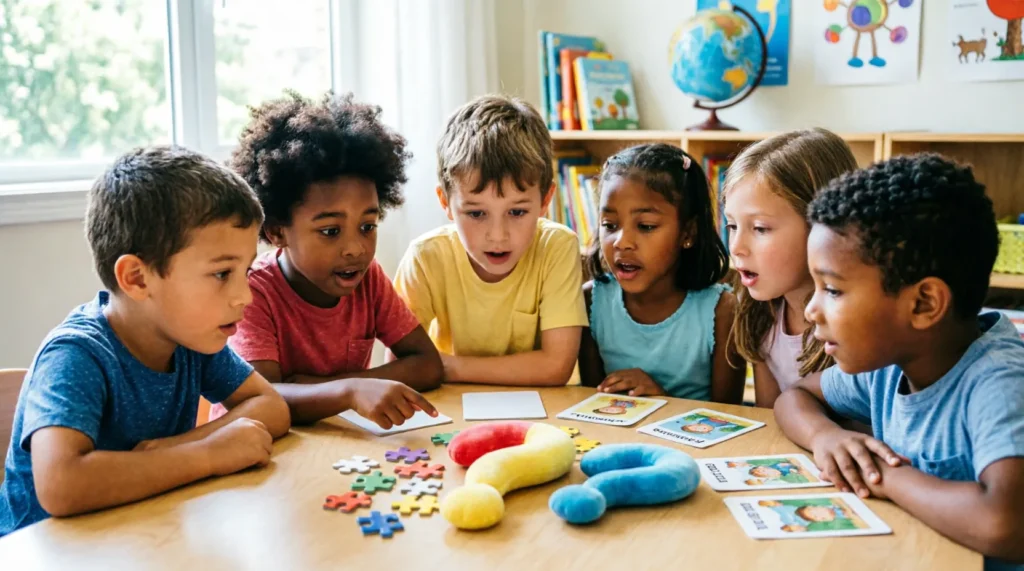
Riddles are one of the most reliable tools I have found for getting kids to engage with language without realizing they are learning. This collection of riddles with answers for kids in English is curated from years of family game nights and classroom visits, focusing only on wordplay that lands with young audiences rather than confusing them. Every single riddle below includes its answer immediately underneath so you never have to scroll or guess while a child waits impatiently.
Top 5 Riddles with Answers for Kids in English
These five are my absolute go-to openers because they balance cleverness with accessibility, setting a positive tone before moving to harder material.
I speak without a mouth and hear without ears. I have no body, but I come alive with wind. What am I? Answer: An echo
The more of this there is, the less you see. What is it? Answer: Darkness
I have cities, but no houses. I have mountains, but no trees. I have water, but no fish. What am I? Answer: A map
What has hands but cannot clap? Answer: A clock
What comes once in a minute, twice in a moment, but never in a thousand years? Answer: The letter M
Easy Riddles with Answers for Kids in English
These work best for ages four through seven or as warm-ups for older groups who need confidence before tackling trickier wordplay.
What goes up but never comes down? Answer: Your age
What has to be broken before you can use it? Answer: An egg
I’m tall when I’m young, and I’m short when I’m old. What am I? Answer: A candle
What can you catch but not throw? Answer: A cold
What has many teeth but cannot bite? Answer: A comb
What begins with T, ends with T, and has T in it? Answer: A teapot
What gets wetter the more it dries? Answer: A towel
What belongs to you but other people use it more than you do? Answer: Your name
In my experience testing these with kindergarten and first-grade groups, “What gets wetter the more it dries?” consistently produces giggles once the answer clicks because the paradox feels like a magic trick rather than a test. Younger children often shout “sponge” first, which is a reasonable guess but misses the verb-noun wordplay that makes the riddle satisfying.
Funny Riddles with Answers for Kids in English
Humor lowers the barrier to entry for reluctant participants and makes wrong answers feel safe rather than embarrassing.
Why did the math book look sad? Answer: Because it had too many problems
What do you call a fake noodle? Answer: An impasta
Where do cows go for entertainment? Answer: To the moo-vies
What do you call cheese that isn’t yours? Answer: Nacho cheese
Why don’t skeletons fight each other? Answer: They don’t have the guts
What did the ocean say to the shore? Answer: Nothing, it just waved
How does a penguin build its house? Answer: Igloo it together
What do you call a bear with no teeth? Answer: A gummy bear
When I run the “fake noodle” riddle at parties, adults groan loudly while kids aged six to nine absolutely lose their minds laughing. The pun relies on phonetic similarity rather than complex vocabulary, which is why it lands so reliably across different reading levels. Skeptical parents sometimes worry puns are “too silly,” but that silliness is precisely what keeps children asking for more riddles instead of tuning out.
Animal Riddles with Answers for Kids in English
Animals provide concrete imagery that helps younger solvers anchor abstract wordplay to something familiar and visual.
I have a long neck and spots on my skin. I eat leaves from tall trees. What am I? Answer: A giraffe
I’m small and furry, I love to chase mice, and I purr when I’m happy. What am I? Answer: A cat
I carry my home on my back and move very slowly. What am I? Answer: A snail
I have eight legs and spin webs to catch flies. What am I? Answer: A spider
I’m the king of the jungle and have a big mane. What am I? Answer: A lion
I hop around, have long ears, and love carrots. What am I? Answer: A rabbit
I live in the ocean, have eight arms, and squirt ink when scared. What am I? Answer: An octopus
I’m green, I jump, and I say ribbit. What am I? Answer: A frog
According to Wikipedia, riddles historically served as both entertainment and educational tools across cultures, and animal-themed riddles remain among the earliest forms children encounter because they connect linguistic play to observable reality. In my own sessions, animal riddles generate the highest participation rate from shy children who might hesitate with abstract wordplay but light up when the subject is a creature they recognize from picture books or zoo visits.
Tricky Riddles with Answers for Kids in English
These require lateral thinking and reward patience, making them ideal for ages eight and up or for mixed-age groups where older kids can model problem-solving strategies.
What can you hold in your left hand but not in your right? Answer: Your right elbow
If you have a bowl with six apples and you take away four, how many do you have? Answer: Four (you took four, so you have four)
What has a head and a tail but no body? Answer: A coin
The person who makes it has no need of it; the person who buys it has no use for it. The person who uses it can neither see nor feel it. What is it? Answer: A coffin
What can travel around the world while staying in a corner? Answer: A stamp
I shave every day, but my beard stays the same. What am I? Answer: A barber
What question can you never answer yes to? Answer: Are you asleep yet?
The “bowl with six apples” riddle trips up nearly every group I test because children default to subtraction (6 minus 4 equals 2) rather than parsing the pronoun “you” carefully. When I watch kids solve this, the ones who get it right usually re-read the sentence aloud and emphasize “you take away,” which shifts their mental model from arithmetic to ownership. This is genuinely tricky rather than unfairly obscure because all the information needed is present in the wording; the difficulty lies in resisting automatic cognitive shortcuts.
Short Riddles with Answers for Kids in English
Brevity makes these perfect for transitions between activities, car rides, or moments when attention spans are waning but engagement shouldn’t drop entirely.
What goes up and doesn’t come back down? Answer: Rain (once it evaporates) — though commonly accepted as “your age” depending on version; here: Answer: Your age
What has one eye but can’t see? Answer: A needle
What runs but never walks? Answer: Water
What has keys but no locks? Answer: A piano
What can be cracked, made, told, and played? Answer: A joke
What has words but never speaks? Answer: A book
What falls but never breaks? Answer: Nightfall
What can fill a room but takes up no space? Answer: Light
Short riddles demand precision in wording because there is nowhere to hide ambiguity. When crafting or selecting these, I prioritize riddles where the answer feels inevitable in retrospect rather than arbitrary, since brevity amplifies frustration if the logic seems unfair. “What has keys but no locks?” works because keyboards and pianos share the word “keys” in everyday English usage, creating a clean double meaning that children encounter regularly without necessarily noticing until the riddle highlights it.
How to Use These Riddles with Answers for Kids in English
Having a great collection matters less than deploying it in ways that match your context and audience energy.
- Family Game Night: Print ten favorites on index cards and let each person draw one to read aloud; the reader earns a point if nobody solves it within thirty seconds, keeping competitive dynamics playful rather than punitive.
- Classroom Warm-Up: Write one riddle on the board each morning as students arrive; discuss answers during attendance to build routine and activate verbal reasoning before academic content begins.
- Scavenger Hunt Clues: Replace directional instructions with riddles whose answers point to hiding spots (e.g., “I keep things cold” leads to the refrigerator); this transforms passive searching into active decoding.
- Road Trip Entertainment: Keep a printed list in the glove compartment and take turns posing riddles during long stretches; the constraint of no screens makes wordplay feel novel rather than repetitive.
- Birthday Party Icebreaker: Tape riddles under chairs and have guests find them during snack time; solving becomes collaborative as kids compare discoveries and debate answers before revealing solutions.
- Bedtime Wind-Down: Share one gentle riddle after stories to transition from narrative listening to quiet reflection; avoid tricky or funny ones here since laughter or frustration can delay sleep onset.
Frequently Asked Questions About Riddles with Answers for Kids in English
What makes a good riddle for kids versus adults? Good kids’ riddles rely on concrete nouns, familiar experiences, and phonetic play rather than obscure references or abstract philosophy. The best ones feel solvable through careful listening rather than specialized knowledge, and they reward multiple attempts without punishing wrong guesses harshly. Adult riddles often assume cultural literacy or tolerate ambiguity that frustrates younger solvers who are still building confidence in language manipulation.
How do these riddles support language development beyond entertainment? Riddles strengthen metalinguistic awareness by forcing children to notice how words function differently in context than in isolation. According to Wikipedia, English’s rich history of borrowing and blending vocabularies creates abundant opportunities for homophones, polysemy, and syntactic ambiguity that riddles exploit deliberately. Regular exposure builds vocabulary retention, inferential reasoning, and comfort with productive struggle—all transferable to reading comprehension and creative writing without feeling like drill-based instruction.
Should I give hints if a child gets stuck? Yes, but make hints scaffold thinking rather than reveal answers. Instead of saying “it’s something in the kitchen,” ask “what category does this belong to?” or “can you think of another word that sounds like the clue?” This preserves the satisfaction of discovery while preventing shutdown. If three hints fail, simply share the answer cheerfully and move on; dwelling on unsolved riddles breeds avoidance rather than resilience.
Are there riddles that work equally well across different English dialects? Most riddles in this collection avoid region-specific slang or pronunciation-dependent puns that might confuse speakers of British, Australian, or Caribbean English variants. However, riddles relying on spelling (like the letter M riddle) may need adaptation for phonics-focused learners still mastering orthography. Test any new riddle with your specific audience before using it in high-stakes settings like competitions or assessments where dialect differences could create inequitable difficulty.

Patricia Sanchez is an expert in mathematical riddles and lateral thinking puzzles, bringing over a decade of experience to RiddlePlaza. With a dual degree in Mathematics and Psychology, Patricia is adept at creating brain teasers that challenge cognitive processing and numerical skills. Her fascination with puzzles was sparked by her early fascination with Sudoku and the strategic complexities of chess. In the realm of riddles, Patricia enjoys constructing scenarios that require readers to think outside the box, drawing upon her psychological insights to foster creative problem-solving. She is particularly known for her ability to fuse mathematical conundrums with a narrative flair, creating multi-layered puzzles that are both educational and engaging. Patricia is dedicated to integrating puzzles into educational frameworks, believing strongly in their capacity to sharpen young minds and enhance learning.