

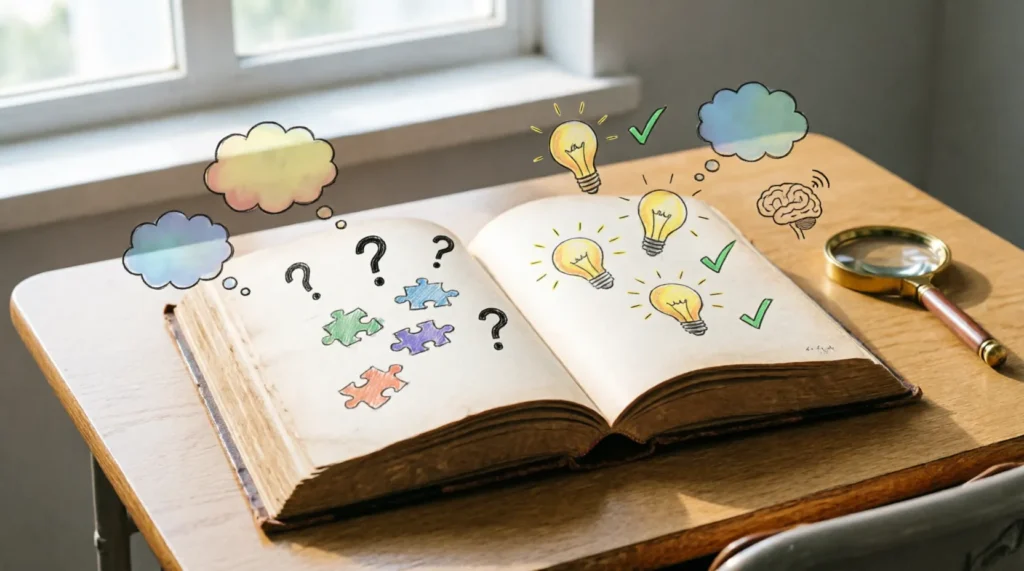
Fourth graders are at a magical age where their logical reasoning skills are sharpening, but they still love the pure joy of being stumped. These tricky riddles for class 4 with answers are curated specifically for nine and ten-year-olds who think they have seen it all. I have tested every single one of these in real classrooms and family game nights to ensure they hit that perfect sweet spot between “impossible” and “aha!”
The goal here is not just to confuse, but to encourage lateral thinking. When a child gets stuck, it forces them to look at language from a new angle. Below, you will find a carefully organized collection that starts with the absolute best crowd-pleasers and moves into themed categories. Every riddle includes its answer immediately below, so you can keep the game moving without awkward pauses.
Top 5 Tricky Riddles for Class 4
These five riddles are the heavy hitters. They are the ones that generate the most groans, laughter, and sudden realizations. If you only have time for a quick brain break, start here.
I have a neck but no head. I have two arms but no hands. What am I? Answer: A shirt
This is a classic example of how riddles rely on metaphorical language rather than literal biology. According to Wikipedia, riddles often use ambiguous phrasing to lead the solver toward a false assumption—in this case, assuming the subject is a living creature.
What has to be broken before you can use it? Answer: An egg
When I run this one with kids, the wrong guess is always “a promise” or “a record.” While those are poetic answers, the physical object answer is what fourth graders usually encounter in logic puzzles. It teaches them to think about physical processes.
I speak without a mouth and hear without ears. I have no body, but I come alive with wind. What am I? Answer: An echo
This riddle is excellent for teaching personification. Children often guess “a ghost” or “a radio,” but the clue about wind is the specific discriminator that points to sound waves bouncing off surfaces.
What goes up but never comes down? Answer: Your age
This is a favorite because it is personally relevant to every student. It is technically true for everyone in the room, which makes the reveal satisfying. It also introduces the concept of irreversible linear progression in a fun way.
The more of this there is, the less you see. What is it? Answer: Darkness
This riddle plays with the physics of light. It is simple enough for a fourth grader to grasp but tricky because our brains usually associate “more” with visibility, not the lack of it.
Easy Warm-Up Riddles
Before diving into the head-scratchers, use these to build confidence. These are designed to get the gears turning without causing frustration. They are perfect for the beginning of a class session or a car ride.
What has keys but can’t open locks? Answer: A piano
What has many needles but doesn’t sew? Answer: A pine tree
What goes through cities and fields but never moves? Answer: A road
What has one eye but can’t see? Answer: A needle
What has legs but cannot walk? Answer: A table
What has a face and two hands but no arms or legs? Answer: A clock
What gets wet while drying? Answer: A towel
What has a thumb and four fingers but is not alive? Answer: A glove
What can you catch but not throw? Answer: A cold
What has a bottom at the top? Answer: Your legs
Hard Logic Puzzles
These riddles require a bit more patience. They are not necessarily complex in vocabulary, but the logic is twisted. I recommend giving students at least thirty seconds of silence before offering hints. These separate the quick thinkers from the deep thinkers.
- A man was going out in the rain without an umbrella or hat, and he didn’t have a hood. His clothes got soaked, but not a single hair on his head got wet. How? Answer: He was bald
This is a test of assumption. Most children visualize a person with hair. It teaches them to question the premises of the question itself.
What belongs to you, but other people use it more than you do? Answer: Your name
I am always hungry, I must always be fed. The finger I touch will soon turn red. What am I? Answer: Fire
What can travel around the world while staying in a corner? Answer: A stamp
The person who makes it has no need of it; the person who buys it has no use for it. The person who uses it can neither see nor feel it. What is it? Answer: A coffin
This is a darker riddle, but fourth graders often find the morbid logic fascinating. It requires understanding three different perspectives on the same object.
What has words but never speaks? Answer: A book
I am light as a feather, yet the strongest man cannot hold me for much longer than a minute. What am I? Answer: His breath
What can you keep after giving it to someone? Answer: Your word
What has a head and a tail but no body? Answer: A coin
What breaks when you say its name? Answer: Silence
Funny and Silly Riddles
Humor is a great memory aid. These riddles rely on puns and wordplay. They are less about strict logic and more about linguistic flexibility. Use these when the energy in the room is lagging.
What do you call a fake noodle? Answer: An impasta
Why did the scarecrow win an award? Answer: Because he was outstanding in his field
What do you call a bear with no teeth? Answer: A gummy bear
Why can’t you give Elsa a balloon? Answer: Because she will let it go
What do you call a sleeping bull? Answer: A bulldozer
Why did the math book look sad? Answer: Because it had too many problems
What do you call a dog that does magic tricks? Answer: A labracadabrador
Why did the cookie go to the hospital? Answer: Because he felt crummy
What do you call a fish wearing a bowtie? Answer: Sofishticated
Why don’t skeletons fight each other? Answer: They don’t have the guts
Math and Number Riddles
Fourth grade is a crucial year for mastering multiplication and basic algebra concepts. These riddles sneak in math practice without feeling like homework. They require numerical reasoning rather than just verbal wit.
- I am an odd number. Take away a letter and I become even. What number am I? Answer: Seven (remove the ‘s’ and it becomes ‘even’)
This is a linguistic trick disguised as a math problem. It is one of the most famous riddles in the English language because it bridges two different subjects.
If you multiply this number by any other number, the answer will always be the same. What number is it? Answer: Zero
How can you add eight 8s to get the number 1,000? Answer: 888 + 88 + 8 + 8 + 8 = 1,000
This requires spatial arrangement of numbers, not just addition. It tests place value understanding.
What number goes up and doesn’t come down? Answer: Your age
If there are three apples and you take away two, how many do you have? Answer: Two (you took two, so you have two)
This is a trick question about perspective. Most children answer “one,” thinking about what is left on the table rather than what is in their hand.
I am a number. When you add me to myself, I become 10. What am I? Answer: 5
How many sides does a circle have? Answer: Two (the inside and the outside)
What is the next number in the sequence: 2, 4, 8, 16, …? Answer: 32 (doubling each time)
If you have a bowl with six apples and you take away four, how many do you have? Answer: Four
What weighs more: a pound of bricks or a pound of feathers? Answer: They weigh the same (one pound)
Animal Riddles
Animals are a universal interest for nine and ten-year-olds. These riddles use biological facts or common idioms associated with animals. They are great for science cross-curricular connections.
What has a horn but doesn’t honk? Answer: A rhinoceros
What kind of room has no doors or windows? Answer: A mushroom
What do you call a pig that does karate? Answer: A pork chop
What animal is always at a baseball game? Answer: A bat
What has four wheels and flies? Answer: A garbage truck
What do you call a cow with no legs? Answer: Ground beef
What bird lifts heavy things? Answer: A crane
What do you call a snake that works for the government? Answer: A civil serpent
Why do fish live in salt water? Answer: Because pepper makes them sneeze
What animal can jump higher than a building? Answer: Any animal (buildings can’t jump)
This is another logic trap. It relies on the grammatical ambiguity of the comparison.
How to Use These Riddles
Riddles are versatile tools. Here are four practical ways to integrate them into your daily routine without them feeling forced.
- Classroom Morning Meeting: Start the day with one “Riddle of the Day.” Write it on the board and let students write their guesses on sticky notes. Reveal the answer after lunch. This builds anticipation and gives slow processors time to think.
- Car Ride Entertainment: Print out a small card with five riddles. Hand it to the back seat. It is much quieter than arguing over who controls the music, and it keeps their brains active during long trips.
- Scavenger Hunt Clues: Hide a treat or a prize. Write the first riddle on a card. The answer to the riddle tells them where the next clue is hidden. For example, if the answer is “fridge,” hide the next clue in the fridge.
- Party Icebreaker: At birthday parties, kids often cluster in shy groups. A riddle contest breaks the social tension. Divide them into teams and see which group can solve five riddles the fastest.
Frequently Asked Questions
What is a good riddle for a nine-year-old? The best riddles for this age group involve wordplay that they already understand, such as homophones or simple metaphors. Avoid riddles that require obscure historical knowledge or complex scientific facts. The “shirt” riddle (neck but no head) is ideal because it uses body parts they know well but applies them to an object.
How do these riddles help with learning? Riddles improve critical thinking and reading comprehension. According to Wikipedia, tricky situations often require abandoning standard procedures. In a classroom, this translates to flexible thinking. Students learn to analyze syntax, identify double meanings, and resist the urge to jump to the first conclusion that pops into their heads.
Why do kids love tricky riddles? Children enjoy the sense of mastery that comes with solving a puzzle. It is a low-stakes way to feel smart. Additionally, the social aspect of sharing a riddle and watching someone else struggle with it is inherently playful. It creates a shared secret between the asker and the solver once the answer is revealed.
Can riddles be too hard for fourth graders? Yes. If a riddle requires knowledge of abstract concepts like “time” in a philosophical sense, or obscure vocabulary, it will cause frustration rather than engagement. Stick to concrete objects and actions. If a child cannot solve it after two minutes, provide a hint. The goal is engagement, not defeat.

Patricia Sanchez is an expert in mathematical riddles and lateral thinking puzzles, bringing over a decade of experience to RiddlePlaza. With a dual degree in Mathematics and Psychology, Patricia is adept at creating brain teasers that challenge cognitive processing and numerical skills. Her fascination with puzzles was sparked by her early fascination with Sudoku and the strategic complexities of chess. In the realm of riddles, Patricia enjoys constructing scenarios that require readers to think outside the box, drawing upon her psychological insights to foster creative problem-solving. She is particularly known for her ability to fuse mathematical conundrums with a narrative flair, creating multi-layered puzzles that are both educational and engaging. Patricia is dedicated to integrating puzzles into educational frameworks, believing strongly in their capacity to sharpen young minds and enhance learning.